 Indietro
Rational Exponents and Their Properties
Guida di studio - Note intelligenti
 Appunti personalizzati basati sui tuoi materiali, ampliati con definizioni chiave, esempi e contesto.
Rational Exponents
Definition and Notation
Rational exponents provide an alternative way to express roots using exponents. This notation is essential for simplifying expressions and solving equations involving radicals.
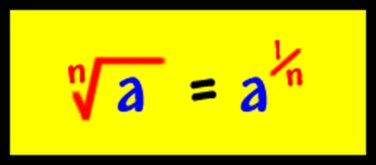
Rational Exponent: An exponent that is a fraction, such as , where n is a positive integer.
Radical Notation: The nth root of a is written as .
Equivalence:
Example:
General Rational Exponents
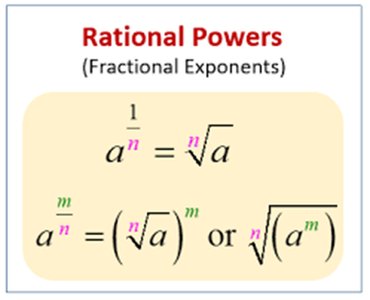
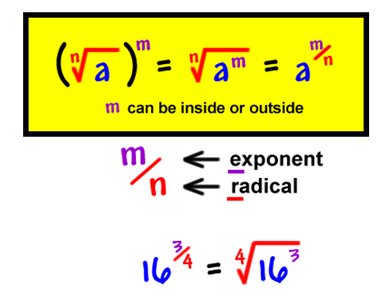
When the exponent is a fraction , it represents both a power and a root. The denominator n is the root, and the numerator m is the power.
This allows flexibility in simplifying and evaluating expressions.
Example:
Negative Rational Exponents
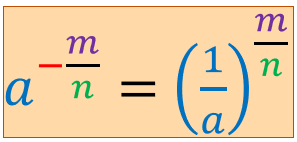
Negative exponents indicate reciprocals. For rational exponents, this means:
Negative exponents move the base to the denominator.
Example:
Properties of Rational Exponents
Exponent Rules
The rules for rational exponents are extensions of the rules for integer exponents. These properties are essential for simplifying expressions and solving equations.
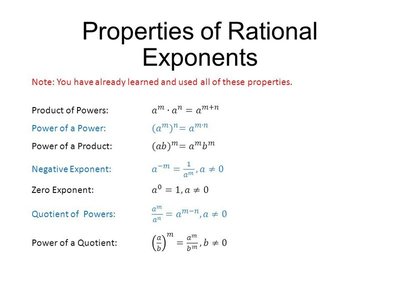
Product of Powers:
Power of a Power:
Power of a Product:
Negative Exponent:
Zero Exponent: (for )
Quotient of Powers:
Power of a Quotient:
Example:
Simplifying Radical Expressions Using Rational Exponents
Rational exponents make it easier to manipulate and simplify radical expressions, especially when dealing with products, quotients, or powers.
Convert all radicals to rational exponents for easier calculation.
Apply exponent rules to combine or simplify expressions.
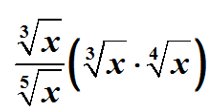
Example:
Complex Radical Expressions
For more complicat ed expressions, rational exponents allow for systematic simplification using the properties above.
Rewrite all radic als as rational exponents.
Apply exponent rules to simplify step by step.
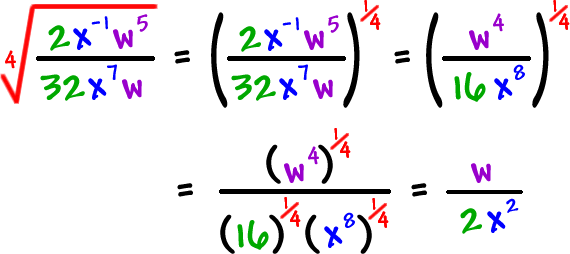
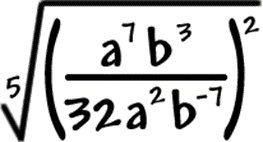
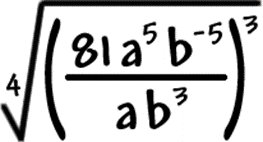
Example: (after simplification)
Why Learn These Rules?
Understanding rational exponents and their properties is crucial for simplifying expressions, solving equations, and working with more advanced algebraic concepts. These skills are foundational for calculus, science, and engineering courses.
