 Indietro
Rational Functions and Their Graphs: The Reciprocal Function
Guida di studio - Note intelligenti
 Appunti personalizzati basati sui tuoi materiali, ampliati con definizioni chiave, esempi e contesto.
Rational Functions and Graphs
Introduction to Rational Functions
Rational functions are quotients of two polynomials, where the denominator is not zero. They are a key topic in College Algebra, especially for understanding asymptotic behavior and discontinuities in graphs.
Definition: A rational function is any function of the form , where and are polynomials and .
Domain: All real numbers except those that make the denominator zero.
The Reciprocal Function
Basic Properties and Graphs
The reciprocal function is a fundamental example of a rational function. Its general form is , but it can be shifted, reflected, or stretched.
Parent Function:
Vertical Asymptote: (the graph approaches but never crosses this line)
Horizontal Asymptote: (the graph approaches but never crosses this line as goes to infinity or negative infinity)
Domain:
Range:
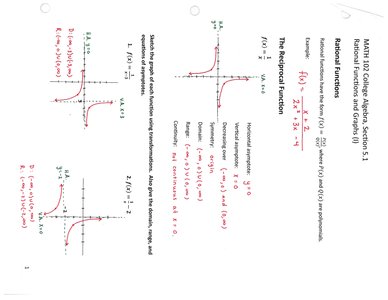
Example: The graph of is shown below. Notice the asymptotes and the behavior in each quadrant.
Transformations of the Reciprocal Function
Rational functions can be transformed by shifting, reflecting, or stretching. For example, shifts the graph right by 2 units, and reflects it over the x-axis.
Horizontal Shift: shifts the graph units right.
Vertical Shift: shifts the graph units up.
Reflection: reflects the graph over the x-axis.
Example: The graph of has a vertical asymptote at and a horizontal asymptote at .
Identifying Asymptotes and Intercepts
To analyze a rational function, identify its vertical and horizontal asymptotes, as well as any intercepts.
Vertical Asymptote: Set the denominator equal to zero and solve for .
Horizontal Asymptote: Compare the degrees of the numerator and denominator polynomials.
Y-intercept: Set and solve for , if defined.
X-intercept: Set the numerator equal to zero and solve for , if possible.
Summary Table: Properties of the Reciprocal Function
Property | |
|---|---|
Domain | |
Range | |
Vertical Asymptote | |
Horizontal Asymptote | |
Intercepts | None |
Sketching Rational Functions
To sketch the graph of a rational function, follow these steps:
Find the domain by identifying values that make the denominator zero.
Locate vertical and horizontal asymptotes.
Find intercepts, if any.
Plot key points and sketch the general shape, considering asymptotic behavior.
Example: For , the vertical asymptote is at , and the horizontal asymptote is at .
Additional info: These concepts are foundational for understanding more complex rational functions and their applications in calculus and real-world modeling.
