 Indietro
Solving Inequalities and Interval Notation in College Algebra
Guida di studio - Note intelligenti
 Appunti personalizzati basati sui tuoi materiali, ampliati con definizioni chiave, esempi e contesto.
Equations and Inequalities
Solving Inequalities
Inequalities are mathematical statements that compare two expressions using inequality symbols such as <, >, ≤, or ≥. Understanding how to solve and represent inequalities is fundamental in algebra, as it allows us to describe ranges of possible values for variables.
Objectives
Use interval notation to describe solution sets
Apply properties of inequalities to solve algebraic inequalities
Solve combined (compound) inequalities
Intervals and Interval Notation
Intervals are sets of real numbers that lie between two endpoints. Interval notation provides a concise way to represent these sets.
Open Interval (a, b): All real numbers x such that a < x < b.
Closed Interval [a, b]: All real numbers x such that a ≤ x ≤ b.
Half-Open Intervals: (a, b] means a < x ≤ b; [a, b) means a ≤ x < b.
Unbounded Intervals: Use ∞ or –∞ to indicate intervals that extend indefinitely in one direction.
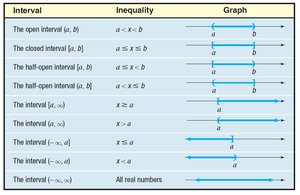
Examples of Interval Notation
4 ≤ x ≤ 7: Interval notation: [4, 7]
–3 < x < 0: Interval notation: (–3, 0)
x > 3: Interval notation: (3, ∞)
x ≤ 5: Interval notation: (–∞, 5]
Examples of Inequality Notation
[0, 3): 0 ≤ x < 3
(3, ∞): x > 3
[3, 4]: 3 ≤ x ≤ 4
(–∞, –5]: x ≤ –5
Properties of Inequalities
Solving inequalities often involves applying certain properties that preserve or reverse the direction of the inequality symbol.
Nonnegative Property: For any real number a,
Addition Property: For real numbers a, b, and c:
If a < b, then a + c < b + c
If a > b, then a + c > b + c
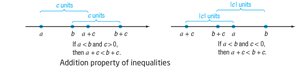
Example: Addition Property
If x < –4, then x + 4 < 0
If x > 4, then x – 4 > 0
Multiplication Property of Inequalities
If a < b and c > 0, then ac < bc
If a < b and c < 0, then ac > bc (the inequality reverses)
If a > b and c > 0, then ac > bc
If a > b and c < 0, then ac < bc
Examples: Multiplying Inequalities
Multiplying both sides of 5 < 8 by 3: 15 < 24
Multiplying both sides of 8 > 3 by –2: –16 < –6 (note the reversal of the inequality)
Reciprocal Property for Inequalities
If a > 0, then
If a < 0, then
If b > a > 0, then
If a < b < 0, then
Solving Inequalities: Procedures
When solving inequalities, certain algebraic manipulations preserve the direction of the inequality, while others reverse it.
Procedures that leave the inequality unchanged:
Simplifying both sides
Adding or subtracting the same value from both sides
Multiplying or dividing both sides by a positive number
Procedures that reverse the inequality:
Multiplying or dividing both sides by a negative number
Interchanging the two sides of the inequality
Examples: Solving and Graphing Inequalities
Example 7: Solving a Linear Inequality
Solve: 5 – 4x < 9
Subtract 5: –4x < 4
Divide by –4 (reverse the inequality): x > –1
Interval notation: (–1, ∞)

Example 8: Solving a Linear Inequality
Solve: 2x – 2 ≥ 3 + x
Simplify: x ≥ 5
Interval notation: [5, ∞)

Example 9: Solving a Combined (Compound) Inequality
Solve: 4 < 2x + 2 < 10
Break into two inequalities: 4 < 2x + 2 and 2x + 2 < 10
Solve both: 1 < x < 4
Interval notation: (1, 4)

Example 10: Solving a Combined Inequality with Negative Multiplication
After solving, the solution is: –6 ≤ x ≤ 0
Interval notation: [–6, 0]

Example 11: Using the Reciprocal Property
Solve: (2x – 4)–1 > 0
By the reciprocal property, 2x – 4 > 0
Solve: x > 2
Interval notation: (2, ∞)

Creating Equivalent Inequalities
It is often useful to manipulate inequalities to create equivalent forms, especially when solving compound inequalities. For example, dividing each part of –4 < x < 0 by 2 gives –2 < x/2 < 0.
Application: Physics (Ohm’s Law)
Ohm’s Law relates voltage (E), current (I), and resistance (R) in an electric circuit: . If the voltage varies between 90 and 110 volts and resistance is 10 ohms, the current I satisfies:
90 ≤ 10I ≤ 110
Divide by 10: 9 ≤ I ≤ 11
The air conditioner draws between 9 and 11 amperes of current, inclusive.
