 Indietro
Solving Linear Equations and Inequalities in One Variable
Guida di studio - Note intelligenti
 Appunti personalizzati basati sui tuoi materiali, ampliati con definizioni chiave, esempi e contesto.
Linear Equations and Inequalities in One Variable
The Multiplication Property of Equality
Solving linear equations often requires manipulating both sides of the equation to isolate the variable. The Multiplication Property of Equality states that multiplying both sides of an equation by the same nonzero number does not change the solution set.
Property Statement: If and , then .
Application: This property allows us to clear coefficients or fractions from equations to solve for the variable.
Example: Solving an Equation Using the Multiplication Property
Given:
Multiply both sides by 3:
Result:
Solution set:
Dividing Both Sides by the Same Nonzero Number
Division is equivalent to multiplying by the multiplicative inverse. Thus, dividing both sides of an equation by the same nonzero number preserves equality.
Key Point: If and , then .
Example: Solving
Divide both sides by 5:
Solution set:
Example: Solving
Divide both sides by -11:
Solution set:
Eliminating Fractional Coefficients
When an equation contains a fractional coefficient, multiply both sides by the denominator to clear the fraction and simplify the equation.
Example: Solving
Multiply both sides by 8:
Solution set:
Example: Solving
Multiply both sides by 2:
Solution set:
Solving Equations of the Form
To solve equations where the variable has a negative coefficient, such as , multiply both sides by -1 to isolate .
Key Point: is equivalent to .
Example: Solving
Multiply both sides by -1:
Solution set:
Example: Solving
Multiply both sides by -1:
Solution set:
Using Both the Addition and Multiplication Properties
Some equations require both addition (or subtraction) and multiplication (or division) to isolate the variable. Always perform inverse operations in the correct order to solve for the variable.
Example: Solving
Subtract 5 from both sides:
Divide both sides by 2:
Solution set:
Example: Solving
Subtract 4 from both sides:
Divide both sides by -3:
Solution set:
Solving Applied Problems Using Formulas
Many real-world problems can be modeled and solved using linear equations. Formulas are often used to represent relationships between quantities, and solving for a variable can answer practical questions.
Example: Price Model for Purebred Westie Puppy
The price (in dollars) of a purebred Westie puppy years after 1940 is given by the formula:
Application: Use the formula to estimate prices for different years or to determine the year when a certain price is reached.
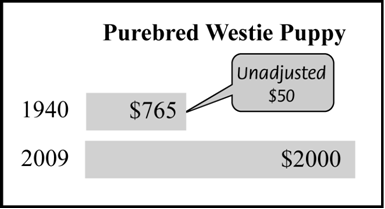
Example: Does the Formula Overestimate or Underestimate the 2009 Price?
For 2009 ():
Actual price in 2009: $2000$
Conclusion: The formula overestimates the price by dollars.
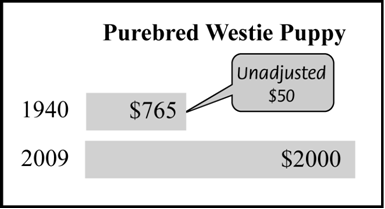
Example: When Will the Price Reach $2151?
Set and solve for :
Interpretation: The price will reach $2151 years after 1940, which is in 2017.
