 Indietro
Solving Rational Equations Algebraically
Guida di studio - Note intelligenti
 Appunti personalizzati basati sui tuoi materiali, ampliati con definizioni chiave, esempi e contesto.
Solving Rational Equations Algebraically
Introduction
Rational equations are equations that involve rational expressions, which are fractions containing polynomials in the numerator and denominator. Solving these equations is a fundamental skill in College Algebra, particularly in the study of polynomial and rational functions. The process typically involves finding a common denominator, clearing fractions, and solving the resulting polynomial equation.
Key Concepts in Solving Rational Equations
Rational Expression: An expression of the form \( \frac{P(x)}{Q(x)} \), where \(P(x)\) and \(Q(x)\) are polynomials and \(Q(x) \neq 0\).
Least Common Multiple (LCM): The smallest expression that is a multiple of all denominators in the equation. Used to clear fractions.
Extraneous Solutions: Solutions that arise from the algebraic process but do not satisfy the original equation, often due to division by zero.
Solving Rational Equations: Step-by-Step
Step 1: Identify the LCM of Denominators
To eliminate fractions, multiply both sides of the equation by the LCM of all denominators. This step is crucial for simplifying the equation.
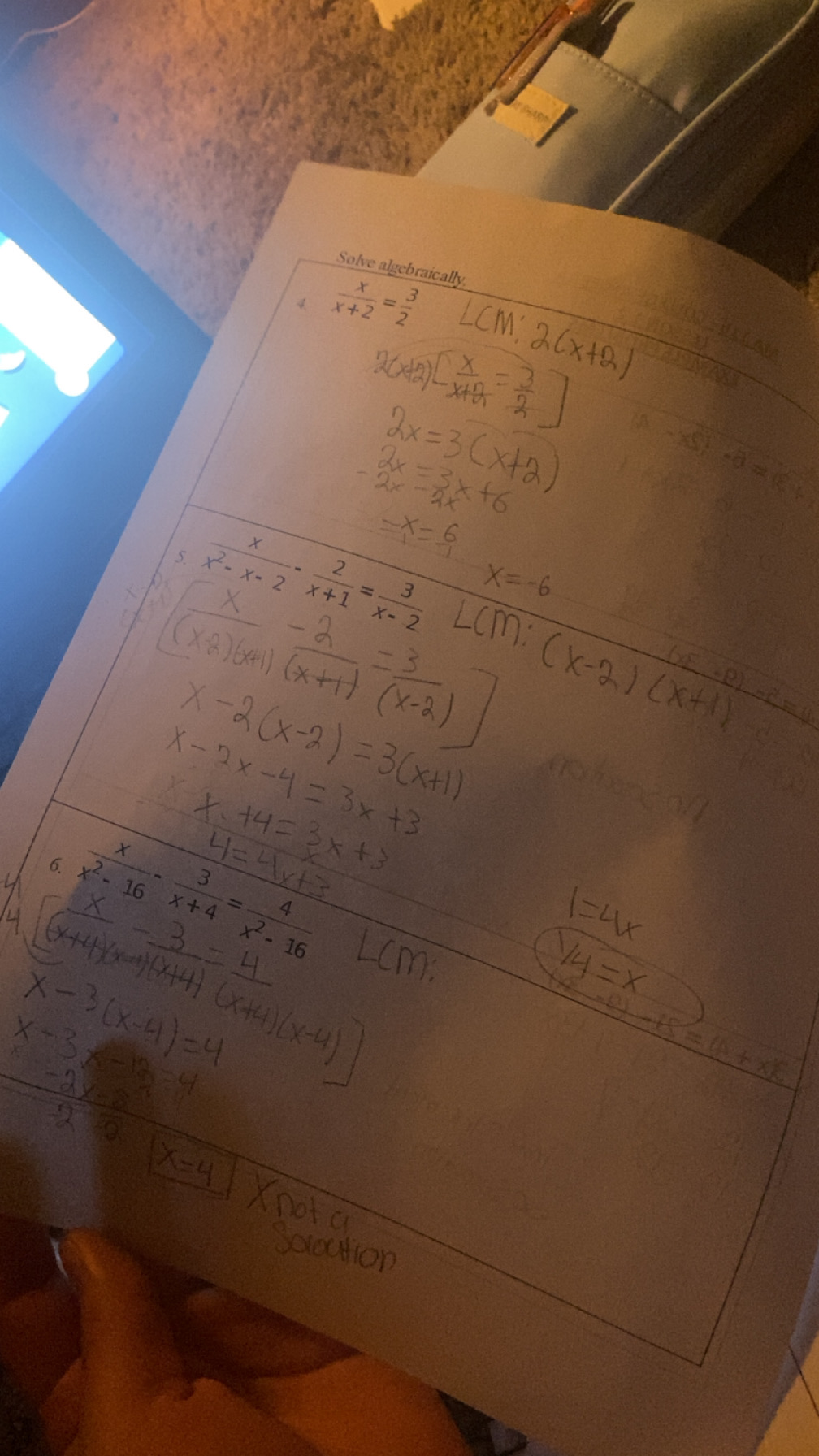
Example: For \( \frac{x}{x+2} = \frac{3}{2} \), the LCM is \(2(x+2)\).
Step 2: Multiply Both Sides by the LCM
Apply the LCM to each term to clear the denominators, resulting in a polynomial equation.
Example: \(2(x+2)\left[\frac{x}{x+2}\right] = 2(x+2)\left[\frac{3}{2}\right]\)
This simplifies to \(2x = 3(x+2)\).
Step 3: Solve the Resulting Equation
Expand and solve the polynomial equation for the variable.
Example: \(2x = 3x + 6\) leads to \(-x = 6\), so \(x = -6\).
Step 4: Check for Extraneous Solutions
Substitute the solution back into the original equation to ensure it does not make any denominator zero.
Example: If \(x = 4\) makes a denominator zero, it is not a valid solution.
Examples of Solving Rational Equations
Example 1: Simple Rational Equation
\( \frac{x}{x+2} = \frac{3}{2} \)
LCM: \(2(x+2)\)
Multiply both sides: \(2x = 3(x+2)\)
Solve: \(2x = 3x + 6 \Rightarrow -x = 6 \Rightarrow x = -6\)
Check: \(x = -6\) does not make denominator zero.
Example 2: Rational Equation with Multiple Denominators
\( \frac{x}{x-2} - \frac{2}{x+1} = \frac{3}{x-2} \)
LCM: \((x-2)(x+1)\)
Multiply both sides: \(x(x+1) - 2(x-2) = 3(x+1)\)
Expand: \(x^2 + x - 2x + 4 = 3x + 3\)
Solve: \(x^2 - x + 4 = 3x + 3\)
Rearrange: \(x^2 - 4x + 1 = 0\)
Check for extraneous solutions.
Example 3: Rational Equation with Quadratic Denominators
\( \frac{x}{x+4} - \frac{3}{x-4} = \frac{4}{x^2 - 16} \)
LCM: \((x+4)(x-4)\)
Multiply both sides: \(x(x-4) - 3(x+4) = 4\)
Expand: \(x^2 - 4x - 3x - 12 = 4\)
Solve: \(x^2 - 7x - 16 = 4\)
Rearrange: \(x^2 - 7x - 20 = 0\)
Factor: \((x-4)(x-5) = 0\)
Solutions: \(x = 4\) or \(x = 5\)
Check: \(x = 4\) makes denominator zero, so it is not a solution.
Summary Table: Steps for Solving Rational Equations
Step | Description |
|---|---|
1 | Find the LCM of all denominators |
2 | Multiply both sides by the LCM to clear fractions |
3 | Solve the resulting polynomial equation |
4 | Check for extraneous solutions |
Additional info:
These notes are directly relevant to College Algebra, specifically to Chapter 5: Polynomial and Rational Functions, and Chapter 8: Systems of Equations and Inequalities. The examples provided illustrate the process of solving rational equations, a key skill for understanding more advanced algebraic concepts.
