 Indietro
Solving Various Types of Equations in College Algebra
Guida di studio - Note intelligenti
 Appunti personalizzati basati sui tuoi materiali, ampliati con definizioni chiave, esempi e contesto.
Equations and Inequalities
Other Types of Equations
This section explores advanced techniques for solving different types of equations commonly encountered in College Algebra. Mastery of these methods is essential for progressing in algebra and related mathematical fields.
Polynomial Equations
Definition and General Form
Polynomial Equation: An equation where two polynomials are set equal to each other.
General Form: One side is zero, and the other side is a polynomial in descending powers of the variable.
Degree: The highest degree of any term in the equation determines the degree of the polynomial equation.
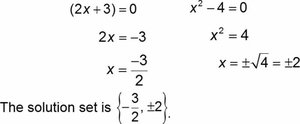
Solving Polynomial Equations by Factoring
Move all nonzero terms to one side to set the equation equal to zero.
Factor the polynomial completely.
Set each factor equal to zero and solve for the variable.
Check all solutions in the original equation to verify validity.
Example: Solve by factoring.
Radical Equations
Definition and Solution Steps
Radical Equation: An equation in which the variable occurs under a root (square root, cube root, etc.).
Isolate one radical on one side of the equation if necessary.
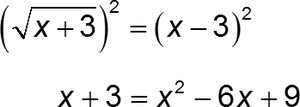
Raise both sides to the nth power to eliminate the radical.
Solve the resulting equation. If radicals remain, repeat the process.
Check all proposed solutions in the original equation, as extraneous solutions may arise.
Example: Solve .
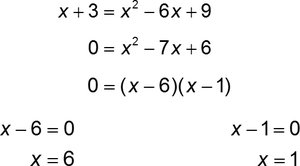
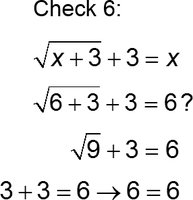
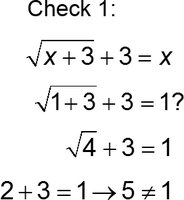
Conclusion: is the only valid solution; is extraneous.
Equations with Rational Exponents
Definition and Solution Method
Rational Exponents: Exponents that are fractions, representing roots (e.g., ).
Isolate the expression with the rational exponent.
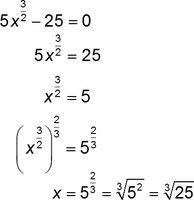
Raise both sides to the reciprocal of the rational exponent to eliminate it.
Example: Solve .
Equations That Are Quadratic in Form
Definition and Solution Strategy
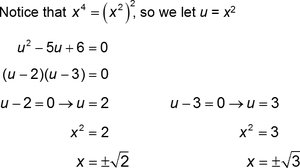
An equation is quadratic in form if it can be rewritten as a quadratic equation using substitution.
Let represent a power of (e.g., ), solve the quadratic in , then substitute back and solve for .
Example: Solve by letting .
Equations Involving Absolute Value
Definition and Solution Steps
Absolute Value: represents the distance of from zero on the number line.
To solve (where ), rewrite as or .

Example: Solve .
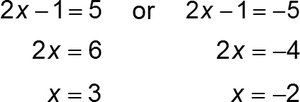
Solution Set:
Applications of Equations
Modeling with Equations
Equations can be used to model real-world scenarios, such as income and time spent on activities.
To solve, substitute known values and solve for the unknown variable using algebraic techniques.
Example: The formula models weekly television viewing time (in hours) by annual income (in thousands of dollars). What annual income corresponds to hours per week watching TV?

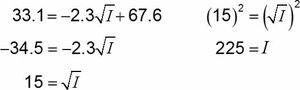
Conclusion: An annual income of hours per week watching TV.
Additional info: The above notes cover the main types of equations discussed in College Algebra, including polynomial, radical, rational exponent, quadratic form, and absolute value equations, as well as their applications. Each section provides definitions, solution strategies, and worked examples for clarity.
