 Indietro
Study Guide: Composite Functions, Domains, and Symmetry in College Algebra
Guida di studio - Note intelligenti
 Appunti personalizzati basati sui tuoi materiali, ampliati con definizioni chiave, esempi e contesto.
Q1. Find and and the domain of each for the following pairs of functions:
17. ,
18. ,
19. ,
20. ,
21. ,
22. ,
23. ,
24. ,


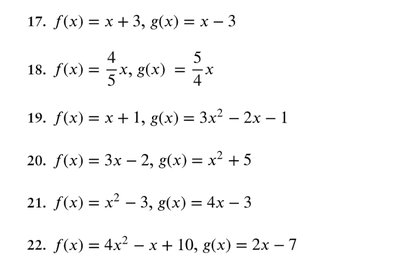
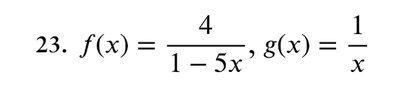
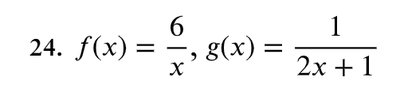
Background
Topic: Composite Functions and Domains
This set of questions tests your ability to find the composition of two functions and determine the domain of the resulting composite function. You must consider both the domain of the inner function and the domain restrictions imposed by the outer function.
Key Terms and Formulas
Composite Function:
Domain: The set of input values for which the function is defined.
For , must be in the domain of , and must be in the domain of .
Step-by-Step Guidance
Write out the expressions for and for the given pair.
Find by substituting into : .
Find by substituting into : .
Determine the domain of (the inner function) and note any restrictions (such as division by zero or square roots of negative numbers).
Check if the output of is always valid as an input for , and vice versa for . Identify any additional restrictions from $f(x)$.
Set up the domain for each composite function, but stop before listing the final domain intervals or values.
Try solving on your own before revealing the answer!
Final Answer: See below for each pair
17. , domain: all real numbers. , domain: all real numbers.
18. , domain: all real numbers. , domain: all real numbers.
19. , domain: all real numbers. , domain: all real numbers.
20. , domain: all real numbers. , domain: all real numbers.
21. , domain: all real numbers. , domain: all real numbers.
22. , domain: all real numbers. , domain: all real numbers.
23. , domain: and . , domain: and .
24. , domain: . , domain: and .
For each composite function, the domain is determined by considering the restrictions from both the inner and outer functions.
Q2. Decompose the following functions as a composition of two functions:
41.
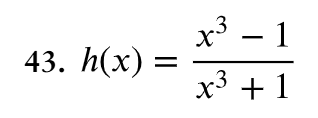
43.
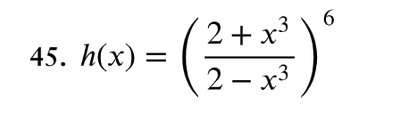
45.
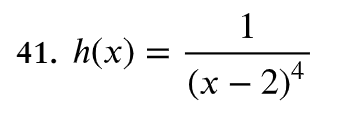

Background
Topic: Function Decomposition
This question tests your ability to express a given function as the composition of two simpler functions. This skill is useful for understanding function structure and for calculus applications.
Key Terms and Formulas
Decomposition: Writing as for some and .
Composition: means applying first, then .
Step-by-Step Guidance
Identify the "inner" and "outer" functions in the given .
Write in the form by isolating a part of the expression that can be substituted as .
Define as the inner function and as the outer function.
Check that reconstructs exactly.
Set up the decomposition for each function, but stop before stating the final and pairs.
Try solving on your own before revealing the answer!
Final Answer: See below for each function
41. can be decomposed as where , .
43. can be decomposed as where , .
45. can be decomposed as where , .
Each function is written as a composition of two simpler functions, which helps in understanding their structure.
Q3. Test algebraically whether the graph is symmetric with respect to the x-axis, y-axis, and the origin.

Background
Topic: Symmetry of Functions
This question tests your ability to determine whether a function is symmetric with respect to the x-axis, y-axis, or the origin using algebraic methods. Understanding symmetry is important for graphing and analyzing functions.
Key Terms and Formulas
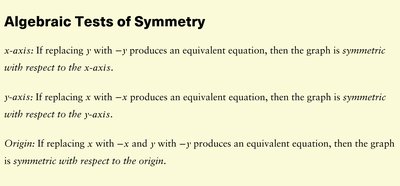
x-axis symmetry: Replace with in the equation.
y-axis symmetry: Replace with in the equation.
Origin symmetry: Replace with and with in the equation.
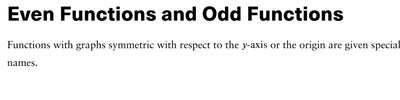
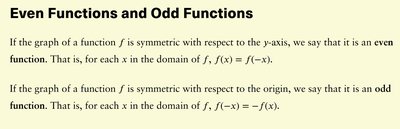
Even function: (y-axis symmetry).
Odd function: (origin symmetry).
Step-by-Step Guidance
Write the function equation in terms of and if needed.
For x-axis symmetry, replace with and check if the equation is unchanged.
For y-axis symmetry, replace with and check if the equation is unchanged.
For origin symmetry, replace with and with and check if the equation is unchanged.
Set up the algebraic tests for each type of symmetry, but stop before stating the final conclusion for the function.
Try solving on your own before revealing the answer!
Final Answer: See below for symmetry tests
x-axis: If replacing with produces an equivalent equation, the graph is symmetric with respect to the x-axis.
y-axis: If replacing with produces an equivalent equation, the graph is symmetric with respect to the y-axis.
Origin: If replacing with and with produces an equivalent equation, the graph is symmetric with respect to the origin.
Even function: .
Odd function: .
Apply these tests to your function to determine its symmetry properties.
