 Indietro
Study Notes: Differentiation and Applications for College Algebra
Guida di studio - Note intelligenti
 Appunti personalizzati basati sui tuoi materiali, ampliati con definizioni chiave, esempi e contesto.
Functions and Differentiation
Geometric Interpretation of the Derivative
The derivative of a function at a point provides the slope of the tangent line to the curve at that point. This concept is foundational in calculus and is used to analyze rates of change and optimize functions.
Tangent Line: The tangent to the curve y = f(x) at P(a, f(a)) has slope given by the limit:
Equation of Tangent Line:
Rate of Change
The average rate of change of y = f(x) over an interval [a, a + \Delta x] is:
The instantaneous rate of change (the derivative) at x = a is:
Definition and Notation of the Derivative
The derivative of y = f(x) at a is:
Newton's notation:
Leibniz's notation:
The derivative represents both the slope of the tangent and the instantaneous rate of change.
Rules and Techniques of Differentiation
Basic Derivative Rules
Constant Rule:
Power Rule:
Exponential Rule:
Logarithmic Rule:
Trigonometric Rules:
Inverse Trigonometric Rules:
Product, Quotient, and Chain Rules
Product Rule:
Quotient Rule:
Chain Rule:
Applications of the Derivative
Marginal Quantities in Economics
In economics, the marginal value refers to the additional amount resulting from a small increase in the independent variable. For a function y = f(x):
If , then . The marginal function is .
Elasticity
Elasticity measures the percentage change in the dependent variable resulting from a 1% change in the independent variable. For y = f(x):
This is widely used in economics to analyze responsiveness.
Linear Approximation and Differentials
The linear approximation of f(x) near x = a is:
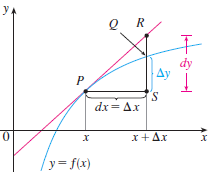
The differential of y = f(x) at a is:
Generally, . The differential approximates the change along the tangent, while is the actual change along the curve.
Implicit Differentiation
Implicit Functions
Some functions are defined implicitly by equations of the form F(x, y) = C. To find :
Differentiate both sides with respect to x, applying the chain rule as needed.
Solve for .
For higher-order derivatives, differentiate again as needed.
Higher-Order Derivatives
The n-th derivative of f is denoted or . These are found by repeated differentiation.
Applications: L'Hôpital's Rule
Indeterminate Forms
L'Hôpital's Rule is used to evaluate limits of the form or :
Other indeterminate forms can often be converted to these types before applying the rule.
Optimization: Extrema of Functions
Local and Global Extrema
Local Maximum: is a local maximum if in a neighborhood of .
Local Minimum: is a local minimum if in a neighborhood of .
Global Maximum/Minimum: The largest/smallest value on the domain.
Finding Extrema
Find stationary points by solving .
Use the first or second derivative test to classify each point:
First Derivative Test: If changes sign, there is a local extremum.
Second Derivative Test: If , local minimum; if , local maximum.
For global extrema on , compare values at stationary points and endpoints.
Summary Table: Key Derivative Rules
Rule | Formula |
|---|---|
Constant | |
Power | |
Exponential | |
Logarithmic | |
Product | |
Quotient | |
Chain |
