 Indietro
Symmetry of Functions: Even and Odd Functions
Guida di studio - Note intelligenti
 Appunti personalizzati basati sui tuoi materiali, ampliati con definizioni chiave, esempi e contesto.
Functions and Graphs
Symmetry in Functions: Even and Odd Functions
Understanding the symmetry of functions is a fundamental concept in College Algebra, particularly when analyzing and graphing functions. Symmetry helps classify functions as even or odd, which has implications for their algebraic properties and graphical behavior.
Odd Functions
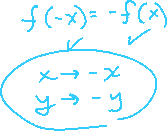
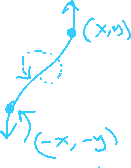
An odd function is defined by the property that for every x in the domain, . This means the function is symmetric with respect to the origin: if you reflect a point (x, y) across both axes, you get (-x, -y), which also lies on the graph.
Definition: for all x in the domain.
Graphical Symmetry: Origin symmetry; the graph looks the same after a 180-degree rotation about the origin.
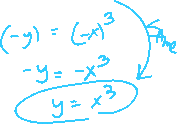
Example: is an odd function because .
Even Functions
An even function is defined by the property that for every x in the domain, . This means the function is symmetric with respect to the y-axis: reflecting a point (x, y) across the y-axis gives (-x, y), which also lies on the graph.
Definition: for all x in the domain.
Graphical Symmetry: y-axis symmetry; the graph is unchanged when reflected across the y-axis.
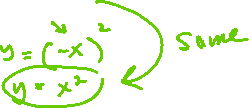
Example: is an even function because .
Summary Table: Properties of Even and Odd Functions
Type | Algebraic Property | Graphical Symmetry | Example |
|---|---|---|---|
Even | y-axis | ||
Odd | Origin |
Applications and Importance
Recognizing symmetry simplifies graphing and solving equations.
Even and odd functions appear frequently in algebra, calculus, and physics.
Symmetry can help predict function behavior without plotting every point.
Additional info: The images reinforce the algebraic and graphical properties of even and odd functions, showing both the transformation rules and specific examples.
