In Exercises 15–18, use the Leading Coefficient Test to determine the end behavior of the graph of the given polynomial function. Then use this end behavior to match the polynomial function with its graph. [The graphs are labeled (a) through (d).] <IMAGE>
Ch. 3 - Polynomial and Rational Functions

Capitolo 4, Problema 18
Solve each polynomial inequality in Exercises 1–42 and graph the solution set on a real number line. Express each solution set in interval notation. 4x2 + 1 ≥ 4x
Guida verificata passo dopo passo1
Rewrite the inequality to have zero on one side by subtracting \(4x\) from both sides: \(4x^2 + 1 - 4x \geq 0\).
Rearrange the terms to standard quadratic form: \(4x^2 - 4x + 1 \geq 0\).
Identify the quadratic expression \(4x^2 - 4x + 1\) and find its roots by solving the equation \(4x^2 - 4x + 1 = 0\) using the quadratic formula \(x = \frac{-b \pm \sqrt{b^2 - 4ac}}{2a}\), where \(a=4\), \(b=-4\), and \(c=1\).
Determine the nature of the roots by calculating the discriminant \(\Delta = b^2 - 4ac\). This will tell you if the quadratic touches or crosses the x-axis.
Use the roots (if any) to divide the number line into intervals, then test a value from each interval in the inequality \(4x^2 - 4x + 1 \geq 0\) to determine where the inequality holds true. Express the solution set in interval notation and graph it on the real number line.

Risposta video verificata per un problema simile:
Questa soluzione video è stata consigliata dai nostri tutor come utile per risolvere questo problema.
Durata del video:
2mConcetti chiave
Ecco i concetti essenziali che devi comprendere per rispondere correttamente alla domanda.
Polynomial Inequalities
Polynomial inequalities involve expressions where a polynomial is compared to another value using inequality symbols (>, <, ≥, ≤). Solving them requires finding the values of the variable that make the inequality true, often by analyzing the sign of the polynomial over different intervals.
Video consigliato:
Percorso guidato
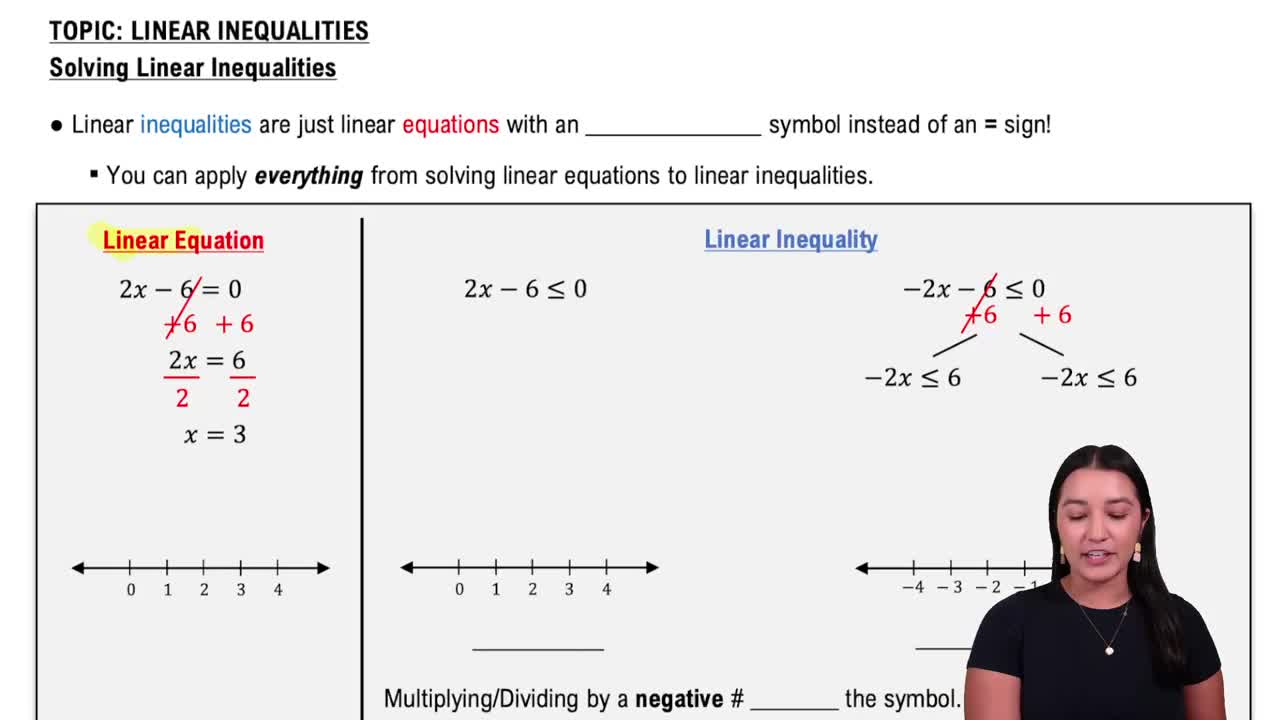
Linear Inequalities
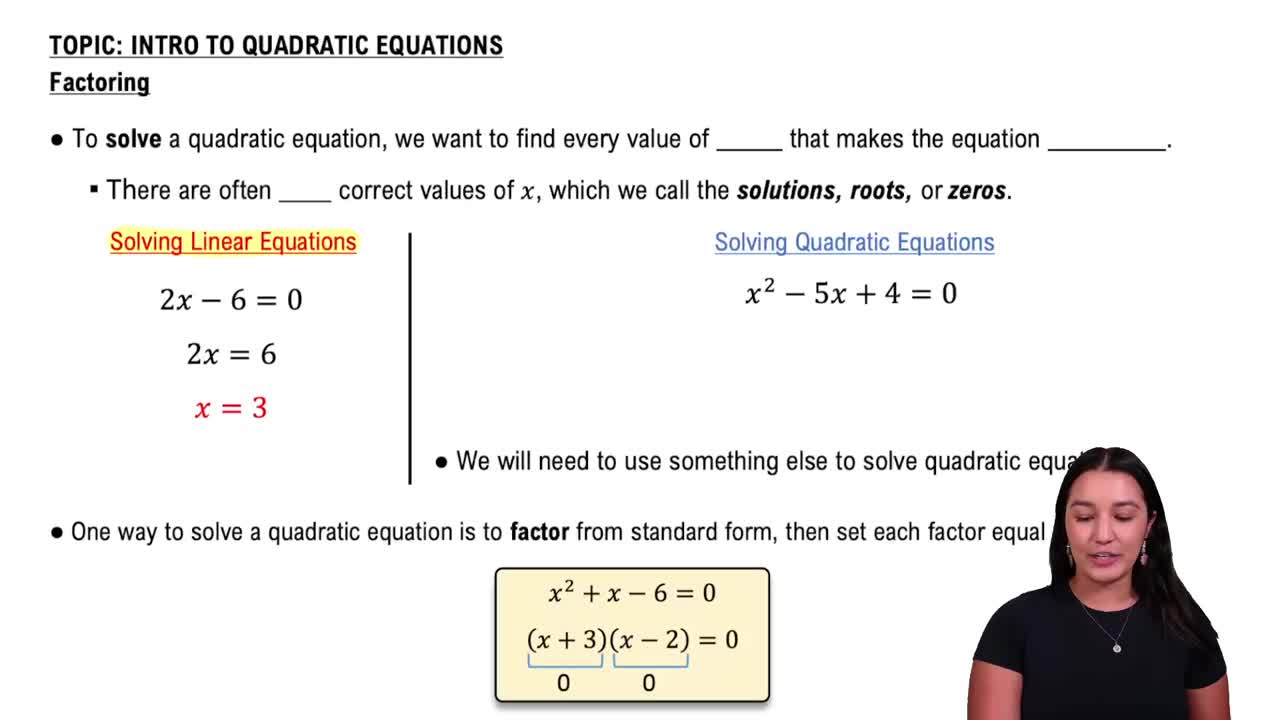
Factoring and Solving Quadratic Equations
To solve polynomial inequalities, especially quadratics like 4x² + 1 ≥ 4x, it is helpful to rewrite the inequality in standard form and factor or use the quadratic formula. This helps identify critical points where the expression equals zero, which divide the number line into intervals for testing.
Video consigliato:
Percorso guidato
Solving Quadratic Equations by Factoring
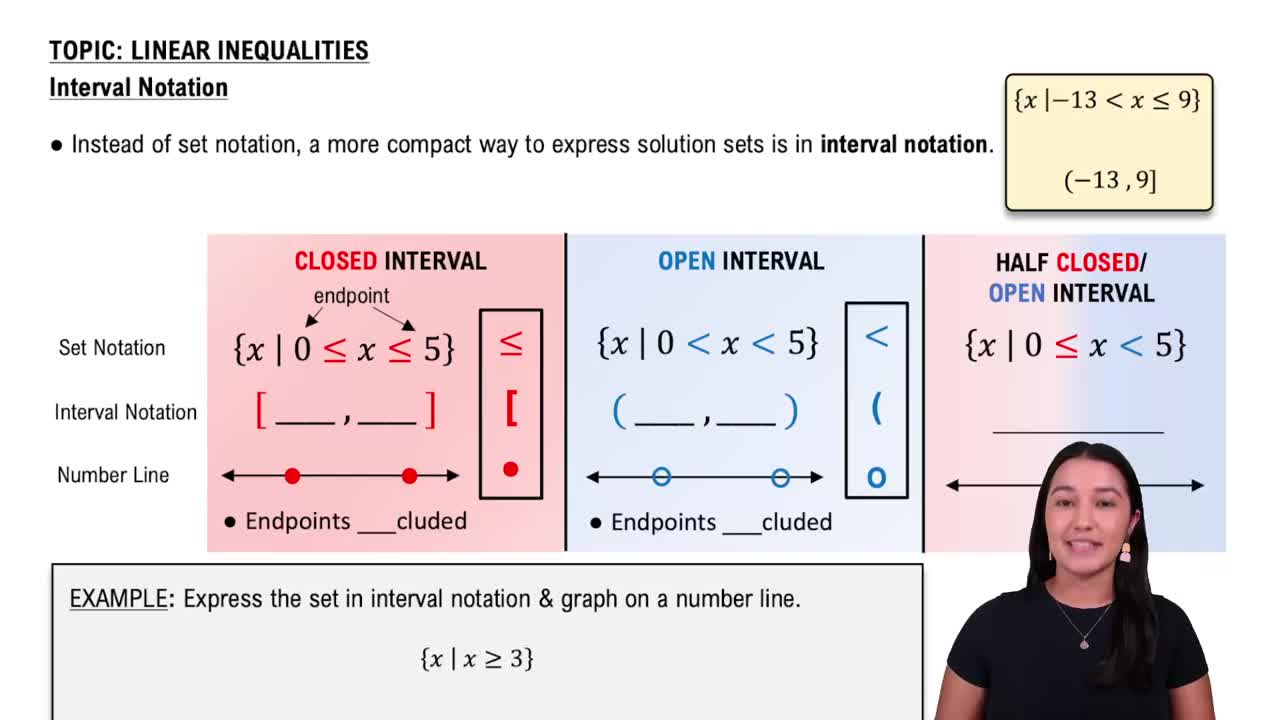
Interval Notation and Graphing Solution Sets
After determining where the polynomial is positive or negative, solutions are expressed using interval notation, which concisely represents sets of numbers. Graphing on a number line visually shows these intervals, indicating where the inequality holds true with open or closed circles depending on strict or inclusive inequalities.
Video consigliato:
Percorso guidato
Interval Notation
Pratica correlata
Domanda del libro di testo
605
views
Domanda del libro di testo
In Exercises 19–24, (a) Use the Leading Coefficient Test to determine the graph's end behavior. (b) Determine whether the graph has y-axis symmetry, origin symmetry, or neither. (c) Graph the function.
969
views
Domanda del libro di testo
Show that f(x) = x^3 - 2x - 1 has a real zero between 1 and 2.
677
views
Domanda del libro di testo
Solve each polynomial inequality in Exercises 1–42 and graph the solution set on a real number line. Express each solution set in interval notation.
498
views
Domanda del libro di testo
Write an equation that expresses each relationship. Then solve the equation for y. x varies jointly as z and the difference between y and w.
561
views
Domanda del libro di testo
Divide using synthetic division. (2x2+x−10)÷(x−2)
550
views
