Solve each logarithmic equation in Exercises 49–92. Be sure to reject any value of x that is not in the domain of the original logarithmic expressions. Give the exact answer. Then, where necessary, use a calculator to obtain a decimal approximation, correct to two decimal places, for the solution. log(x+4)=log x+log 4
Ch. 4 - Exponential and Logarithmic Functions

Capitolo 5, Problema 79
Find the domain of each logarithmic function. f(x) = ln (x-2)²
Guida verificata passo dopo passo1
Recall that the domain of a logarithmic function \( f(x) = \ln(g(x)) \) requires the argument \( g(x) \) to be strictly greater than zero, so we need to find where \( (x-2)^2 > 0 \).
Set up the inequality \( (x-2)^2 > 0 \) and analyze it. Since a square of any real number is always non-negative, \( (x-2)^2 \geq 0 \) for all \( x \), but it equals zero when \( x = 2 \).
Because the logarithm is undefined at zero, exclude \( x = 2 \) from the domain. Therefore, the domain includes all real numbers except \( x = 2 \).
Express the domain in interval notation as \( (-\infty, 2) \cup (2, \infty) \).
Summarize that the domain of \( f(x) = \ln((x-2)^2) \) is all real numbers except \( x = 2 \), because the argument of the logarithm must be positive.

Risposta video verificata per un problema simile:
Questa soluzione video è stata consigliata dai nostri tutor come utile per risolvere questo problema.
Durata del video:
4mConcetti chiave
Ecco i concetti essenziali che devi comprendere per rispondere correttamente alla domanda.
Domain of a Function
The domain of a function is the set of all input values (x-values) for which the function is defined. For logarithmic functions, the domain is restricted to values that make the argument inside the logarithm positive, since the logarithm of zero or a negative number is undefined.
Video consigliato:
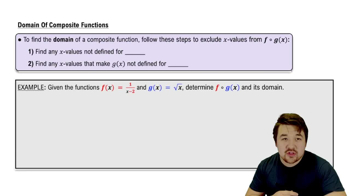
Domain Restrictions of Composed Functions
Properties of Logarithmic Functions
A logarithmic function, such as ln(x), is only defined for positive arguments. This means the expression inside the logarithm must be greater than zero. Understanding this property is essential to determine the domain by setting the argument greater than zero and solving the inequality.
Video consigliato:
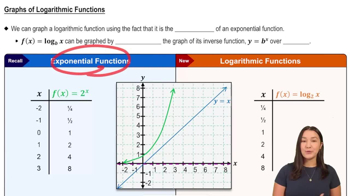
Graphs of Logarithmic Functions
Solving Inequalities Involving Squares
When the argument of the logarithm is a squared expression, like (x-2)², it is always non-negative. To find the domain, you must analyze when the squared expression is strictly greater than zero, since the logarithm requires a positive argument, not zero. This involves solving inequalities and understanding the behavior of squared terms.
Video consigliato:
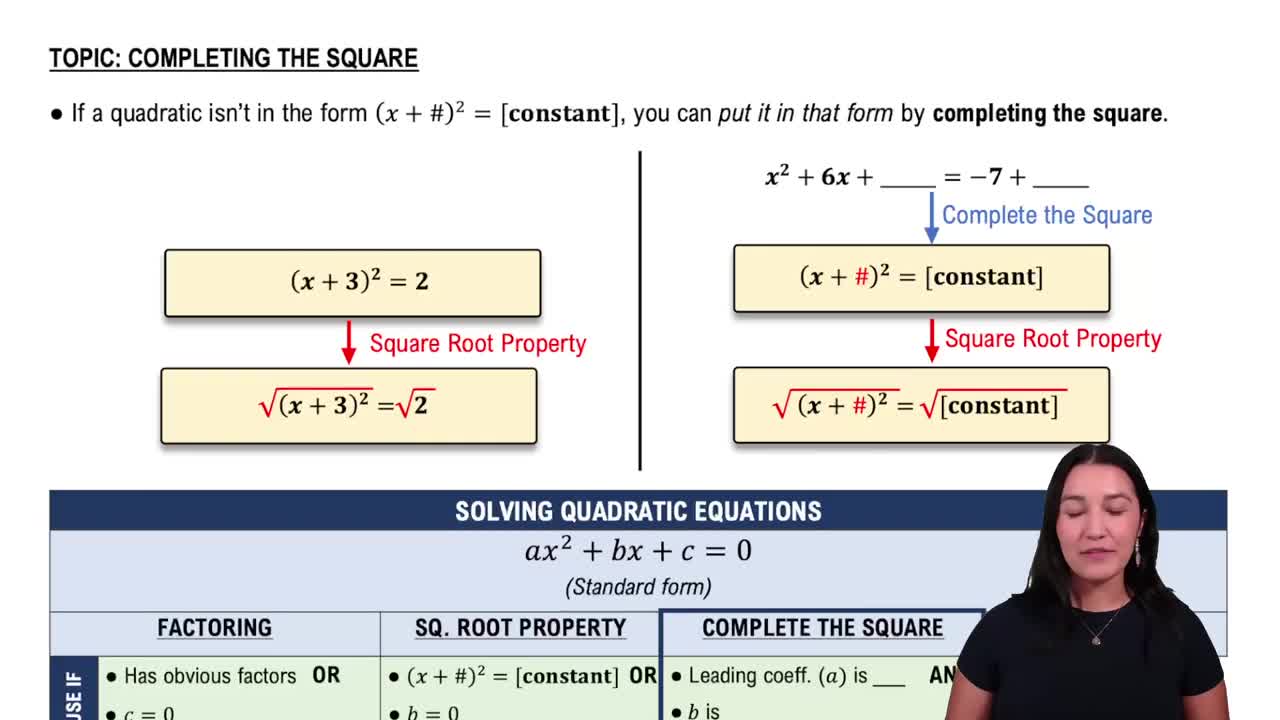
Solving Quadratic Equations by Completing the Square
Pratica correlata
Domanda del libro di testo
750
views
Domanda del libro di testo
Use a graphing utility and the change-of-base property to graph each function. y = log3 x
798
views
Domanda del libro di testo
Use a graphing utility and the change-of-base property to graph each function. y = log2 (x + 2)
680
views
Domanda del libro di testo
In Exercises 74–79, solve each logarithmic equation. log4 (2x+1) = log4 (x-3) + log4 (x+5)
959
views
Domanda del libro di testo
Solve each logarithmic equation in Exercises 49–92. Be sure to reject any value of x that is not in the domain of the original logarithmic expressions. Give the exact answer. Then, where necessary, use a calculator to obtain a decimal approximation, correct to two decimal places, for the solution. log(3x−3)=log(x+1)+log 4
719
views
Domanda del libro di testo
Use common logarithms or natural logarithms and a calculator to evaluate to four decimal places. logπ 63
829
views
