Solve each logarithmic equation in Exercises 49–92. Be sure to reject any value of x that is not in the domain of the original logarithmic expressions. Give the exact answer. Then, where necessary, use a calculator to obtain a decimal approximation, correct to two decimal places, for the solution. log(x+4)=log x+log 4
Ch. 4 - Exponential and Logarithmic Functions

Capitolo 5, Problema 79
Use a graphing utility and the change-of-base property to graph each function. y = log3 x
Guida verificata passo dopo passo1
Understand that the function given is \( y = \log_3 x \), which is a logarithmic function with base 3. This means it gives the exponent to which 3 must be raised to get \( x \).
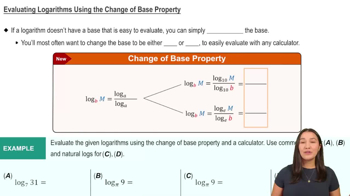
Recall the change-of-base formula for logarithms: \( \log_a b = \frac{\log_c b}{\log_c a} \), where \( c \) is any positive number different from 1. This allows us to rewrite \( \log_3 x \) in terms of common logarithms (base 10) or natural logarithms (base \( e \)).
Apply the change-of-base formula to rewrite \( y = \log_3 x \) as \( y = \frac{\log x}{\log 3} \) if using common logarithms, or \( y = \frac{\ln x}{\ln 3} \) if using natural logarithms.
Use a graphing utility (such as a graphing calculator or software) to plot the function \( y = \frac{\log x}{\log 3} \) or \( y = \frac{\ln x}{\ln 3} \). This will give the graph of \( y = \log_3 x \).
Analyze the graph: note that the domain is \( x > 0 \), the graph passes through the point \( (1,0) \) because \( \log_3 1 = 0 \), and the graph increases slowly as \( x \) increases.

Risposta video verificata per un problema simile:
Questa soluzione video è stata consigliata dai nostri tutor come utile per risolvere questo problema.
Durata del video:
1mConcetti chiave
Ecco i concetti essenziali che devi comprendere per rispondere correttamente alla domanda.
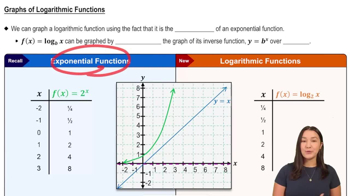
Logarithmic Functions
A logarithmic function is the inverse of an exponential function and is written as y = log_b(x), where b is the base. It answers the question: to what power must the base b be raised to produce x? Understanding the domain (x > 0) and range (all real numbers) is essential for graphing.
Video consigliato:
Graphs of Logarithmic Functions
Change-of-Base Formula
The change-of-base formula allows you to rewrite logarithms with any base b as a ratio of logarithms with a different base, typically base 10 or e: log_b(x) = log_c(x) / log_c(b). This is useful when graphing with calculators or utilities that only support common or natural logs.
Video consigliato:
Change of Base Property
Using Graphing Utilities
Graphing utilities like calculators or software can plot functions by evaluating points. Since many utilities do not support arbitrary log bases directly, applying the change-of-base formula lets you graph y = log_3(x) by inputting y = log(x)/log(3), enabling visualization of the function's shape and behavior.
Video consigliato:
Graphing Rational Functions Using Transformations
Pratica correlata
Domanda del libro di testo
750
views
Domanda del libro di testo
Find the domain of each logarithmic function. f(x) = ln (x-2)²
795
views
Domanda del libro di testo
In Exercises 74–79, solve each logarithmic equation. log4 (2x+1) = log4 (x-3) + log4 (x+5)
959
views
Domanda del libro di testo
Solve each logarithmic equation in Exercises 49–92. Be sure to reject any value of x that is not in the domain of the original logarithmic expressions. Give the exact answer. Then, where necessary, use a calculator to obtain a decimal approximation, correct to two decimal places, for the solution. log(3x−3)=log(x+1)+log 4
719
views
Domanda del libro di testo
Use common logarithms or natural logarithms and a calculator to evaluate to four decimal places. logπ 63
829
views
Domanda del libro di testo
Find the domain of each logarithmic function. f(x) = log (2 - x)
1117
views
