 Indietro
Chapter 2: Recording Business Transactions – Financial Accounting Study Notes
Guida di studio - Note intelligenti
 Appunti personalizzati basati sui tuoi materiali, ampliati con definizioni chiave, esempi e contesto.
Recording Business Transactions
Introduction
This chapter covers the foundational concepts and procedures for recording business transactions in financial accounting. It introduces the types of accounts, the accounting equation, the impact of transactions, and the steps of the accounting cycle, providing a structured approach to understanding how businesses document their financial activities.
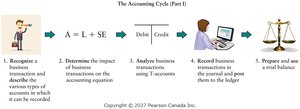
The Accounting Cycle: First Five Steps
The accounting cycle is a systematic process used to identify, record, and summarize business transactions. The first five steps are essential for ensuring accurate financial reporting.
Recognize a business transaction: Identify events that affect the financial position and can be reliably measured.
Determine the impact on the accounting equation: Assess how each transaction affects assets, liabilities, and shareholders’ equity.
Analyze transactions using T-accounts: Use T-accounts to visualize increases and decreases in accounts.
Record transactions in the journal: Enter transactions chronologically using the rules of debit and credit.
Prepare and use a trial balance: List all accounts and their balances to ensure debits equal credits.
The Account and the Accounting Equation
An account is a record of each asset, liability, and shareholders’ equity element. The accounting equation forms the basis of financial accounting:
Assets = Liabilities + Shareholders’ Equity
Assets: Economic resources providing future benefit (e.g., cash, accounts receivable, prepaid expenses, inventory, land, buildings, equipment).
Liabilities: Obligations to pay (e.g., accounts payable, loans payable, accrued liabilities).
Shareholders’ Equity: Owners’ claim to assets (e.g., common shares, retained earnings, dividends, revenues, expenses).
Types of Accounts
Accounts are classified as assets, liabilities, or shareholders’ equity. Each type has specific examples:
Asset Accounts: Cash, Accounts Receivable, Prepaid Expenses, Inventory, Land, Buildings, Equipment, Furniture, Fixtures.
Liability Accounts: Accounts Payable, Loans Payable, Accrued Liabilities.
Shareholders’ Equity Accounts: Common Shares, Retained Earnings, Dividends, Revenues, Expenses.
Impact of Business Transactions on the Accounting Equation
A transaction is an event that affects the financial position of the business and can be reliably measured. Each transaction must be analyzed to determine its effect on assets, liabilities, and shareholders’ equity.
Example: Investment of $50,000 by owners increases assets (cash) and shareholders’ equity (common shares).
Example: Purchase of land for $40,000 decreases cash (asset) and increases land (asset).
Example: Purchase of supplies on account increases assets (supplies) and liabilities (accounts payable).
Example: Earning revenue increases assets (cash or accounts receivable) and shareholders’ equity (revenue).
Example: Payment of expenses decreases assets (cash) and shareholders’ equity (expenses).
Transactions and Financial Statements
Business transactions are summarized in three main financial statements:
Income Statement: Reports revenues and expenses for a period.
Statement of Retained Earnings: Shows changes in retained earnings.
Balance Sheet: Presents assets, liabilities, and shareholders’ equity at a point in time.
Double-Entry Accounting and T-Accounts
The double-entry system uses debits and credits to record the dual effects of each transaction. T-accounts help visualize these effects.
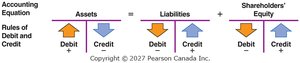
Debits: Increase assets and expenses; decrease liabilities, shareholders’ equity, and revenues.
Credits: Increase liabilities, shareholders’ equity, and revenues; decrease assets and expenses.
Rules of Debit and Credit
The rules of debit and credit are based on the accounting equation:
Assets: Debit increases, credit decreases.
Liabilities: Credit increases, debit decreases.
Shareholders’ Equity: Credit increases, debit decreases.
Recording Transactions: Journal and Ledger
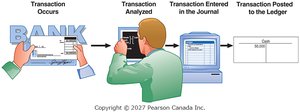
Transactions are first recorded in the journal and then posted to the ledger. The process involves:
Specifying each account affected
Determining if each account is increased or decreased
Applying the rules of debit and credit
Recording in the journal
Posting to the ledger
Trial Balance
A trial balance lists all accounts with their balances at the end of the period. It ensures that total debits equal total credits and facilitates the preparation of financial statements.
Assets are listed first, followed by liabilities and shareholders’ equity.
Purpose: To check the accuracy of the ledger and prepare for financial statement creation.
Artificial Intelligence and Machine Learning in Accounting
Artificial intelligence (AI) and machine learning (ML) are increasingly used in accounting and business. AI refers to building programs and machines that solve problems in a humanlike manner. ML is a subset of AI where machines learn from data without explicit programming.
Supervised Learning: Machines learn from labeled data (e.g., spam filters, ad placements).
Unsupervised Learning: Machines find patterns in unlabeled data (e.g., recommendation systems).
Applications in Accounting: Expanding sales, increasing profits, reducing errors.
Programming Languages: Python, R, Julia, Java.
Summary Table: Rules of Debit and Credit
Account Type | Debit (+) | Credit (-) |
|---|---|---|
Assets | Increase | Decrease |
Liabilities | Decrease | Increase |
Shareholders’ Equity | Decrease | Increase |
Revenues | Decrease | Increase |
Expenses | Increase | Decrease |
Dividends | Increase | Decrease |
Key Formulas
Accounting Equation:
Trial Balance:
Conclusion
Understanding how to record business transactions, apply the rules of debit and credit, and use the accounting cycle is fundamental to financial accounting. These concepts ensure accurate and reliable financial reporting, forming the basis for further study in accounting.
