 Indietro
Chapter 5: Receivables and Revenue – Financial Accounting Study Notes
Guida di studio - Note intelligenti
 Appunti personalizzati basati sui tuoi materiali, ampliati con definizioni chiave, esempi e contesto.
Receivables and Revenue
Introduction
This chapter covers the accounting principles and procedures for recognizing revenue, accounting for receivables, and handling related transactions such as sales returns, allowances, discounts, and uncollectible accounts. It also addresses the treatment of notes receivable and interest revenue, all of which are essential for accurate financial reporting and analysis.
Revenue Recognition Principle
Definition and Application
Revenue: The inflow of resources (or reduction of liabilities) resulting from providing goods or services to customers.
Revenue increases net assets, typically through an increase in cash, accounts receivable (AR), notes receivable (NR), or a decrease in unearned revenue.
Revenue Recognition Principle: Revenue should be recognized when it is earned, not before. This occurs when the company transfers goods or provides services to the customer.
Five Steps of Revenue Recognition:
Identify the contract(s) with the customer.
Identify the performance obligation(s) in the contract.
Determine the transaction price.
Allocate the transaction price to the performance obligation(s).
Recognize revenue when (or as) the entity satisfies its performance obligation(s).
Additional info: These steps are based on the core guidance from ASC 606, the revenue recognition standard under GAAP.
Shipping Terms and Revenue Recognition Timing
Legal Title Transfer and Shipping Terms
Point of Purchase Sale: Legal title transfers at the point of sale in the store.
FOB Shipping Point: Legal title transfers to the buyer when goods are handed to the carrier. Buyer pays shipping; seller recognizes revenue on shipment date.
FOB Destination: Legal title transfers when goods reach the buyer. Seller pays shipping; seller recognizes revenue on delivery date.
Example: If goods are sold FOB Shipping Point, revenue is recognized when shipped; if FOB Destination, revenue is recognized upon delivery.
Journal Entries for Sales Revenue
Types of Sales and Their Journal Entries
Cash Sales: Immediate payment by customer.
Debit Cash, Credit Sales Revenue
Credit Sales: Customer purchases on account.
Debit Accounts Receivable, Credit Sales Revenue
Credit Card Sales: Treated as cash sales minus the credit card fee.
Debit Cash and Credit Card Discount Expense, Credit Sales Revenue
Example: If a company sells $1,000 of goods on account, the entry is: Debit AR $1,000; Credit Sales Revenue $1,000.
Sales Returns and Allowances
Accounting for Returns and Allowances
Sales Returns: Merchandise returned by customers.
Sales Allowances: Reductions in price for damaged or incorrect goods kept by the customer.
Both are recorded in a contra revenue account (normal balance: debit) and used to calculate net sales.
GAAP requires estimation and accrual of expected returns and allowances at period end.
Example: If $300 of goods are returned, Debit Sales Refunds Payable $300; Credit AR $300.
Sales Discounts
Early Payment Incentives
Sales Discount: A percentage reduction in price for early payment (e.g., 2/10, n/30 means 2% discount if paid within 10 days).
Recorded in a contra revenue account (normal balance: debit).
Used to calculate net sales.
Example: If a customer pays $1,000 invoice within the discount period, they pay $980 and the company records a $20 sales discount.
Net Sales Calculation
Formula and Application
Net Sales = Total Sales Revenue – Sales Returns and Allowances – Sales Discounts
Example: If total sales are $10,000, returns and allowances are $500, and discounts are $200, then net sales are $9,300.
Accounts Receivable and Allowance for Doubtful Accounts
Nature and Reporting
Accounts Receivable (AR): Amounts due from customers for sales on account.
Allowance for Doubtful Accounts (ADA): Contra asset account estimating uncollectible AR (normal balance: credit).
Net Realizable Value (NRV): The amount of AR expected to be collected:
Example: If AR is $100,000 and ADA is $6,000, NRV is $94,000.
Estimating Uncollectible Accounts
Allowance Method
Estimates uncollectible accounts at period end, matching bad debt expense to the period of the related sales.
Adjusting entry: Debit Bad Debt Expense, Credit ADA.
When an account is written off: Debit ADA, Credit AR.
Balance Sheet Method (Aging of Receivables):
AR is categorized by age; older accounts are less likely to be collected.
ADA is adjusted to the sum of estimated uncollectibles for each age category.
Bad Debt Expense = Ending ADA – Unadjusted ADA
Example: If aging schedule estimates $4,900 uncollectible and unadjusted ADA is $1,000, then Bad Debt Expense is $3,900.
Notes Receivable and Interest Revenue
Key Terms and Accounting
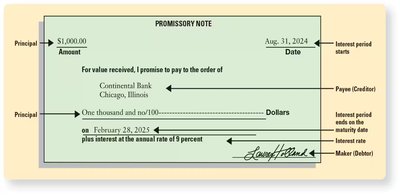
Notes Receivable (N/R): Formal written promises to pay a specified amount (principal) plus interest at a future date.
Interest: Cost of borrowing, stated as an annual percentage rate.
Maturity Value: Principal plus interest due at maturity.
Disclosure: N/R due within one year are current assets; those due beyond one year are long-term assets.
Interest Calculation Formula:
Example: For a \text{Interest} = 20,000 \times 12\% \times \frac{5}{12} = 1,000$
Journal Entries for Notes Receivable
Typical Transactions
Issuance: Debit Notes Receivable, Credit Service Revenue or AR.
Accruing Interest: Debit Interest Receivable, Credit Interest Revenue.
Collection at Maturity: Debit Cash, Credit Notes Receivable, Interest Receivable, and Interest Revenue as appropriate.
Example: For a $3,000, 3-month, 6% note:
Interest = $3,000 \times 6\% \times \frac{3}{12} = $45
Maturity Value = $3,000 + $45 = $3,045
Summary Table: Key Accounts and Formulas
Account | Normal Balance | Purpose |
|---|---|---|
Sales Revenue | Credit | Main revenue account |
Sales Returns & Allowances | Debit | Contra revenue |
Sales Discounts | Debit | Contra revenue |
Accounts Receivable | Debit | Customer claims |
Allowance for Doubtful Accounts | Credit | Contra asset |
Notes Receivable | Debit | Formal written claims |
Helpful Formulas
Net Sales:
Net Realizable Value (NRV):
Interest on Notes Receivable:
