Indietro
Financial Accounting Study Guide: Internal Control, Cash, and Receivables
Guida di studio - Note intelligenti
 Appunti personalizzati basati sui tuoi materiali, ampliati con definizioni chiave, esempi e contesto.
Unit 2: Internal Control, Cash, and Receivables
Overview
This study guide covers essential topics from Financial Accounting, focusing on internal control, cash management, and receivables. It is structured to help students prepare for exams and understand key concepts, journal entries, and calculations relevant to Chapters 4 and 5.
Internal Control and Cash (Chapter 4)
Fraud and Internal Control
Fraud is an intentional misrepresentation of facts designed to persuade another party to act in a way that causes injury or damage. Internal control systems are implemented to prevent and detect fraud, ensuring the accuracy and reliability of financial records.
Fraud Types: Misappropriation of assets and fraudulent financial reporting.
Objectives of Internal Control: Safeguard assets, ensure reliable accounting, promote operational efficiency, and encourage adherence to policies.
Components of Internal Control: Control environment, risk assessment, control activities, information and communication, monitoring.
Example: Requiring independent review of accounting records addresses the objective of ensuring accurate and reliable records.
Bank Reconciliation
Bank reconciliation is a process that resolves differences between the bank statement and the company's book balance. It ensures that all cash transactions are accurately recorded.
Purpose: To identify errors, omissions, and timing differences.
Two Sides: Bank Side (deposits in transit, outstanding checks, bank errors), Book Side (interest, NSF checks, service charges, company errors).
Journal Entries: Only the book side requires journal entries to adjust the company's records.
Example: Adjusting for a bank error does not require a journal entry; adjusting for an NSF check does.
Cash and Cash Equivalents
Cash and cash equivalents are reported as a single total on the balance sheet. Cash equivalents are short-term, highly liquid investments with original maturities of three months or less.
Included: Checking accounts, savings accounts, petty cash, certificates of deposit (original maturity ≤ 3 months), Treasury bills (original maturity ≤ 3 months).
Excluded: Postdated checks, accounts receivable, investments with longer maturities.
Example: A Treasury bill purchased with an original maturity of 6 months is not a cash equivalent if more than 3 months remain.
Bank Reconciliation Table
The following table summarizes typical items found on each side of a bank reconciliation:
Bank Side | Book Side |
|---|---|
Deposits in transit | Interest earned |
Outstanding checks | NSF checks |
Bank errors | Service charges |
Company errors |
Receivables and Revenue (Chapter 5)
Revenue Recognition Principle
Revenue is recognized when the performance obligation is satisfied, not necessarily when cash is received. Shipping terms affect the timing of revenue recognition.
FOB Shipping Point: Revenue recognized when goods leave the seller's location; buyer pays shipping.
FOB Destination: Revenue recognized when goods arrive at buyer's location; seller pays shipping.
Example: Goods shipped FOB Shipping Point on December 29 and delivered January 4—revenue is recognized in December.
Sales Adjustments
Sales returns, allowances, and discounts are common adjustments to sales revenue.
Sales Return: Customer returns merchandise; both sales and inventory are adjusted.
Sales Allowance: Customer keeps merchandise but receives a price reduction.
Sales Discount: Reduction in price for early payment (e.g., 2/10, n/30).
Example: Journalizing a return involves debiting Sales Returns and Allowances and crediting Accounts Receivable.
Accounts Receivable and Net Realizable Value (NRV)
Accounts receivable represent amounts owed by customers. NRV is the amount the company expects to collect, calculated as:
Formula:
Allowance for Doubtful Accounts: Contra-asset account used to estimate uncollectible receivables.
Example: If A/R is $94,700 and Allowance is $6,850, NRV is $87,850.
Allowance Method for Uncollectible Accounts
The allowance method estimates bad debts and records adjusting entries to match expenses with revenues.
Write-off Entry: Debit Allowance for Doubtful Accounts; Credit Accounts Receivable.
Effect on NRV: NRV does not change when an account is written off under the allowance method.
Balance Sheet Approach: Uses aging reports to estimate the required balance in the allowance account.
Example: If the aging report indicates $6,500 is needed and the current balance is $2,600, the adjusting entry is for $3,900.
Notes Receivable
Notes receivable are formal promises to pay, often including interest. The maturity value is calculated as:
Formula:
Interest Calculation:
Example: An \text{Interest} = 18,000 \times 0.09 \times \frac{4}{12} = 540.
Accrued Interest
Interest revenue is accrued at the end of the period if not yet received.
Journal Entry: Debit Interest Receivable; Credit Interest Revenue.
Example: For a 6-month, 10% note of $24,000, accrued interest after 3 months is $24,000 \times 0.10 \times \frac{3}{6} = $1,200.
Key Accounting Concepts and Tools
The Accounting Equation
The fundamental equation of accounting is:
Formula:
Debits and Credits (DEALOR)
Debits and credits are used to record transactions. The DEALOR mnemonic helps remember which accounts increase with debits or credits:
Debits: Dividends, Expenses, Assets
Credits: Liabilities, Owner’s Equity, Revenue
Journal Entries
Journal entries record business transactions in the accounting system. The format is:
Date | Account Name | Debit | Credit
T-Accounts
T-accounts are visual representations of accounts, showing debits on the left and credits on the right. They are used to track changes in account balances.
Cash-Basis vs. Accrual-Basis Accounting
Cash-Basis: Revenue and expenses recorded only when cash is received or paid.
Accrual-Basis: Revenue recorded when earned; expenses recorded when incurred, regardless of cash flow.
Real vs. Nominal Accounts
Real (Permanent) Accounts: Balance sheet accounts (assets, liabilities, equity).
Nominal (Temporary) Accounts: Income statement accounts (revenues, expenses) and dividends.
Practice Questions and Exam Preparation
Study Tips
Attend SI sessions and office hours for clarification.
Use flashcards and practice problems for review.
Watch educational videos for additional explanations.
Appendix: Example Table for Aging of Accounts Receivable
The aging schedule helps estimate uncollectible accounts using different percentages based on the age of receivables:
Age of Accounts | Accounts Receivable | Estimated Uncollectible (%) |
|---|---|---|
1–30 days | $48,000 | 1% |
31–60 days | $22,000 | 5% |
61–90 days | $8,000 | 20% |
Over 90 days | $2,000 | 55% |
Relevant Images
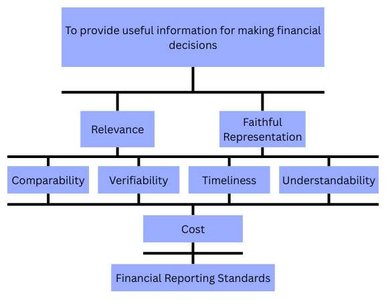
The following image visually reinforces the conceptual framework of financial accounting, which underpins the topics discussed: