 Indietro
Internal Control and Cash Management: Study Notes for Financial Accounting
Guida di studio - Note intelligenti
 Appunti personalizzati basati sui tuoi materiali, ampliati con definizioni chiave, esempi e contesto.
Internal Control and Cash
Fraud and Its Impact
Fraud is defined as the intentional misrepresentation of facts, designed to persuade another party to act in a way that causes injury or damage. Fraud can significantly impact organizations, both financially and reputationally.
Key Statistics:
Organizations lose approximately 5% of revenue annually to fraud, totaling over $7.7 trillion worldwide.
21% of reported fraud cases cause losses of at least $1 million, often involving misleading financial statements.
Nearly half of frauds are perpetrated by employees in operations, accounting, executive management, or sales.
Common behavioral red flags include living beyond means, financial difficulties, and close associations with vendors/customers.
Types of Fraud:
Misappropriation of assets: Employees steal money or assets and cover it up by falsifying records. Includes theft, bribery, and kickback schemes.
Fraudulent financial reporting: Managers make false accounting entries to deceive investors and creditors.
Objectives and Components of Internal Control
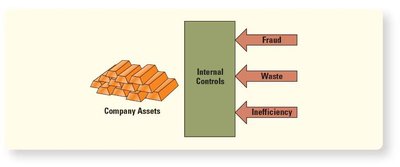
Internal control is a plan of organization and system of procedures implemented by management and the board of directors to achieve five main objectives:
Safeguard assets
Encourage employees to follow firm policies
Promote operational efficiency
Ensure accurate, reliable accounting records
Comply with legal requirements
The components of internal control include:
Control environment
Risk assessment
Information system
Control procedures
Monitoring of controls
Cash Management and Internal Controls
Tools of Effective Cash Management
Effective cash management is essential for safeguarding assets and ensuring accurate financial reporting. Key tools include:
Cash Flow Statement
Cash Budgets
Petty Cash Funds
Bank Reconciliation
Internal Controls over Cash Receipts and Disbursements
Internal controls for cash receipts require recording when received, depositing receipts intact, and separation of duties (recording, custody, authorization). For cash disbursements, major payments are made by check, petty cash is used for small expenditures, and bank reconciliation is prepared regularly.
Without good internal controls, risks such as embezzlement (theft or misappropriation of funds) increase.
Bank Statement and Bank Reconciliation
Bank Statement
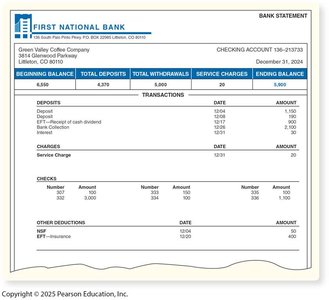
A bank statement is a detailed list provided by the bank of all activity for a particular account during the month. It helps control cash by providing a safe place for funds and a detailed list of transactions for comparison with company records.
Includes: Beginning balance, deposits, check payments, NSF checks, electronic fund transfers (EFT), service charges, interest earned, customer notes collected, credit and debit memos, ending balance.
Bank Reconciliation
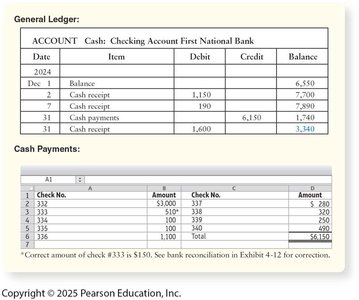
Bank reconciliation resolves differences between the ending balance on the bank statement and the ending balance in the company's Cash T-account. It ensures both records are correct and establishes the balance of cash to report on the balance sheet.
Two Sides:
Bank side: Adjusts for deposits in transit, outstanding checks, and bank errors.
Book side: Adjusts for credit and debit memos, book errors, and prepares journal entries for changes.
Bank Side of Bank Reconciliation
Steps for reconciling the bank side:
Start with ending bank balance.
Add deposits in transit (recorded by firm, not yet by bank).
Subtract outstanding checks (recorded by firm, not yet cleared by bank).
Correct bank errors.
Calculate adjusted bank balance.
Book Side of Bank Reconciliation
Steps for reconciling the book side:
Start with ending book balance (firm’s Cash T-account).
Add credit memoranda (interest, bank collections).
Subtract debit memoranda (NSF checks, service charges, EFT payments).
Correct book errors.
Calculate adjusted book balance.
Prepare journal entries for all changes on book side.
Example: If a bank collects a note for the firm, the firm must record the increase in cash. If a service charge is deducted, the firm must record the decrease.
Reporting Cash on the Balance Sheet
Cash and Cash Equivalents
All cash amounts are combined into a single total called “Cash and Cash Equivalents” on the balance sheet. This includes:
Cash on Hand: Coin and currency available for immediate use.
Petty Cash Funds: Small amounts kept for incidentals.
Cash on Deposit: Funds in checking and savings accounts.
Undeposited Checks: Checks received but not yet deposited.
Cash Equivalents: Investments with maturity of three months or less, readily convertible to cash (e.g., Treasury bills, certificates of deposit).
Not included: Postage stamps, IOUs, accounts receivable.
Presentation: Cash and cash equivalents are shown as a single line item on the balance sheet.
Bank Reconciliation Example
Sample Bank Reconciliation Table
The following table summarizes the typical adjustments made during a bank reconciliation:
Bank Side | Book Side |
|---|---|
Ending Bank Balance | Ending Book Balance |
+ Deposits in Transit | + Credit Memoranda (Interest, Bank Collections) |
- Outstanding Checks | - Debit Memoranda (NSF, Service Charges, EFT Payments) |
+/- Bank Errors | +/- Book Errors |
Adjusted Bank Balance | Adjusted Book Balance |
Journal Entries for Book Side Adjustments
For each adjustment on the book side, a journal entry is required to update the Cash T-account. For example:
To record bank collection:
To record service charge:
To record NSF check:
Cash and Cash Equivalents Classification Example
Classification Table
The following table shows which items are included in Cash and Cash Equivalents:
Item | Amount | Include? |
|---|---|---|
Cash in checking account | $15,000 | Yes |
Petty cash | $580 | Yes |
Postage Stamps | $654 | No |
Check from customer dated Jan 20, next year | $321 | No |
3-month certificate of deposit | $40,000 | Yes |
12-month certificate of deposit | $36,000 | No |
Check from customer dated Dec 15, this year | $175 | Yes |
Undeposited Cashier’s Checks from customer | $729 | Yes |
IOU from customer | $500 | No |
6-month U.S. Treasury bill purchased 4 months ago | $2,500 | No |
2-month high-grade Canada government security purchased 1 month ago | $1,000 | Yes |
Cash in savings account | $100 | Yes |
Accounts Receivable | $3,700 | No |
1-month U.S. Treasury bill purchased 2 weeks ago | $2,000 | Yes |
Time Deposits | $1,600 | Yes |
Example: Only items that are readily available or convertible to cash within three months are included in Cash and Cash Equivalents.
Additional info: These notes expand on brief points from the original materials, providing definitions, examples, and structured explanations suitable for exam preparation in Financial Accounting.
