 Indietro
CH 6 Inventory Accounting Methods and Their Financial Impacts
Guida di studio - Note intelligenti
 Appunti personalizzati basati sui tuoi materiali, ampliati con definizioni chiave, esempi e contesto.
Inventory Accounting Methods
Overview of Inventory Accounting
Inventory accounting involves tracking the cost of goods purchased, sold, and remaining on hand. The method chosen for inventory valuation affects both the income statement and the balance sheet, influencing reported profits and asset values.
Key Inventory Costing Methods
First-In, First-Out (FIFO): Assumes the earliest goods purchased are the first to be sold. Ending inventory consists of the most recently purchased items.
Last-In, First-Out (LIFO): Assumes the latest goods purchased are the first to be sold. Ending inventory consists of the oldest items.
Weighted Average: Calculates a weighted average cost per unit for all goods available for sale during the period.
Specific Identification: Tracks the actual cost of each specific item sold and remaining in inventory. Used when items are unique or easily distinguishable.
Inventory Flow and Financial Statement Impact
The choice of inventory method affects the cost of goods sold (COGS), gross profit, and ending inventory values. In periods of rising prices:
FIFO: Lower COGS, higher ending inventory, higher net income.
LIFO: Higher COGS, lower ending inventory, lower net income.
Weighted Average: Results fall between FIFO and LIFO.
Inventory Method Comparison Table
The following table summarizes the effects of different inventory methods on COGS, net income, and ending inventory during periods of rising and declining costs:
Method | COGS (Rising Costs) | Net Income (Rising Costs) | Ending Inventory (Rising Costs) | COGS (Declining Costs) | Net Income (Declining Costs) | Ending Inventory (Declining Costs) |
|---|---|---|---|---|---|---|
FIFO | Lowest | Highest | Highest | Highest | Lowest | Lowest |
LIFO | Highest | Lowest | Lowest | Lowest | Highest | Highest |
Weighted Average | Middle | Middle | Middle | Middle | Middle | Middle |
Specific Identification | Varies | Varies | Varies | Varies | Varies | Varies |
FIFO, LIFO, and Weighted Average: Example Calculations
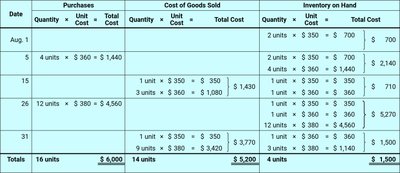
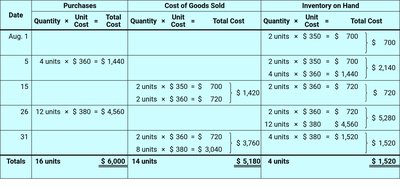
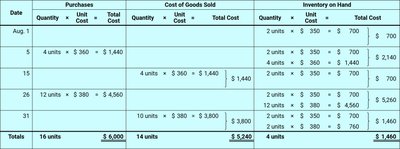
Below are sample schedules for each method, showing purchases, cost of goods sold, and inventory on hand for a period:
FIFO Example:
LIFO Example:
Weighted Average Example:
Weighted Average Cost Formula
The weighted average cost per unit is calculated as follows:
Inventory Errors and Financial Statement Effects
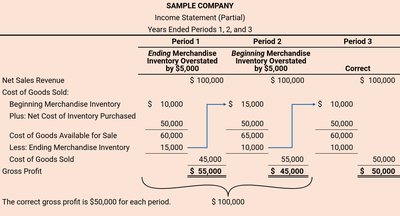
Errors in inventory reporting can affect both the current and subsequent periods. For example, overstating ending inventory in one period overstates net income for that period and understates net income for the next period. The effects counterbalance over two periods.
Lower of Cost or Market (LCM) Rule
Inventory must be reported at the lower of its historical cost or market value. If market value drops below cost, inventory is written down and a loss is recognized:
Journal Entry: Debit Cost of Goods Sold, Credit Merchandise Inventory for the amount of the write-down.
Inventory Turnover Ratio
This ratio measures how efficiently inventory is managed and sold during a period. It is calculated as:
The average number of days inventory is held is:
Summary Table: Inventory Turnover and Days in Inventory
Inventory Turnover | Days in Inventory |
|---|---|
7.85 | 46 |
Key Takeaways
The choice of inventory method affects reported profits, taxes, and asset values.
Inventory errors have a counterbalancing effect over two periods.
Inventory must be reported at the lower of cost or market value.
Inventory turnover and days in inventory are important measures of efficiency.
