 Indietro
Plant Assets, Natural Resources, and Intangibles: Study Notes
Guida di studio - Note intelligenti
 Appunti personalizzati basati sui tuoi materiali, ampliati con definizioni chiave, esempi e contesto.
Plant Assets, Natural Resources, and Intangibles
Types of Long-term Assets
Long-term assets are resources owned by a business that are expected to provide economic benefits over multiple years. They are classified into three main categories:
Property, Plant, and Equipment (PP&E): Includes land, buildings, equipment, machinery, furniture, autos, and trucks.
Natural Resources: Includes oil and gas deposits, timber tracts, and mineral deposits.
Intangible Assets: Includes patents, copyrights, trademarks, franchises, and goodwill.
These assets are essential for generating revenue and supporting business operations.
Initial Cost of Long-term Assets
The initial cost of a long-term asset is the sum of its purchase price and all expenditures necessary to get the asset ready and in place for its intended use. This includes:
Buildings: Architectural fees, building permits, contractors’ charges, materials, labor, overhead, and interest on borrowed funds (if constructed); purchase price, brokerage commission, taxes, repairs, and renovations (if purchased).
Equipment: Purchase price, transportation, insurance in transit, taxes, commissions, installation, testing, and special platforms.
Land: Purchase price, closing costs, attorney fees, agent commissions, title search and insurance, recording fees, mortgage origination, inspection, survey, back property taxes, clearing, draining, and removal of old buildings (less proceeds from salvage sales).
Land improvements (driveways, signs, fences, sprinkler systems) are recorded separately and depreciated over their useful life.
Lump-Sum (Basket) Purchase of Assets
When multiple assets are purchased together for a single price, the total cost is allocated among the assets based on their relative market values. This technique is called the lump-sum allocation method.
Capital Expenditure vs. Immediate Expense
Expenditures on plant assets are classified as either:
Capital Expenditures: Increase the asset’s capacity or extend its useful life. These costs are capitalized (added to the asset’s value).
Immediate Expenses: Costs that do not enhance the asset’s value or life and are expensed immediately.
Depreciation on Plant Assets
Depreciation is the process of allocating the cost of a plant asset over its useful life. It is necessary because assets wear out, become obsolete, or lose value over time. The matching principle requires that depreciation expense be matched with the revenue the asset helps generate each period.
Depreciation Expense: Reported on the income statement.
Land: Not depreciated.
Journal Entry: Dr: Depreciation Expense Cr: Accumulated Depreciation
Book Value:
Depreciation Methods
Three main methods are used to calculate depreciation:
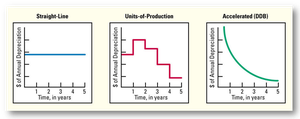
Straight-Line Method: Allocates an equal amount of depreciation each year.
Units-of-Production Method: Depreciation is based on usage or output.
Double-Declining-Balance Method: An accelerated method that applies twice the straight-line rate to the declining book value.
Comparison of Depreciation Methods:
Straight-line: Best for assets generating revenue evenly over time.
Units-of-production: Best for assets that wear out due to use.
Double-declining-balance: Best for assets generating more revenue early in their life.
Depreciation for Partial Years
When an asset is purchased partway through the year, depreciation is prorated based on the number of months the asset was in use.
Plant Asset Disposal
Disposal refers to removing an asset from the books. Steps include:
Measure the final book value.
Calculate up-to-date depreciation (partial year if needed).
Determine up-to-date book value.
Compare book value to selling price (cash proceeds).
Record gain or loss on disposal.
Journal Entry Example: Dr: Cash (new asset) Dr: Accumulated Depreciation (old asset) Dr: Loss on Disposal Cr: Gain on Disposal Cr: Asset (old asset)
Natural Resources
Natural resources are long-term assets that are depleted as they are used. Examples include iron ore, petroleum, and timber. Depletion tracks the flow of the resource from its raw state through inventory to cost of goods sold.
Depletion Rate:
Depletion Expense:
Example: If ExxonMobil buys an oil reserve for $100 million containing 10 million barrels, the depletion rate is $10 per barrel. If 3 million barrels are extracted, depletion expense is $30 million.
Intangible Assets
Intangible assets are long-term assets with no physical form but carry special rights. Examples include patents, copyrights, trademarks, franchises, and goodwill. They are accounted for as follows:
Finite Lives: Amortization is recorded over the asset’s useful life.
Indefinite Lives: Checked annually for impairment (value decreasing).

Research and Development (R&D): Under U.S. GAAP, R&D costs are expensed as incurred and cannot be reported as assets on the balance sheet.
Summary Table: Depreciation Methods
Method | Basis | Best Use |
|---|---|---|
Straight-Line | Time | Assets generating revenue evenly |
Units-of-Production | Usage/Output | Assets worn out by use |
Double-Declining-Balance | Accelerated (Time) | Assets generating more revenue early |
