 Indietro
Receivables and Revenue: Financial Accounting Chapter 5 Study Notes
Guida di studio - Note intelligenti
 Appunti personalizzati basati sui tuoi materiali, ampliati con definizioni chiave, esempi e contesto.
Receivables and Revenue
Revenue Recognition Principle
The Revenue Recognition Principle is a foundational concept in financial accounting that governs when and how revenue is recognized in the financial statements. According to GAAP, revenue should be recognized when it is earned, which occurs when a company transfers goods or provides services to customers.
Revenue: The inflow of resources or reduction of liabilities from providing goods/services.
Recognition: Revenue is recognized when earned, not when cash is received.
5 Steps of Revenue Recognition:
Identify the contract(s) with the customer.
Identify the performance obligation(s) in the contract.
Determine the transaction price.
Allocate the transaction price to the performance obligation(s).
Recognize revenue when (or as) the entity satisfies its performance obligation(s).
Example: A company delivers goods to a customer; revenue is recognized when the goods are delivered, not when payment is received.
Shipping Terms and Revenue Recognition
Shipping terms determine when the legal title of goods transfers to the customer, which affects the timing of revenue recognition.
FOB Shipping Point: Legal title transfers when goods are shipped; buyer pays shipping; seller recognizes revenue on shipment date.
FOB Destination: Legal title transfers when goods arrive; seller pays shipping; seller recognizes revenue on delivery date.
Example: If goods are shipped FOB Shipping Point, revenue is recognized when shipped. If FOB Destination, revenue is recognized when delivered.
Journal Entries for Sales Revenue
Sales can be made for cash, on account (credit), or by credit card. Each method has distinct journal entries.
Cash Sales: Customer pays immediately.
Date: Debit Cash, Credit Sales Revenue.
Credit Sales: Customer pays later.
Date: Debit Accounts Receivable, Credit Sales Revenue.
Credit Card Sales: Treated as cash sales minus a fee; company sells A/R to a financial institution (factor).
Date: Debit Cash and Credit Card Discount Expense, Credit Sales Revenue.
Example: If a company sells $3,000 of goods with a 5% credit card fee, the entry is:
Debit Cash $2,850, Debit Credit Card Discount Expense $150, Credit Sales Revenue $3,000.
Sales Returns and Allowances
Customers may return goods or receive allowances for damaged goods. These are recorded in contra revenue accounts.
Sales Returns: Merchandise returned by customers.
Sales Allowances: Refunds or credits for damaged/wrong goods kept by customers.
Contra Revenue Account: Sales Returns and Allowances (normal balance = debit).
GAAP Requirement: Companies must estimate returns/allowances at period end.
Example: If $300 of goods are returned, Debit Sales Refunds Payable $300, Credit Accounts Receivable $300.
Sales Discounts
Sales discounts incentivize customers to pay early. They are recorded as contra revenue accounts.
Sales Discount: Percentage discount for early payment (e.g., "2/10, n/30").
Contra Revenue Account: Sales Discount (normal balance = debit).
Example: If a customer pays $1,000 invoice within discount period (2%), they pay $980; Debit Cash $980, Debit Sales Discount $20, Credit Accounts Receivable $1,000.
Net Sales Calculation
Net Sales is calculated by subtracting contra sales accounts from total sales.
Formula:
Example: If total sales are $10,000, returns/allowances are $500, and discounts are $200, net sales are $9,300.
Accounts Receivable and Allowance for Doubtful Accounts
Accounts Receivable (A/R)
Accounts Receivable are amounts due from customers for goods/services sold on credit. They are classified as current or long-term assets based on collection period.
Trade Receivables: Oral promises to pay for goods/services.
Nontrade Receivables: Arise from transactions outside normal operations (e.g., advances, interest).
Allowance for Doubtful Accounts (ADA)
The Allowance for Doubtful Accounts is a contra asset account that estimates the portion of A/R not expected to be collected.
Bad Debts: Cost of doing business on account.
Contra Asset Account: ADA (normal balance = credit).
Reporting: A/R is reported net of ADA as Net Realizable Value (NRV).
Formula:
Example: If A/R is $100,000 and ADA is $6,000, NRV is $94,000.
Allowance Method for Estimating Doubtful Accounts
Companies estimate uncollectible accounts at year-end and record Bad Debt Expense via an adjusting entry, following the matching principle.
Bad Debt Expense: Debit Bad Debt Expense, Credit ADA.
Write Offs: When an account is uncollectible, Debit ADA, Credit A/R.
Estimation Methods:
Percent of Sales Method: Estimate as % of credit sales (not on exam).
Balance Sheet Method: Estimate as % of ending A/R.
Aging of Receivables: Categorize A/R by age; older accounts have higher % uncollectible.
Example: If aging schedule estimates $4,900 uncollectible, and ADA unadjusted is $1,000, Bad Debt Expense is $3,900.
Helpful Formulas for A/R and ADA
Accounts Receivable:
Allowance for Doubtful Accounts:
Net Realizable Value:
Notes Receivable and Interest Revenue
Notes Receivable: Terminology and Accounting
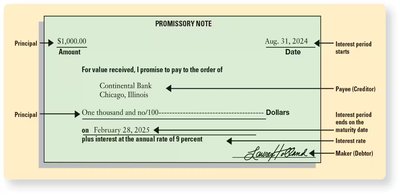
Notes Receivable (N/R) are formal written promises to receive money, often with interest. They specify principal, interest rate, and maturity date.
Creditor (Lender): Party to whom money is owed.
Debtor (Maker/Borrower): Party who owes money.
Interest: Cost of borrowing, stated as annual percentage rate.
Maturity Date: Date payment is due.
Maturity Value: Principal plus interest.
Principal: Amount borrowed.
Term: Length from signing to payment.
Balance Sheet Classification: Current if due within one year; long-term if due after one year.
Example: If a $500,000 N/R is paid in $100,000 yearly installments, the first $100,000 is current, $400,000 is long-term.
Notes Receivable: Journal Entries and Calculations
When a note is issued, the company records the principal as a note receivable. Interest revenue is accrued over time.
Formula for Interest:
Example: For a $20,000 note at 12% for 5 months:
Interest =
Maturity Value =
Journal Entries:
Issue Note: Debit N/R $20,000, Credit Service Revenue $20,000
Accrue Interest: Debit Interest Receivable $600, Credit Interest Revenue $600
Receive Payment: Debit Cash $21,000, Credit N/R $20,000, Credit Interest Receivable $600, Credit Interest Revenue $400
Notes Receivable: Balance Sheet Disclosure
Notes receivable are disclosed as current or long-term assets based on their maturity. The current portion is due within one year; the remainder is long-term.
Example: If a note is paid in installments, classify each portion accordingly.
Notes Receivable: Activity Example
When a company replaces an account receivable with a note receivable, the original sale is recorded, then the note is accepted, and interest is accrued.
Journal Entries:
Record sale: Debit A/R, Credit Sales Revenue.
Accept note: Debit N/R, Credit A/R.
Accrue interest: Debit Interest Receivable, Credit Interest Revenue.
Receive payment: Debit Cash, Credit N/R, Credit Interest Receivable, Credit Interest Revenue.
Formula for Maturity Value:
Summary Table: Key Accounts and Their Properties
Account | Type | Normal Balance | Purpose |
|---|---|---|---|
Sales Revenue | Revenue | Credit | Records sales of goods/services |
Sales Returns & Allowances | Contra Revenue | Debit | Records returns/allowances |
Sales Discount | Contra Revenue | Debit | Records early payment discounts |
Accounts Receivable | Asset | Debit | Amounts due from customers |
Allowance for Doubtful Accounts | Contra Asset | Credit | Estimated uncollectible A/R |
Notes Receivable | Asset | Debit | Formal written promises to pay |
Interest Revenue | Revenue | Credit | Earned from notes receivable |
