 Indietro
Receivables and Revenue: Financial Accounting Study Notes
Guida di studio - Note intelligenti
 Appunti personalizzati basati sui tuoi materiali, ampliati con definizioni chiave, esempi e contesto.
Receivables and Revenue
GAAP for Proper Revenue Recognition
Revenue recognition is a fundamental principle in financial accounting, governed by Generally Accepted Accounting Principles (GAAP). It determines when and how revenue is recorded in the financial statements.
Revenue is recognized when goods are delivered or services are performed, not necessarily when cash is received.
Expenses are recognized when they are matched to the revenues they help generate, following the matching principle.
Example: If Apple Inc. delivers 1,000 iPhones to AT&T, revenue is recognized at delivery, and expenses are matched to the cost of producing those iPhones.
Shortening the Credit Cycle
Businesses aim to accelerate cash flow from sales by shortening the credit cycle. This involves offering incentives for early payment and adopting efficient collection procedures.
Sales Discounts: Percentage discounts offered to customers for early payment. Format: % discount/discount period, n/credit cycle (e.g., 2/10, n/30 means 2% off if paid within 10 days, full payment due in 30 days).
Credit Card Sales: Accepting credit cards speeds up cash collection, though a fee is paid to the card issuer (e.g., VISA charges 2%).
Example: Ace Hardware sells $100,000 of lumber with a 2/10, n/30 discount. If the customer pays within 10 days, they receive a 2% discount.
Sales Returns and Allowances
Sales returns and allowances account for merchandise returned by customers or price reductions granted after sale. Estimations are made each period based on historical data and current sales.
Sales Returns: Increase sales returns and accrue a liability for estimated returns.
Allowances: Estimated inventory returns and decrease cost of goods sold.
Example: Amazon estimates 1% of sales are returned. For $50 billion in sales, $500 million is estimated as returns.
Net Sales Formula:


Accounts Receivable and Subsidiary Ledgers
Accounts receivable are amounts owed by customers for goods or services sold on credit. Subsidiary ledgers track individual customer balances.
Controlled by: Tracking subsidiary ledger accounts by customer.
Reported as: Net accounts receivable (gross receivables minus allowance for uncollectible accounts).
Uncollectible Accounts and Allowance Method (GAAP)
Uncollectible accounts (bad debts) are estimated and recorded using the allowance method, which complies with GAAP. This method matches bad debt expense to the period in which related revenue is earned.
Income Statement Approach: Uncollectible-account expense is computed as a percent of revenue (e.g., 0.02% of $400,000 million revenue = $80 million).
Balance Sheet Approach: Specific accounts are analyzed based on aging schedule.
Journal Entry:
Example: Apple estimates uncollectible accounts expense based on historical experience.
Direct Write-Off Method
The direct write-off method records bad debt expense only when a specific account is deemed uncollectible. This method is less preferable under GAAP as it may overstate assets and fails to match expenses to revenues.
No allowance for uncollectibles: Assets may be overstated.
Fails to match: Uncollectible accounts are not recognized in the same period as related revenue.
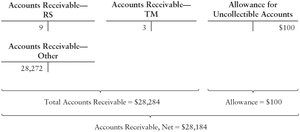
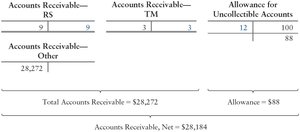
Example: Apple writes off receivables from customers RS ($9) and TM ($3).
Computing Cash Collections from Customers
Cash collections from customers are computed by analyzing changes in accounts receivable balances, sales, and write-offs.
Formula:
Example: If beginning balance is $200, sales are $1,300, write-offs are $100, and ending balance is $400, collections are $1,000.

Notes Receivable and Interest Revenue
Notes receivable are formal written promises to pay a specified amount of money, usually with interest, at a future date. Interest revenue is recognized as it accrues.
Interest Formula: where P = principal, I/R = interest rate, T = time (in years).
Issuance Example: Whitman Inc. signs a 6-month, 9% promissory note for $1 million. The bank records the loan and accrues interest revenue.
Adjusting for Accrued Interest: At year-end, interest revenue is accrued for the months outstanding.
Reporting: Notes receivable and accrued interest are reported in financial statements at period end.
Liquidity and Ratios
Liquidity measures a company's ability to meet short-term obligations. Ratios such as the accounts receivable turnover and days sales outstanding are used to assess liquidity.
Accounts Receivable Turnover:
Days Sales Outstanding:
Application: Higher turnover and lower DSO indicate efficient collection and strong liquidity.
Financial Statement Presentation
Receivables and related allowances are presented in the balance sheet and income statement, providing transparency about asset quality and revenue recognition.
Balance Sheet: Accounts receivable are shown net of allowance for uncollectible accounts.
Income Statement: Net sales are reported after deducting sales returns and allowances.
Summary Table: Receivables and Allowances
Method | Basis | Journal Entry | Financial Statement Impact |
|---|---|---|---|
Allowance Method | Estimate based on sales or aging | DR: Bad Debt Expense CR: Allowance for Uncollectible Accounts | Net receivables reported |
Direct Write-Off | Actual uncollectibles | DR: Bad Debt Expense CR: Accounts Receivable | Assets may be overstated |
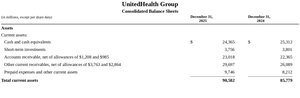
Example: UnitedHealth Group Balance Sheet
Accounts receivable are reported net of allowances, providing a realistic view of expected collections.
Example: Asset Allowances Disclosure
Asset allowances are disclosed in the notes to financial statements, detailing the amounts set aside for uncollectible accounts.
Example: Accounts Receivable Ledger
Accounts receivable ledgers show individual customer balances and the allowance for uncollectible accounts, supporting the net receivable reported.
Example: Cash Collections Table
Cash collections are computed by analyzing changes in accounts receivable, sales, and write-offs.
Additional info:
Allowance for uncollectible accounts is a contra-asset account, reducing the gross accounts receivable to net realizable value.
Sales discounts, returns, and allowances are deducted from gross sales to arrive at net sales, which is reported on the income statement.
Notes receivable accrue interest revenue, which is recognized periodically and reported in financial statements.
