 Indietro
Acid/Base Equilibria I: Study Guide and Reference Tables
Guida di studio - Note intelligenti
 Appunti personalizzati basati sui tuoi materiali, ampliati con definizioni chiave, esempi e contesto.
Acid/Base Equilibria
Introduction to Acid/Base Equilibria
Acid/base equilibria are fundamental to understanding chemical reactions in aqueous solutions. This topic covers the calculation of pH, pOH, and concentrations of hydronium and hydroxide ions, as well as the identification and classification of acids, bases, and their conjugate pairs.
Key Concepts and Definitions
Acid: A substance that donates a proton (H+) in solution. According to Arrhenius, acids increase [H+] in water; according to Brønsted-Lowry, acids are proton donors; according to Lewis, acids accept electron pairs.
Base: A substance that accepts a proton or donates an electron pair. Arrhenius bases increase [OH-] in water; Brønsted-Lowry bases are proton acceptors; Lewis bases donate electron pairs.
Conjugate Acid/Base Pair: Two species that differ by a single proton. The acid donates a proton to become its conjugate base.
Amphoteric: A substance that can act as both an acid and a base (e.g., H2O).
Strong vs. Weak Acids/Bases: Strong acids/bases dissociate completely in water; weak acids/bases only partially dissociate.
Spectator Ions: Ions that do not participate in the acid-base reaction.
Water Dissociation and Ion Product
Water self-ionizes to produce hydronium and hydroxide ions. The equilibrium constant for this process is known as the ion product of water, Kw.
Equation:
At 25°C:
Relationship:
pH and pOH Calculations
The pH and pOH are logarithmic measures of the concentrations of H+ and OH- ions, respectively. They are related by the equation .
pH:
pOH:
At 25°C:
Acidic Solution:
Basic Solution:
Neutral Solution:
Acid and Base Strength
The strength of an acid or base is quantified by its dissociation constant: Ka for acids and Kb for bases. Strong acids/bases have large Ka/Kb values, while weak acids/bases have small values.
Relationship:
Percent Ionization:
Polyprotic Acids
Polyprotic acids can donate more than one proton. Each dissociation step has its own Ka value, with the first usually being the largest.
Example: Sulfuric acid (H2SO4) dissociates in two steps.
Acid/Base Classifications and Examples
Strong Acids: HCl, HBr, HI, HNO3, HClO4, H2SO4
Weak Acids: HF, HNO2, HClO, CH3COOH
Strong Bases: NaOH, KOH, Ca(OH)2, Ba(OH)2
Weak Bases: NH3, C5H5N (pyridine), (CH3)3N
Lewis Acids and Bases
The Lewis definition expands acid/base chemistry to include electron pair transfer. A Lewis acid accepts an electron pair, while a Lewis base donates an electron pair.
Example:
Example:
Example:
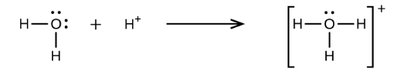
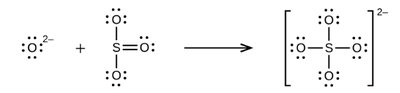
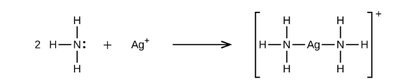
Acid/Base Equilibrium Tables
The dissociation constants for common acids and bases are essential for equilibrium calculations. These tables provide reference values for Ka and Kb at 25°C.
Table: Dissociation Constants for Acids at 25°C
Name | Formula | Ka | Kb |
|---|---|---|---|
Acetic | HC2H3O2 | 1.8 × 10⁻⁵ | 1.0 × 10⁻⁹ |
Benzoic | C6H5COOH | 6.3 × 10⁻⁵ | 1.6 × 10⁻¹⁰ |
Formic | HCOOH | 1.8 × 10⁻⁴ | 5.6 × 10⁻¹¹ |
Hydrochloric | HCl | 1.3 × 10⁶ | 7.7 × 10⁻¹⁹ |
Phosphoric | H3PO4 | 7.5 × 10⁻³ | 4.2 × 10⁻¹² |
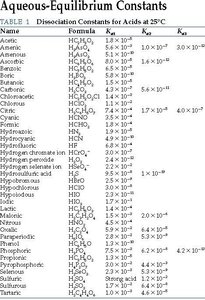
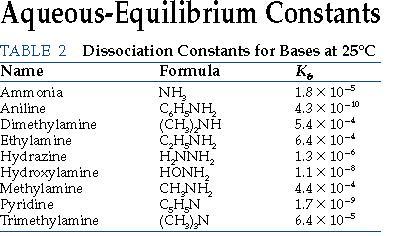
Table: Dissociation Constants for Bases at 25°C
Name | Formula | Kb |
|---|---|---|
Ammonia | NH3 | 1.8 × 10⁻⁵ |
Aniline | C6H5NH2 | 4.3 × 10⁻¹⁰ |
Dimethylamine | (CH3)2NH | 5.4 × 10⁻⁴ |
Ethylamine | C2H5NH2 | 6.4 × 10⁻⁴ |
Trimethylamine | (CH3)3N | 6.4 × 10⁻⁵ |
Examples and Applications
Example: Calculate the pH of a 0.100 M solution of HCl (strong acid):
Example: Calculate the pH of a 0.100 M solution of acetic acid (weak acid): Use ICE table and solve for at equilibrium.
Example: Identify the acid and base in the reaction: NH3 is the base, H+ is the acid.
Acid/Base Structure and Function
The structure of acids and bases influences their strength. For example, electronegativity and bond length affect how easily a proton is donated or accepted.
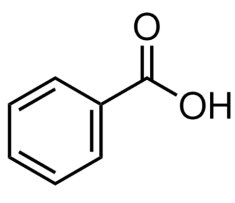
Example: Benzoic acid (C6H5COOH) is a weak acid due to resonance stabilization of its conjugate base.
Polyhydroxy Acids
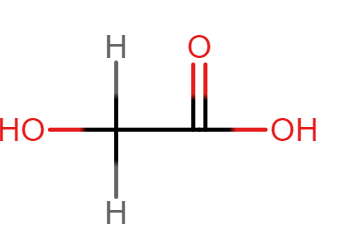
Polyhydroxy acids contain multiple hydroxyl groups and can participate in multiple acid-base reactions.
Summary Table: Acid/Base Classifications
Type | Examples | Characteristic |
|---|---|---|
Strong Acid | HCl, HNO3, HClO4 | Complete dissociation |
Weak Acid | HF, CH3COOH | Partial dissociation |
Strong Base | NaOH, KOH | Complete dissociation |
Weak Base | NH3, C5H5N | Partial dissociation |
Additional info: The notes cover all major aspects of acid/base equilibria, including definitions, calculations, classifications, and reference tables. Images included are directly relevant to the structure, reactions, and equilibrium constants discussed.
