 Indietro
Acid/Base Equilibria I: Study Guide and Reference Tables
Guida di studio - Note intelligenti
 Appunti personalizzati basati sui tuoi materiali, ampliati con definizioni chiave, esempi e contesto.
Acid/Base Equilibria
Introduction to Acid/Base Equilibria
Acid/base equilibria are fundamental to understanding chemical reactions in aqueous solutions. This topic covers the calculation of pH, pOH, and concentrations of hydronium and hydroxide ions, as well as the identification and classification of acids, bases, and their conjugate pairs.
Acidic, Basic, and Neutral Solutions: Determined by the relative concentrations of [H+] and [OH-].
pH and pOH: Logarithmic measures of [H+] and [OH-] respectively.
Equilibrium Constants: Ka for acids, Kb for bases, and Kw for water.
Key Definitions and Concepts
Arrhenius Acid: Produces H+ in water.
Arrhenius Base: Produces OH- in water.
Brønsted-Lowry Acid: Proton donor.
Brønsted-Lowry Base: Proton acceptor.
Lewis Acid: Electron pair acceptor.
Lewis Base: Electron pair donor.
Conjugate Acid/Base Pair: Species differing by one proton.
Amphoteric: Can act as either acid or base (e.g., H2O).
Water Dissociation and Ion Product
Water self-ionizes to produce hydronium and hydroxide ions. The equilibrium constant for this process is Kw.
Equation:
At 25°C:
Relationship: If [H+] increases, [OH-] decreases, and vice versa.
pH and pOH Calculations
The pH and pOH are calculated using the concentrations of H+ and OH- ions:
pH:
pOH:
Relationship: (at 25°C)
Acid and Base Strength
Acids and bases are classified as strong or weak based on their degree of ionization in water.
Strong Acids/Bases: Completely ionize in solution.
Weak Acids/Bases: Partially ionize; equilibrium established.
Ka and Kb: Quantify the strength of acids and bases.
Percent Ionization:
Polyprotic Acids
Polyprotic acids can donate more than one proton. Each dissociation step has its own Ka value.
Example: Sulfuric acid (H2SO4) has two dissociation steps.
First dissociation: Strong acid, complete ionization.
Second dissociation: Weak acid, partial ionization.
Acid-Base Spectator Ions
Spectator ions do not participate in acid-base reactions and remain unchanged in solution.
Examples: Na+, K+, Cl-, NO3-
Lewis Acid/Base Reactions
Lewis acids and bases are defined by their ability to accept or donate electron pairs, expanding the scope of acid-base chemistry beyond aqueous solutions.
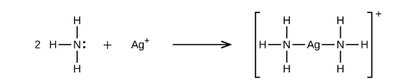
Example: NH3 donates a lone pair to Ag+ to form a complex.
Reference Tables
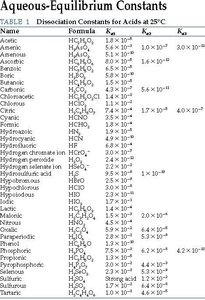
Dissociation Constants for Acids
The table below lists the dissociation constants (Ka) for common acids at 25°C. These values are essential for calculating equilibrium concentrations and predicting acid strength.
Name | Formula | Ka | Kb |
|---|---|---|---|
Acetic | HC2H3O2 | 1.8 × 10⁻⁵ | 1.0 × 10⁻⁹ |
Benzoic | HC7H5O2 | 6.3 × 10⁻⁵ | 1.6 × 10⁻¹⁰ |
Chlorous | HClO2 | 1.1 × 10⁻² | 9.1 × 10⁻⁷ |
Hydrofluoric | HF | 6.8 × 10⁻⁴ | 1.5 × 10⁻¹¹ |
Phosphoric | H3PO4 | 7.5 × 10⁻³ | 4.2 × 10⁻¹² |
Dissociation Constants for Bases
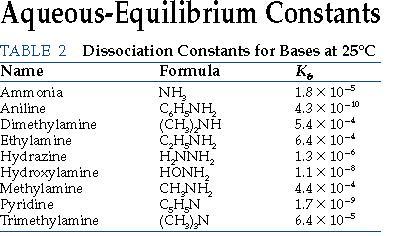
The table below lists the dissociation constants (Kb) for common bases at 25°C. These values are used to determine the strength of bases and their equilibrium behavior in solution.
Name | Formula | Kb |
|---|---|---|
Ammonia | NH3 | 1.8 × 10⁻⁵ |
Aniline | C6H5NH2 | 4.3 × 10⁻¹⁰ |
Dimethylamine | (CH3)2NH | 5.4 × 10⁻⁴ |
Ethylamine | C2H5NH2 | 6.4 × 10⁻⁴ |
Hydrazine | H2N2 | 1.1 × 10⁻⁶ |
Hydroxylamine | HONH2 | 1.1 × 10⁻⁸ |
Methylamine | CH3NH2 | 4.4 × 10⁻⁴ |
Pyridine | C5H5N | 1.7 × 10⁻⁹ |
Trimethylamine | (CH3)3N | 6.4 × 10⁻⁵ |
Examples of Acid/Base Reactions
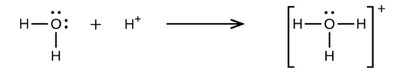
Acid/base reactions can be described using different definitions. The Lewis definition is the most general, encompassing reactions that do not involve proton transfer.
Example 1: Formation of hydronium ion:
Example 2: Lewis base (O2-) reacts with Lewis acid (SO3) to form SO42-.
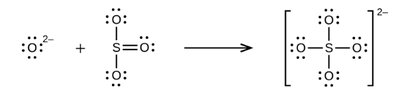
Example 3: Lewis base (NH3) reacts with Lewis acid (Ag+) to form a complex ion.
Structure and Acid Strength
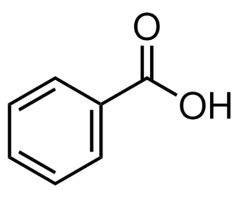
The structure of a molecule affects its acid strength. For example, benzoic acid (shown below) is a weak acid due to resonance stabilization of its conjugate base.
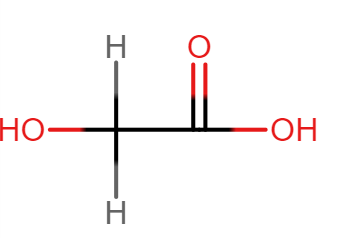
Polyhydroxy acids, such as the one shown below, can have multiple acidic protons.
Summary Table: Acid/Base Classifications
Type | Definition | Example |
|---|---|---|
Arrhenius Acid | Produces H+ in water | HCl |
Arrhenius Base | Produces OH- in water | NaOH |
Brønsted-Lowry Acid | Proton donor | NH4+ |
Brønsted-Lowry Base | Proton acceptor | NH3 |
Lewis Acid | Electron pair acceptor | Ag+ |
Lewis Base | Electron pair donor | NH3 |
Additional info:
Tables are truncated for brevity; refer to original materials for full lists.
Images included only when directly relevant to the explanation of acid/base structure, equilibrium, or reaction mechanism.
