 Indietro
Acid/Base Equilibria I: Study Guide and Reference Tables
Guida di studio - Note intelligenti
 Appunti personalizzati basati sui tuoi materiali, ampliati con definizioni chiave, esempi e contesto.
Acid/Base Equilibria
Introduction to Acid/Base Equilibria
Acid/base equilibria are fundamental to understanding chemical reactions in aqueous solutions. This topic covers the calculation of pH, pOH, and concentrations of hydronium and hydroxide ions, as well as the identification and classification of acids, bases, and their conjugate pairs.
Key Concepts and Definitions
Acid: A substance that donates a proton (H+) in solution. According to Arrhenius, acids increase the concentration of H+ in water; according to Brønsted-Lowry, acids are proton donors; according to Lewis, acids accept electron pairs.
Base: A substance that accepts a proton or donates an electron pair. Arrhenius bases increase OH- concentration; Brønsted-Lowry bases are proton acceptors; Lewis bases donate electron pairs.
Conjugate Acid/Base Pair: Two species that differ by a single proton. The acid donates a proton to become its conjugate base.
Amphoteric: A substance that can act as both an acid and a base (e.g., H2O).
Strong vs. Weak Acids/Bases: Strong acids/bases dissociate completely in water; weak acids/bases only partially dissociate.
Spectator Ions: Ions that do not participate in the acid-base reaction.
Water Dissociation and Ion Product
Water self-ionizes to produce hydronium and hydroxide ions. The equilibrium constant for this process is known as the ion product of water, Kw.
Equation:
At 25°C:
Relationship:
pH and pOH Calculations
The pH and pOH are logarithmic measures of the concentrations of H+ and OH- ions, respectively. They are related by the equation .
pH:
pOH:
Relationship: (at 25°C)
Neutral Solution: M, pH = 7
Acid and Base Strength
The strength of an acid or base is quantified by its dissociation constant: Ka for acids and Kb for bases. Strong acids/bases have large Ka/Kb values, while weak acids/bases have small values.
Acid Dissociation:
Base Dissociation:
Relationship:
Polyprotic Acids
Polyprotic acids can donate more than one proton. Each dissociation step has its own Ka value, with the first usually being the largest.
Example: Sulfuric acid (H2SO4) dissociates in two steps.
Lewis Acids and Bases
The Lewis definition expands acid/base chemistry to include electron pair transfer. Lewis acids accept electron pairs, while Lewis bases donate them.
Example: is a Lewis acid; is a Lewis base.
Acid/Base Equilibrium Tables
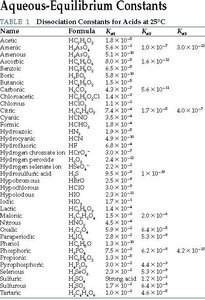
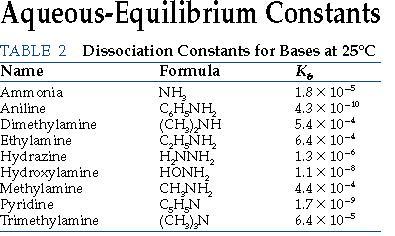
Reference tables provide dissociation constants for common acids and bases, which are essential for equilibrium calculations.
Name | Formula | Ka | Kb |
|---|---|---|---|
Acetic | HC2H3O2 | 1.8 × 10⁻⁵ | 1.0 × 10⁻⁹ |
Benzoic | C6H5COOH | 6.3 × 10⁻⁵ | 1.6 × 10⁻¹⁰ |
Ammonia | NH3 | - | 1.8 × 10⁻⁵ |
Aniline | C6H5NH2 | - | 4.3 × 10⁻¹⁰ |
Hydrazine | H2NNH2 | - | 1.1 × 10⁻⁶ |
Trimethylamine | (CH3)3N | - | 6.4 × 10⁻⁵ |
Hydroxylamine | HONH2 | - | 1.1 × 10⁻⁸ |
Examples of Acid/Base Reactions
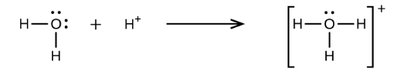
Hydronium Formation:
Lewis Acid/Base Reaction:
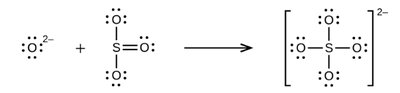
Coordination Complex Formation:
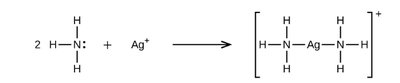
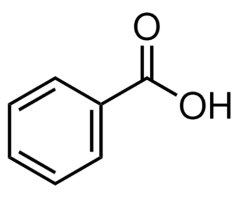
Structure and Acid Strength
The molecular structure of acids and bases affects their strength. For example, electronegativity and bond length influence how easily a proton dissociates.
Example: Benzoic acid (C6H5COOH) is a weak acid due to resonance stabilization of its conjugate base.
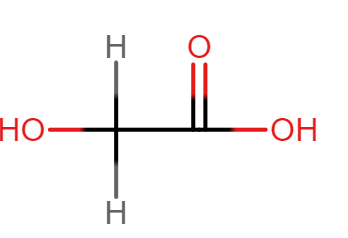
Polyprotic Acid Example
Polyprotic acids, such as oxalic acid, can donate more than one proton. The dissociation occurs in steps, each with its own equilibrium constant.
Example: Oxalic acid (HOOC-COOH) is a diprotic acid.
Summary Table: Acid/Base Classifications
Type | Definition | Example |
|---|---|---|
Arrhenius Acid | Produces H+ in water | HCl |
Arrhenius Base | Produces OH- in water | NaOH |
Brønsted-Lowry Acid | Proton donor | NH4+ |
Brønsted-Lowry Base | Proton acceptor | NH3 |
Lewis Acid | Electron pair acceptor | Ag+ |
Lewis Base | Electron pair donor | NH3 |
Additional info:
Acid/base equilibria are temperature dependent; the value of Kw changes with temperature, affecting the definition of neutral, acidic, and basic solutions.
Successive approximations and ICE tables are used to solve equilibrium problems for weak acids and bases.
Percent ionization is a useful measure for weak acids and bases, indicating the fraction of molecules that dissociate.
