 Indietro
Acids, Bases, Solubility, and Oxidation Numbers: Essential Concepts for General Chemistry
Guida di studio - Note intelligenti
 Appunti personalizzati basati sui tuoi materiali, ampliati con definizioni chiave, esempi e contesto.
Acids and Bases
Bronsted-Lowry Acids and Bases
The Bronsted-Lowry theory defines acids as proton (H+) donors and bases as proton acceptors. This concept is fundamental for understanding acid-base reactions in aqueous solutions.
Weak Acid Example: Acetic acid (CH3COOH) is a weak acid. It partially dissociates in water:
Weak Base Example: Ammonia (NH3) is a weak base. It reacts with water to produce ammonium and hydroxide ions:
Strong Acids and Bases
Strong acids and bases dissociate completely in water, making them important in chemical reactions and calculations.
Strong Acids: Hydrochloric acid (HCl), Hydrobromic acid (HBr), Hydroiodic acid (HI), Nitric acid (HNO3), Sulfuric acid (H2SO4), Perchloric acid (HClO4), Chloric acid (HClO3)
Strong Bases: Group 1A metal hydroxides (LiOH, NaOH, KOH, RbOH, CsOH), Heavy group 2A metal hydroxides (Ca(OH)2, Sr(OH)2, Ba(OH)2)
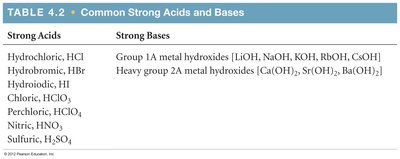
Mnemonic for Strong Acids: "So I Brought No Clean Clothes" helps recall: H2SO4, HI, HBr, HNO3, HCl, HClO3, HClO4.
Solubility Rules
General Solubility Guidelines
Solubility rules help predict whether a compound will dissolve in water, which is crucial for understanding precipitation reactions and solution chemistry.
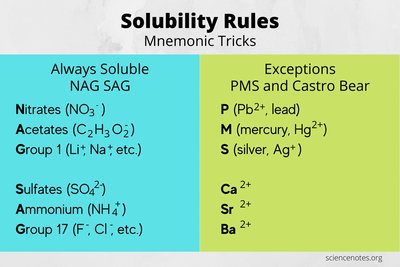
Always Soluble: Compounds containing alkali metals (Li+, Na+, K+), ammonium (NH4+), nitrates (NO3-), acetates (C2H3O2- or CH3COO-), halogens (Cl-, Br-, I-)
Exceptions: Halides are insoluble with Ag+, Hg22+, or Pb2+
Oxidation Numbers
Rules for Assigning Oxidation Numbers
Oxidation numbers are used to track electron transfer in chemical reactions, especially in redox processes.
Elements and diatomics: Oxidation number is 0.
Ions: Oxidation number equals the ion's charge.
Metals: Oxidation number equals the metal's charge.
Neutral compounds: Sum of oxidation numbers is 0.
Polyatomic ions: Sum of oxidation numbers equals the ion's charge.
Nonmetals:
Oxygen: Usually -2, except in peroxides (-1).
Hydrogen: -1 when bonded to metals, +1 when bonded to nonmetals.
Fluorine: Always -1.
Other halogens: -1 when negative; can be positive with oxygen or fluorine.
Gas Reactions
Overview
Gas reactions often involve acids and bases, solubility, and oxidation numbers. Understanding these concepts is essential for predicting products and balancing equations in gas-phase reactions.
Example: Reaction of ammonia with water produces ammonium and hydroxide ions, demonstrating gas solubility and acid-base behavior.
Summary Table: Solubility Rules
Purpose
This table summarizes the solubility rules and their exceptions for quick reference.
Always Soluble | Exceptions |
|---|---|
Nitrates (NO3-) Acetates (C2H3O2-) Group 1 (Li+, Na+, etc.) Sulfates (SO42-) Ammonium (NH4+) Group 17 (F-, Cl-, etc.) | P (Pb2+, lead) M (mercury, Hg2+) S (silver, Ag+) Ca2+ Sr2+ Ba2+ |
Summary Table: Strong Acids and Bases
Purpose
This table lists the most common strong acids and bases encountered in general chemistry.
Strong Acids | Strong Bases |
|---|---|
Hydrochloric, HCl Hydrobromic, HBr Hydroiodic, HI Chloric, HClO3 Perchloric, HClO4 Nitric, HNO3 Sulfuric, H2SO4 | Group 1A metal hydroxides (LiOH, NaOH, KOH, RbOH, CsOH) Heavy group 2A metal hydroxides (Ca(OH)2, Sr(OH)2, Ba(OH)2) |
Additional info: Tables and mnemonics are expanded for clarity and completeness. All key rules and exceptions are included for exam preparation.
