 Indietro
Analytical Chemistry: Titrimetric Methods and Calculations
Guida di studio - Note intelligenti
 Appunti personalizzati basati sui tuoi materiali, ampliati con definizioni chiave, esempi e contesto.
Analytical Chemistry
Definition and Applications
Analytical chemistry is the branch of chemistry concerned with the identification and quantification of chemical components in substances. It is essential in fields such as pharmaceuticals, environmental science, forensic science, metallurgy, and medicine.
Qualitative analysis: Identifies which components are present in a sample.
Quantitative analysis: Measures the proportions of each component present.
Applications: Determining purity, diagnosing illness, forensic identification, environmental monitoring, and drug formulation.
Key Terminology
Component: A chemical compound, ion, or element in the material being analyzed.
Sample: A representative portion of the material for analysis.
Analyte: The specific component to be measured or identified.
Interference: Any process or component that causes inaccurate analytical results.
Types of Chemical Analysis
Chemical analyses are classified by the measurement process:
Gravimetric: Measures mass of analyte or its compound.
Titrimetric: Measures quantity of reagent reacting with analyte (also called volumetric analysis).
Spectroscopic: Measures intensity of electromagnetic radiation absorbed/emitted by analyte.
Electrochemical: Measures current, voltage, or conductivity due to analyte.
Radiochemical: Measures nuclear radiation emitted by analyte.
Precision and Accuracy
Accuracy: Closeness of a measurement to the true value.
Precision: Closeness of repeated measurements to each other.
Results may be accurate but not precise, precise but not accurate, both, or neither.
Titrimetric Analysis
Principle and Process
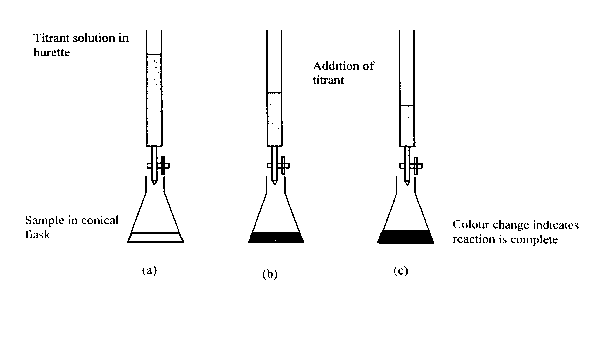
Titrimetric analysis involves adding a solution of known concentration (titrant) to a sample solution (titrand) until the reaction is complete. The volume of titrant used allows calculation of analyte concentration.
Titrant: The reagent in the burette.
Titrand: The analyte in the sample.
Equivalence point: The point where the exact amount of titrant has reacted with all titrand present.
Types of Titration Reactions
Acid-base reactions: Change in pH as reaction proceeds.
Precipitation reactions: Formation of a solid.
Complexation reactions: Formation of a complex.
Redox reactions: Electron transfer between titrant and titrand.
Characteristics of Titration Reactions
Should be fast, complete, and have no alternative reactions.
Reversible or parallel reactions reduce accuracy.
Finding the Equivalence Point
Primary reagent indication: Color change of reactant/product indicates equivalence point.
Ancillary reagent indication: Use of indicators (dyes) that change color near equivalence point.
Instrumental indication: Conductimetric or potentiometric methods to estimate equivalence point.
Acid-Base Titrations
Indicators and Instrumental Methods
Acid-base titrations are followed by measuring pH or using indicators. The choice of indicator depends on the strength of acids and bases involved.
pH calculation:
Indicators must have an end point close to the equivalence point.
Reaction | Example | pH at Equivalence | Suitable Indicator | pH of End Point | Color Change |
|---|---|---|---|---|---|
Strong acid / Strong base | HCl + NaOH | ~7 | Bromothymol blue | 6.9 | Yellow (acid) / Blue (alkali) |
Strong acid / Weak base | HCl + NH4OH | <7 | Methyl orange | 3.5 | Red (acid) / Yellow (alkali) |
Weak acid / Strong base | CH3COOH + NaOH | >7 | Phenolphthalein | 9.5 | Colorless (acid) / Red (alkali) |
Weak acid / Weak base | CH3COOH + NH4OH | Reversible | Unsuitable | - | - |
Precipitation Titrations
Silver Nitrate Titration
Precipitation titrations involve the formation of an insoluble product. The silver nitrate titration is commonly used to determine chloride concentration.
Reaction:
Indicator: Potassium chromate, which turns red in the presence of excess silver ions.
Complexometric Titrations
Principle and Indicators
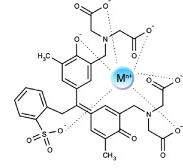
Complexometric titrations involve the reaction of metal cations with ligands to form complexes. EDTA is a common titrant.
Complex: Compound with a metal atom surrounded by ligands in a defined geometry.
Ligand: Molecule bound to a metal center.
EDTA: Ethylene Diamine Tetraacetic Acid, forms strong complexes with metals of higher charge.
Indicator | Preferred pH Range | Color Change | Titrands |
|---|---|---|---|
Eriochrome black | Alkaline (pH 10) | Blue (uncomplexed) / Red (complexed) | Mg2+, Sr2+, Ca2+ |
Xylenol orange | Acidic (pH 5) | Yellow (uncomplexed) / Red (complexed) | Zn2+, Pb2+, Cd2+, Th4+, Hg2+, Ni2+, Cu2+, Al3+, Fe2+, Fe3+ |
Titration Calculations
Molarity and Concentration
Concentration (C): (units: g dm-3)
Molarity (M): (units: mol dm-3)
Number of moles (n):
Conversion:
Stoichiometry in Titrations
Balanced chemical equation:
Stoichiometric coefficients (a, b) are essential for calculations.
Calculating Molarity from Titration Results
General equation:
Where , are molarities, , are volumes, , are stoichiometric coefficients.
Calculating Weights and Percentages
Percentage of analyte:
Different methods: Direct titration or aliquot titration, with calculation adjustments.
Redox Titrations
Principle and Terminology
Redox titrations involve electron transfer between reductant and oxidant. Each redox couple is described by a half-reaction.
Oxidation: Loss of electrons.
Reduction: Gain of electrons.
Oxidant: Removes electrons from reductant; is itself reduced.
Reductant: Gives electrons to oxidant; is itself oxidized.
Balancing Redox Reactions
Balance each half-reaction for atoms and charge.
Combine half-reactions so electrons cancel.
Indicators for Redox Titrations
Titrant | Indicator | Color Change |
|---|---|---|
KMnO4 | None | Colorless to purple |
I2 | Starch | Colorless to blue |
Ce4+ | Iron(II) tri-o-phenanthroline | Red to pale blue |
Permanganate and Iodine Titrations
Permanganate: Used as oxidant, reacts differently at different pH.
Iodine: Can be used as oxidant or reductant; often paired with thiosulfate.
Summary Table: Analytical Chemistry Terms
Term | Definition |
|---|---|
Component | Chemical compound, ion, or element in material |
Sample | Representative portion for analysis |
Analyte | Component to be measured or identified |
Interference | Process/component causing inaccurate results |
Additional info: These notes expand on brief points in the original material, providing full academic context, definitions, and examples for clarity and completeness.
