 Indietro
AP Chemistry Reactions & Particle Diagrams Study Guide
Guida di studio - Note intelligenti
 Appunti personalizzati basati sui tuoi materiali, ampliati con definizioni chiave, esempi e contesto.
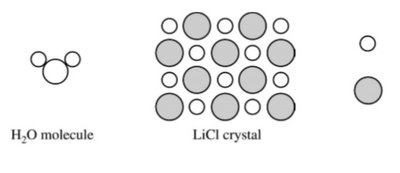
Q2. Determine the identity of each particle below. Explain your reasoning.
Background
Topic: Chemical Structure and Ionic Compounds
This question tests your ability to interpret particle diagrams and identify molecular and ionic species based on their visual representation. Understanding how to distinguish between molecules and ionic crystals is fundamental in General Chemistry.
Key Terms and Concepts:
Molecule: A group of atoms bonded together, representing the smallest fundamental unit of a chemical compound.
Ionic Crystal: A solid structure formed by the regular arrangement of ions, held together by ionic bonds.
LiCl: Lithium chloride, an ionic compound composed of Li+ and Cl- ions.
H2O: Water, a molecular compound with a bent structure.
Step-by-Step Guidance
Examine the leftmost particle: It consists of three circles, two smaller and one larger, arranged in a bent shape. This is characteristic of a water molecule, H2O.
Look at the central structure: It shows alternating large and small circles in a grid-like pattern. This is typical of an ionic crystal lattice, such as LiCl, where the larger circles represent Cl- ions and the smaller circles represent Li+ ions.
Analyze the rightmost particles: There are two separate circles, one larger and one smaller. These likely represent individual ions, possibly Li+ and Cl- after dissociation.
Use your knowledge of ionic and molecular structures to match the visual features to the chemical identities.
Try solving on your own before revealing the answer!
Final Answer:
The leftmost particle is a water molecule (H2O), the central structure is a LiCl crystal (with Li+ and Cl- ions arranged in a lattice), and the rightmost particles are individual Li+ and Cl- ions. The reasoning is based on the arrangement and size of the circles, which correspond to the typical representations of these species in particle diagrams.
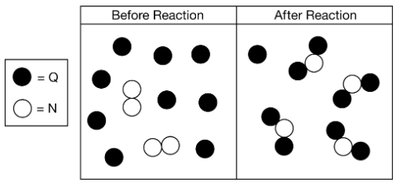
Q5a. Write the balanced chemical equation that takes place between Q and N (refer to the particle diagram).
Background
Topic: Chemical Reactions and Stoichiometry
This question tests your ability to interpret particle diagrams and translate them into balanced chemical equations. Understanding how to identify reactants and products visually is key in General Chemistry.
Key Terms and Concepts:
Reactant: A substance that undergoes change during a reaction.
Product: A substance formed as a result of a chemical reaction.
Balanced Equation: An equation where the number of atoms for each element is equal on both sides.
Step-by-Step Guidance
Observe the 'Before Reaction' box: Identify the number and type of Q and N particles present.
Examine the 'After Reaction' box: Notice how Q and N particles are now paired, indicating a new compound has formed.
Determine the ratio in which Q and N combine based on the diagram.
Set up the chemical equation using the visual information, making sure to balance the number of Q and N particles.
Try solving on your own before revealing the answer!
Final Answer:
The balanced chemical equation is: Q + N2 → QN2. The diagram shows Q particles combining with N2 pairs to form a new compound, QN2, with the correct stoichiometric ratio.
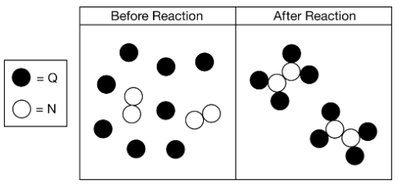
Q6b. A student claims that the particle diagram represents a perfect stoichiometric ratio. Do you agree or disagree? Support your answer by referring to the particle diagram.
Background
Topic: Stoichiometry and Limiting Reactants
This question tests your understanding of stoichiometric ratios and how to identify them in particle diagrams. Recognizing perfect ratios is important for predicting reaction completeness.
Key Terms and Concepts:
Stoichiometric Ratio: The exact ratio of reactants needed for complete reaction with no excess.
Limiting Reactant: The reactant that is completely consumed first, limiting the amount of product formed.
Step-by-Step Guidance
Count the number of Q and N particles in the 'Before Reaction' box.
Observe the 'After Reaction' box: Check if all Q and N particles are used up, with none left over.
Compare the ratio of Q to N in the reactants to the ratio required by the balanced equation.
Assess whether the reaction goes to completion with no excess reactant, indicating a perfect stoichiometric ratio.
Try solving on your own before revealing the answer!
Final Answer:
Agree: The diagram shows that all Q and N particles are used up to form the product, with none left over. This indicates a perfect stoichiometric ratio, as the reactants are present in the exact proportions needed for complete reaction.
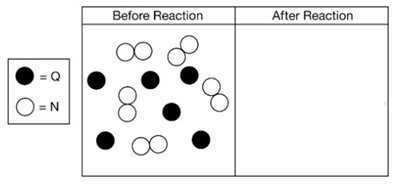
Q7. Shown below are the reactants for the unbalanced chemical reaction Q + N2 → NQ. Draw the particles in the “After Reaction” box.
Background
Topic: Chemical Reactions and Particle Diagrams
This question tests your ability to visualize the outcome of a chemical reaction based on the reactants provided. Drawing particle diagrams helps reinforce understanding of stoichiometry and product formation.
Key Terms and Concepts:
Reactant: The starting substances in a chemical reaction.
Product: The substances formed as a result of the reaction.
Particle Diagram: A visual representation of molecules and ions before and after a reaction.
Step-by-Step Guidance
Identify the number of Q and N2 particles in the 'Before Reaction' box.
Recall the product formula: NQ. Each Q reacts with an N2 pair to form NQ.
Determine how many NQ particles can be formed based on the available Q and N2 particles.
Draw the 'After Reaction' box, showing the NQ particles and any leftover reactants if present.
Try solving on your own before revealing the answer!
Final Answer:
In the 'After Reaction' box, you should draw NQ particles formed from the combination of Q and N2 reactants. The number of NQ particles corresponds to the limiting reactant, and any excess reactant should be shown as leftover particles.
