 Indietro
Aqueous Chemistry and Periodic Properties: Study Guide for General Chemistry
Guida di studio - Note intelligenti
 Appunti personalizzati basati sui tuoi materiali, ampliati con definizioni chiave, esempi e contesto.
Chapter 4: Reactions in Aqueous Solution
General Properties of Aqueous Solutions
Aqueous solutions are central to many chemical reactions, especially in biological and environmental contexts. Understanding their properties is essential for predicting and explaining chemical behavior.
Solution: A homogeneous mixture of two or more substances.
Solvent: The component present in the greatest molar amount (in aqueous solutions, this is water).
Solute: Any component in a solution other than the solvent.
Dissolution: The process by which solutes disperse in the solvent.
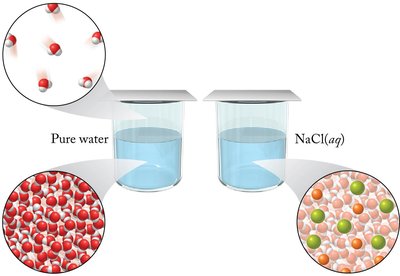
Example: Pure water contains only H2O molecules, while NaCl(aq) contains Na+ and Cl- ions dispersed throughout the solution.
Types of Solutions: Saturated, Unsaturated, and Supersaturated
The solubility of a solute in water depends on temperature and the nature of the solute.
Saturated Solution: Contains the maximum concentration of solute possible at a given temperature.
Supersaturated Solution: Contains more solute than predicted to be soluble at a given temperature.
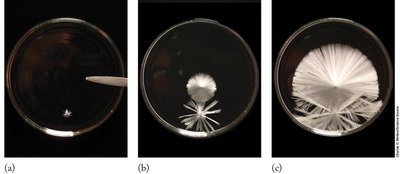
Example: Supersaturated solutions can form precipitates when disturbed.
Electrolytes and Nonelectrolytes
Electrolytes and nonelectrolytes differ in their ability to conduct electricity in solution.
Electrolyte: A substance whose aqueous solutions contain ions and conduct electricity (e.g., NaCl).
Nonelectrolyte: A substance that does not form ions in solution and does not conduct electricity (e.g., C12H22O11).
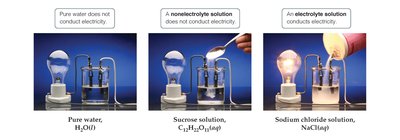
Example: Pure water and sucrose solution do not conduct electricity, while NaCl solution does.
How Ionic Compounds Dissolve in Water
Ionic compounds dissociate into ions when dissolved in water, a process stabilized by solvation.
Water molecules surround and separate Na+ and Cl- ions from solid NaCl.
Solvated ions are denoted as Na+(aq) and Cl-(aq).
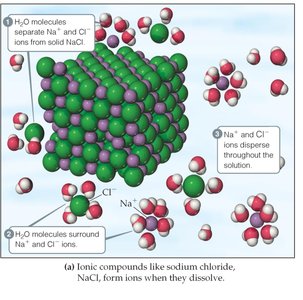
Example: NaCl(s) → Na+(aq) + Cl-(aq)
Polarity of Water
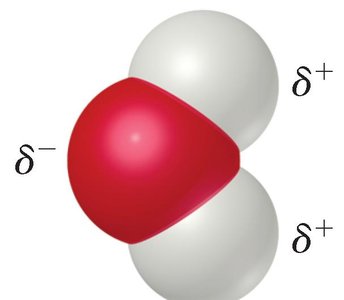
Water is a polar molecule, which enables it to dissolve many ionic and polar substances.
The oxygen atom has a partial negative charge (δ-), while the hydrogen atoms have partial positive charges (δ+).
How Molecular Compounds Dissolve in Water
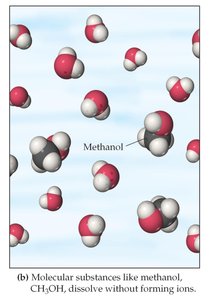
Molecular compounds may dissolve without forming ions, making most of them nonelectrolytes. However, some, like acids, ionize in water.
Methanol (CH3OH) dissolves as intact molecules.
Acids like HCl ionize to form H+ and Cl- ions.
Case Study: Flint Water Crisis
The Flint Water Crisis illustrates the importance of aqueous chemistry in environmental health.
High chloride ion levels from de-icing salt accelerated pipe corrosion.
Low pH dissolved protective layers, increasing lead ion concentration in water.

Precipitation Reactions
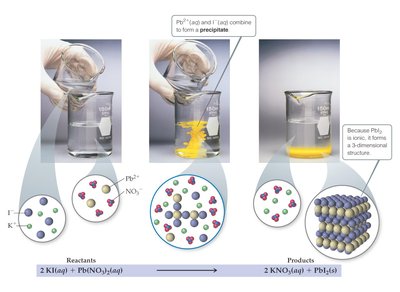
Precipitation reactions occur when soluble reactants form an insoluble product (precipitate).
Solubility guidelines help predict whether a precipitate will form.
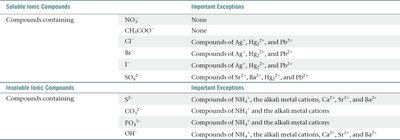
Ionic Equations and Net Ionic Equations
Reactions in aqueous solution are often represented by molecular, complete ionic, and net ionic equations.
Molecular Equation: Shows chemical formulas without indicating ionic character.
Complete Ionic Equation: Shows all soluble strong electrolytes as ions.
Net Ionic Equation: Includes only ions and molecules directly involved in the reaction.
Acids, Bases, and Neutralization Reactions
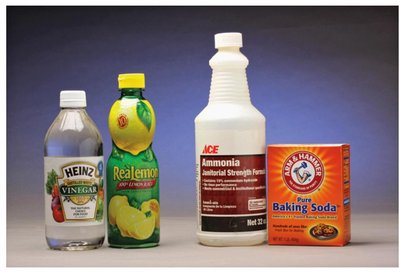
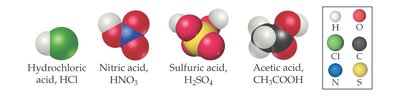
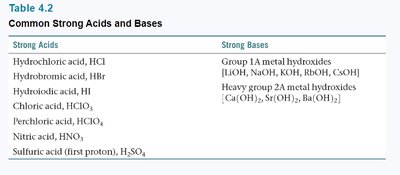
Acids and bases are common electrolytes and participate in neutralization reactions to form salts and water.
Acid: Ionizes in aqueous solution to form H+ ions.
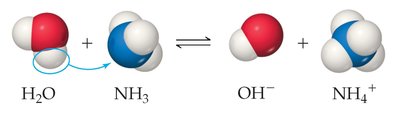
Base: Accepts H+ ions and produces OH- ions in water.
Oxidation-Reduction (Redox) Reactions
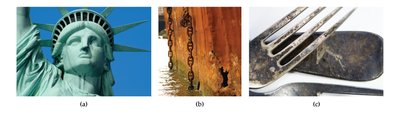
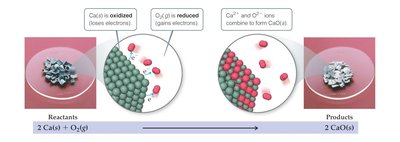
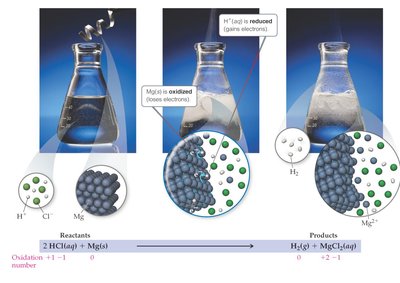
Redox reactions involve the transfer of electrons and are fundamental to processes such as corrosion and battery operation.
Oxidation: Loss of electrons; substance becomes more positively charged.
Reduction: Gain of electrons; substance becomes more negatively charged.
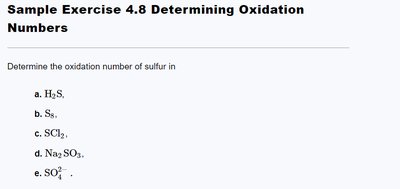
Assigning Oxidation Numbers
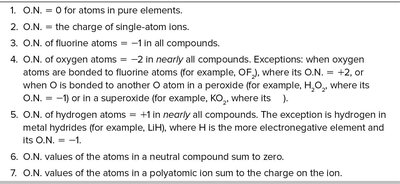
Oxidation numbers help track electron transfer in redox reactions.
Rules for assigning oxidation numbers include values for pure elements, ions, and common elements like oxygen and hydrogen.
Activity Series of Metals
The activity series ranks metals by their ease of oxidation, predicting whether a redox reaction will occur.
Metals higher in the series are more easily oxidized.
Chapter 7: Periodic Properties of the Elements
Development of the Periodic Table
The periodic table organizes elements by increasing atomic number and recurring chemical properties.
Periodic trends arise from electron configuration and effective nuclear charge.
Effective Nuclear Charge and Shielding
Effective nuclear charge (Zeff) is the net positive charge experienced by an electron in a many-electron atom.
Core electrons shield outer electrons from the nucleus, reducing Zeff.
Zeff increases across a period, leading to smaller atomic radii and higher ionization energies.
Trends in Atomic and Ionic Size
Atomic and ionic sizes vary predictably across periods and down groups.
Atomic radius increases down a group (higher n values).
Atomic radius decreases across a period (increasing Zeff).
Cations are smaller, anions are larger than their parent atoms.
Ionization Energy and Electron Affinity
Ionization energy is the energy required to remove an electron; electron affinity is the energy change when an atom gains an electron.
Ionization energy increases across a period and decreases down a group.
Electron affinity is most negative for halogens.
Metals, Nonmetals, and Metalloids
Elements are classified based on their physical and chemical properties.
Metals: Conduct electricity, malleable, ductile.
Nonmetals: Poor conductors, brittle.
Metalloids: Intermediate properties.
Sample Exercises and Applications
Practice ranking atoms and ions by size, predicting trends in ionization energy, and identifying isoelectronic species.
Additional info:
Context and examples were expanded for clarity and completeness.
Images were included only when directly relevant to the explanation.
