 Indietro
Aqueous Equilibria: Acid-Base and Solubility Equilibria
Guida di studio - Note intelligenti
 Appunti personalizzati basati sui tuoi materiali, ampliati con definizioni chiave, esempi e contesto.
Aqueous Equilibria
Introduction to Chemical Equilibrium
Chemical equilibrium occurs when the rates of the forward and reverse reactions are equal, resulting in constant concentrations of reactants and products. In aqueous solutions, equilibrium concepts are essential for understanding acid-base and solubility phenomena.
Equilibrium Constant (K): Describes the ratio of product to reactant concentrations at equilibrium.
Kc and Kp: Kc uses concentrations (mol/L), Kp uses partial pressures (atm).
Reaction Quotient (Q): Used to determine the direction a reaction will proceed to reach equilibrium.
ICE Tables: Used to organize initial, change, and equilibrium concentrations for equilibrium calculations.
Acid–Base Equilibria
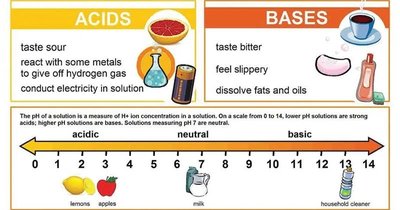
Definitions of Acids and Bases
Acids and bases are fundamental to aqueous equilibria. Their definitions have evolved to encompass a broader range of chemical behavior.
Arrhenius Theory:
Acid: Increases H+ (hydrogen ion) concentration in water.
Base: Increases OH− (hydroxide ion) concentration in water.
Example: HCl(aq) → H+(aq) + Cl−(aq); NaOH(aq) → Na+(aq) + OH−(aq)
Brønsted–Lowry Theory:
Acid: Proton (H+) donor.
Base: Proton (H+) acceptor.
Amphiprotic/Amphoteric: Substances that can act as either acid or base (e.g., H2O, HCO3−).
Conjugate Acid–Base Pairs
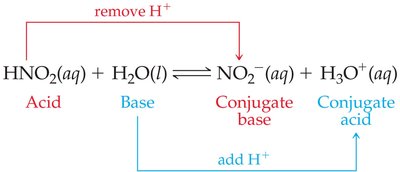
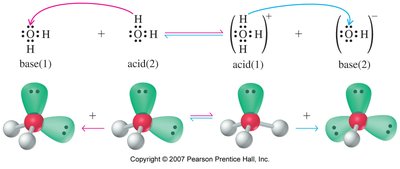
Every acid-base reaction involves the transfer of a proton, resulting in the formation of conjugate acid-base pairs. A conjugate acid is formed when a base gains a proton, and a conjugate base is formed when an acid loses a proton.
Identify pairs that differ by one H+.
Each reaction has two conjugate acid-base pairs.
Example: HNO2(aq) + H2O(l) ⇌ NO2−(aq) + H3O+(aq)
Examples of Conjugate Acid–Base Pairs
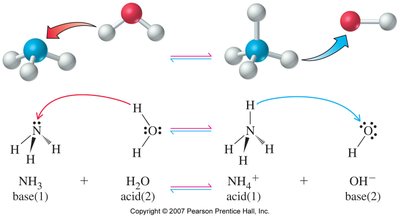
Ammonia and Water: NH3 + H2O ⇌ NH4+ + OH−
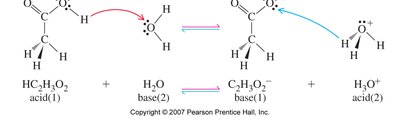
Acetic Acid and Water: CH3COOH + H2O ⇌ CH3COO− + H3O+
Water as Amphoteric: H2O can act as both acid and base.
Relative Strengths of Acids and Bases
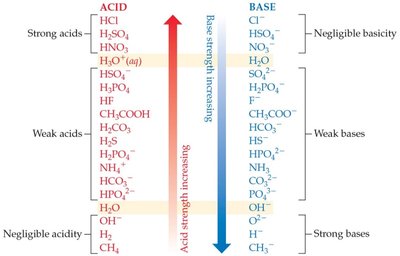
The strength of an acid or base is determined by its tendency to donate or accept protons. Strong acids/bases ionize completely in water, while weak acids/bases only partially ionize.
Stronger acids have weaker conjugate bases, and vice versa.
Species between H3O+ and OH− behave as weak acids or bases in water.
Strong and Weak Electrolytes
Electrolytes are substances that conduct electricity in solution due to ionization. Strong acids and bases ionize completely, while weak acids and bases only partially ionize, establishing equilibrium.
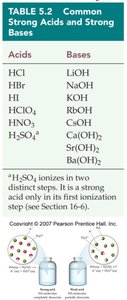
Strong Acids: HCl, HBr, HI, HNO3, H2SO4, HClO3
Strong Bases: Alkali metal and heavier alkaline earth metal hydroxides (e.g., NaOH, KOH, Ca(OH)2)
Weak Acids: HF, CH3COOH, H2CO3
Weak Bases: NH3, CH3NH2, C5H5N
Autoionization of Water and the Ion Product
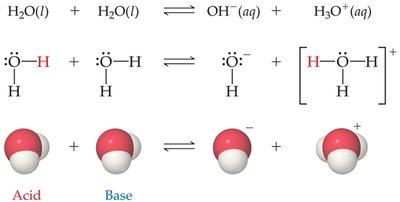
Autoionization of Water
Water can act as both an acid and a base, undergoing autoionization to produce hydronium and hydroxide ions. The equilibrium constant for this process is the ion product constant for water, Kw.
At 25°C,
Neutral solution: M
pH and pOH Scales
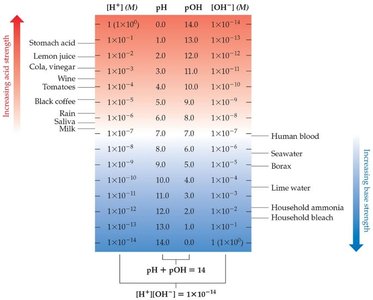
The pH scale is a logarithmic measure of the hydronium ion concentration, while pOH measures hydroxide ion concentration. The two are related by the ion product of water.
(at 25°C)
Calculating pH and Related Quantities
pH calculations are central to acid-base chemistry. They involve converting between concentration and pH, and using equilibrium constants to solve for unknowns.
Given [H3O+], calculate pH:
Given pH, calculate [H3O+]:
Given [OH−], calculate pOH and then pH: ,
Acid and Base Strength: Ka and Kb
Acid and Base Dissociation Constants
The strength of weak acids and bases is quantified by their dissociation constants, Ka for acids and Kb for bases. Larger values indicate stronger acids or bases.
Relationship:
Logarithmic form: , , at 25°C
ICE Tables and Equilibrium Calculations
ICE tables (Initial, Change, Equilibrium) are used to systematically solve equilibrium problems involving weak acids and bases.
Write the balanced equation and Ka or Kb expression.
Set up the ICE table and solve for unknowns.
Calculate pH or pOH as needed.
Percent Ionization
Percent ionization indicates the fraction of acid or base molecules that ionize in solution, reflecting their strength.
Higher percent ionization means a stronger acid or base.
Salts and Hydrolysis
Acid–Base Properties of Salts
When salts dissolve in water, their constituent ions may react with water (hydrolysis), affecting the pH of the solution.
Strong acid + strong base: Neutral solution
Strong acid + weak base: Acidic solution
Weak acid + strong base: Basic solution
Weak acid + weak base: pH depends on relative Ka and Kb
Polyprotic Acids
Stepwise Ionization
Polyprotic acids have more than one ionizable proton, and each ionization step has its own dissociation constant (Ka,1, Ka,2, ...). The first ionization is always the strongest.
Example: Phosphoric Acid (H3PO4):
;
;
;
Summary Table: Common Strong Acids and Bases
Acids | Bases |
|---|---|
HCl | LiOH |
HBr | NaOH |
HI | KOH |
HClO3 | RbOH |
HNO3 | CsOH |
H2SO4 | Ca(OH)2 |
Sr(OH)2 | |
Ba(OH)2 |
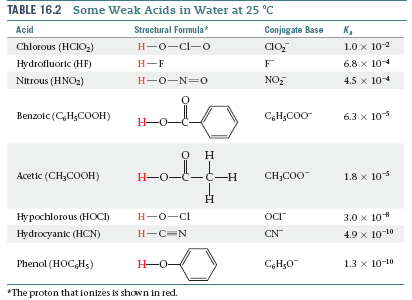
Summary Table: Some Weak Acids and Their Ka Values
Acid | Conjugate Base | Ka |
|---|---|---|
Chlorous (HClO2) | ClO2− | 1.0 × 10⁻² |
Hydrofluoric (HF) | F− | 6.8 × 10⁻⁴ |
Nitrous (HNO2) | NO2− | 4.5 × 10⁻⁴ |
Benzoic (C6H5COOH) | C6H5COO− | 6.3 × 10⁻⁵ |
Acetic (CH3COOH) | CH3COO− | 1.8 × 10⁻⁵ |
Hypochlorous (HOCl) | OCl− | 3.0 × 10⁻⁸ |
Hydrocyanic (HCN) | CN− | 4.9 × 10⁻¹⁰ |
Phenol (HOC6H5) | C6H5O− | 1.3 × 10⁻¹⁰ |
Practice Problems
Calculate the pH of a solution given [H3O+].
Determine Ka or Kb from pH and concentration data using ICE tables.
Identify conjugate acid-base pairs in reactions.
Predict the pH of salt solutions based on their constituent ions.
Key Equations
(at 25°C)
