 Indietro
Aqueous Solutions: Molarity, Dilution, and Titration
Guida di studio - Note intelligenti
 Appunti personalizzati basati sui tuoi materiali, ampliati con definizioni chiave, esempi e contesto.
Aqueous Reactions and Solution Concentration
Molecular, Complete Ionic, and Net Ionic Equations
Chemical reactions in aqueous solutions can be represented in several ways to highlight different aspects of the process.
Molecular Equation: Shows the complete, neutral formulas for every compound in the reaction, as if all substances exist as molecules.
Complete Ionic Equation: Represents all strong electrolytes as their component ions, showing how they actually exist in solution.
Net Ionic Equation: Includes only the species that undergo a chemical change, omitting spectator ions.
Example: The reaction between sodium chloride and silver nitrate in water can be written as:
Molecular:
Complete Ionic:
Net Ionic:
Solution Concentration: Molarity
Definitions and Concepts
Solutions are homogeneous mixtures consisting of a solvent (majority component) and a solute (minority component). When water is the solvent, the solution is called aqueous. The concentration of a solution quantifies the amount of solute relative to the solvent.
Molarity (M): The most common unit of concentration, defined as moles of solute per liter of solution.
The formula for molarity is:
Example: A solution containing 0.5 mol NaCl in 1.0 L of water has a molarity of 0.5 M.
Concentrated vs. Dilute Solutions
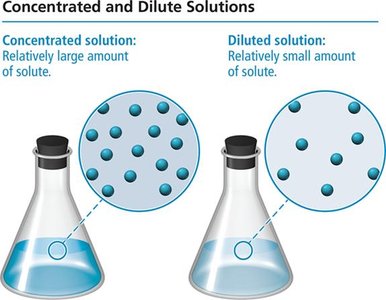
A concentrated solution contains a relatively large amount of solute, while a dilute solution contains a small amount of solute.
Laboratory Equipment for Measuring Volume
Common Glassware
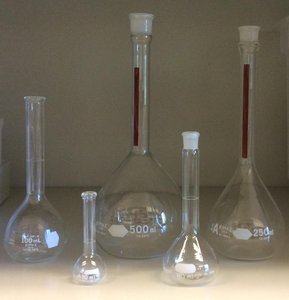
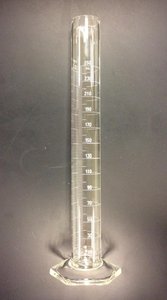
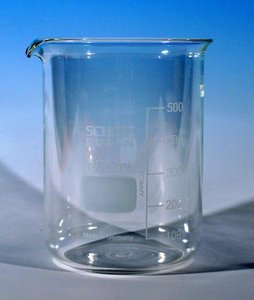
Accurate measurement of liquid volumes is essential in preparing solutions of known concentration. Common laboratory glassware includes:
Volumetric Flasks: Used to prepare solutions of precise volumes.
Graduated Cylinders: Used for measuring approximate volumes of liquids.
Beakers: Used for mixing and rough volume measurements.
Pipettes: Used to deliver precise volumes of liquids.
Preparing a Solution of Known Molarity
Step-by-Step Method
To prepare a solution of known molarity:
Weigh out a known mass of solute (to determine moles).
Add the solute to a volumetric flask.
Partially fill the flask with solvent and swirl to dissolve the solute completely.
Add solvent up to the calibration mark on the neck of the flask.
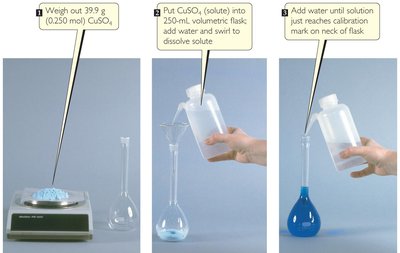
Example: To prepare 250 mL of 0.250 M CuSO4, weigh 9.98 g of CuSO4, dissolve in water, and dilute to 250 mL.
Dilution of Solutions
Principle and Calculation
To obtain a solution of lower concentration from a stock solution, dilution is performed. The amount of solute remains constant; only the volume changes.
The dilution equation is:
= initial (concentrated) molarity
= volume of concentrated solution used
= final (dilute) molarity
= final total volume after dilution
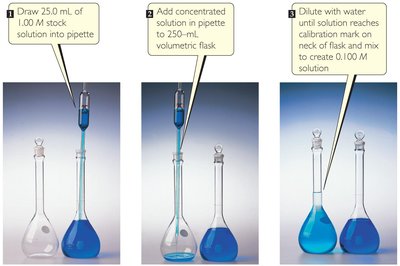
Example: If 10.0 mL of 2.0 M HCl is diluted to 100.0 mL, the final concentration is .
Stoichiometric Calculations Using Molarity
Relating Moles, Mass, Volume, and Number of Particles
Molarity allows conversion between volume of solution and moles of solute, which can then be related to mass or number of particles using molar mass and Avogadro's number.
Mole Ratio: Used in stoichiometric calculations to relate reactants and products.
Molar Mass: Converts between grams and moles.
Avogadro's Number: Converts between moles and number of particles.
Example: If 1.34 g of AgCl is formed from 250.0 mL of Cl− solution, calculate the original molarity of Cl− by converting grams AgCl to moles Cl− and dividing by volume in liters.
Titration
Principle and Process
Titration is a technique to determine the concentration of an unknown solution (titrand) by reacting it with a solution of known concentration (titrant). The reaction is complete at the equivalence point, where stoichiometric amounts of reactants have combined.
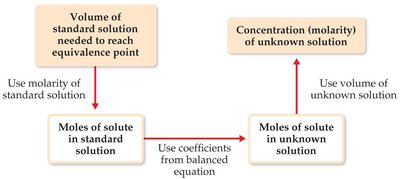
Example: If 30.00 mL of 0.120 M Ba(OH)2 requires 26.4 mL of HCl to reach the equivalence point, use the balanced equation and titration formula to find the concentration of HCl.
Acid–Base Titrations and Indicators
In acid–base titrations, an indicator is used to signal the end point, which should be as close as possible to the equivalence point. The indicator changes color depending on the acidity or basicity of the solution.
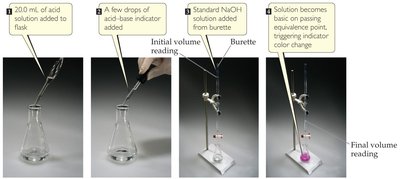
Example: When titrating HCl with NaOH, phenolphthalein turns pink at the equivalence point, indicating neutralization.
Summary Table: Solution Preparation and Titration
Process | Key Steps | Equation |
|---|---|---|
Preparing a Solution | Weigh solute, dissolve, dilute to mark | |
Dilution | Mix known volume of stock with solvent | |
Titration | React titrant with titrand, use indicator | (where = stoichiometric coefficient) |
Additional info: The notes above integrate textbook-level explanations, laboratory techniques, and example calculations to provide a comprehensive overview of solution chemistry relevant to General Chemistry students.
