 Indietro
Atomic Mass, Isotopes, and Mass Spectrometry: Study Notes for General Chemistry
Guida di studio - Note intelligenti
 Appunti personalizzati basati sui tuoi materiali, ampliati con definizioni chiave, esempi e contesto.
Atoms and Elements
Atomic Mass: The Average Mass of an Element’s Atoms
Atomic mass is a fundamental concept in chemistry, representing the average mass of all the isotopes of an element, weighted by their natural abundances. This value is what appears on the periodic table and is crucial for calculations involving chemical reactions and stoichiometry.
Isotopes: Atoms of the same element with different numbers of neutrons, resulting in different mass numbers.
Atomic Mass: The weighted average mass of an element’s isotopes, reflecting both their masses and proportions in nature.
Mass Number: The sum of protons and neutrons in an atom.
Natural Abundance: The relative percentage of each isotope found in a naturally occurring sample of the element.
Example: Chlorine has two isotopes: one with a mass of 34.97 amu (75.77% abundance) and another with a mass of 36.97 amu (24.23% abundance). The atomic mass is calculated as a weighted average.
Simple and Weighted Averages
Understanding averages is essential for calculating atomic mass. A simple average treats all values equally, while a weighted average assigns different weights based on importance or frequency.
Simple Average: Sum all values and divide by the number of values.
Weighted Average: Multiply each value by its weight (or percentage), sum the results, and divide by the total weight.
Example (Simple Average): Sarah’s scores in five subjects are averaged by summing and dividing by five.
Example (Weighted Average): John’s GPA is calculated by multiplying each grade by the course credits, summing, and dividing by total credits.
Calculating Atomic Mass
The atomic mass of an element is calculated using the weighted average formula:
Atomic mass = (mass of isotope 1 × fractional abundance 1) + (mass of isotope 2 × fractional abundance 2) + ...
Formula:
Example: For chlorine:
Practice Problem: An element has two isotopes with masses 68.9255 amu (60.11% abundance) and 70.9247 amu. Calculate the atomic mass.
Determining Isotopic Abundances
Given the atomic mass and isotope masses, you can calculate the abundances using algebraic methods.
Let x = abundance of isotope 1, (1-x) = abundance of isotope 2.
Set up the equation:
Solve for x.
Practice Problem: An element has two isotopes (34.9701 amu and 36.9702 amu) and an average atomic mass of 35.27 amu. Calculate the abundances.
Mass Spectrometry
Principles of Mass Spectrometry
Mass spectrometry is a technique used to determine the isotopic composition of elements. It works by ionizing a sample and separating ions based on their mass-to-charge ratios. The resulting mass spectrum displays the relative abundances of isotopes as peaks.
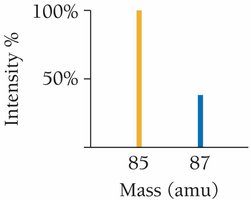
Mass Spectrum: A graph showing intensity (%) versus mass (amu).
Number of Peaks: Indicates the number of isotopes present.
Height of Peaks: Reflects the relative abundance of each isotope.
Example: Rubidium shows two peaks at 85 and 87 amu. The peak at 85 amu has 100% intensity, while the peak at 87 amu has 38.5% intensity, indicating rubidium-85 is more abundant.
Interpreting Mass Spectra
Mass spectra are used to identify isotopes and their abundances. For elements with two isotopes, the spectrum will show two peaks, and their relative heights correspond to their natural abundances.
Example: Copper has two isotopes (62.94 amu and 64.93 amu) and an atomic mass of 63.55 amu. The mass spectrum with two peaks near these masses, with the higher peak closer to 63 amu, matches the natural sample.
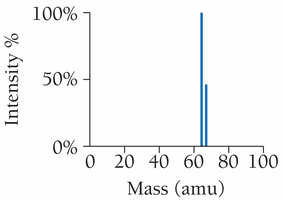
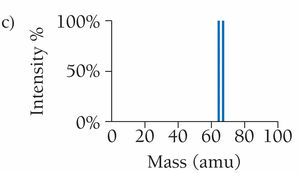
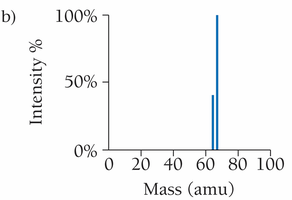
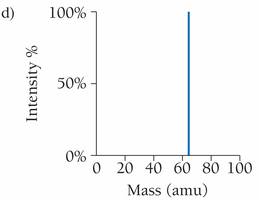
Additional info: The correct mass spectrum for copper would show two peaks, with the peak heights reflecting the natural abundances. The spectrum with two peaks and the higher intensity at the lower mass is most likely correct.
Conceptual Connection: Atomic Mass and Isotopic Abundance
For elements with multiple isotopes, the atomic mass is closest to the mass of the most abundant isotope. For carbon, C-12 (98.93% abundance) is the most abundant, so the atomic mass is closest to 12.0000 amu.
Key Point: The atomic mass of an element is not simply the average of isotope masses, but a weighted average based on their natural abundances.
Example: Carbon’s atomic mass is closest to 12.0000 amu due to the high abundance of C-12.
