 Indietro
Atomic Mass, The Mole, and Chemical Bonding: Foundations of General Chemistry
Guida di studio - Note intelligenti
 Appunti personalizzati basati sui tuoi materiali, ampliati con definizioni chiave, esempi e contesto.
Atomic Mass and the Unified Atomic Mass Unit
Definition and Calculation of Atomic Mass
The atomic mass of an element is the mass of a single atom, essentially the sum of the masses of all protons, neutrons, and electrons in the atom. Because these masses are extremely small, chemists use the unified atomic mass unit (u) as a standard unit, defined as 1/12 the mass of a carbon-12 atom.
1 u = g
Atomic mass values are found on the periodic table for each element.
Formula:
Weighted Average Atomic Mass
The atomic mass reported for each element is a weighted average of all the element’s naturally occurring isotopes. Each isotope’s contribution is weighted by its percent natural abundance.
Example (Chlorine): Chlorine has two isotopes: (34.969 u, 75.76%) and (36.969 u, 24.24%).
Weighted Average Formula:
For chlorine:
Experimental Determination of Isotopic Abundance
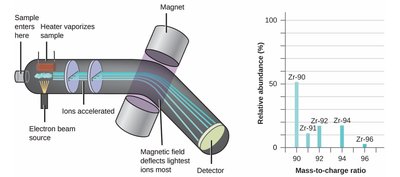
Isotopic abundances are determined experimentally using mass spectrometry, which separates ions based on their mass-to-charge ratio and measures their relative abundance.
The Mole and Molar Mass
Definition of the Mole
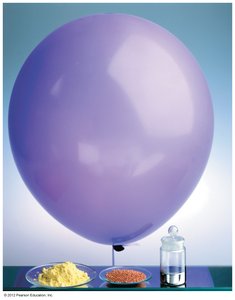
The mole (mol) is a counting unit used to express amounts of a chemical substance. One mole contains exactly entities (Avogadro’s number), analogous to how a dozen means 12 items.
1 mol of any element has a mass in grams equal to its atomic mass (from the periodic table).
This mass is called the molar mass.
Examples:
1 mol S = 36.064 g S
1 mol He = 4.0026 g He
1 mol Cu = 63.546 g Cu
1 mol Hg = 200.59 g Hg
Using Moles and Molar Mass in Calculations
Molar mass is used as a conversion factor between grams and moles, and between moles and number of atoms or molecules.
Conversion factors:
From grams to moles:
From moles to number of particles:
Example Calculation:
How many atoms of carbon are in 1.5 × 10⁻² g?
Classification of Matter
Types of Matter
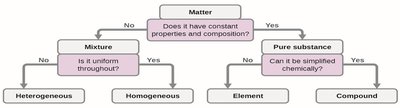
Matter is anything that has mass and occupies space. It can be classified based on its properties and composition:
Mixtures: Combinations of two or more substances that retain their individual properties. Can be homogeneous (uniform) or heterogeneous (not uniform).
Pure Substances: Have constant properties and composition. Can be elements (cannot be chemically broken down) or compounds (can be chemically separated into elements).
Chemical Bonding
Overview of Chemical Bonds
Chemical bonds are the forces that hold atoms together in compounds. The volume of an atom is mostly empty space occupied by electrons, which interact to form bonds as atoms approach each other.
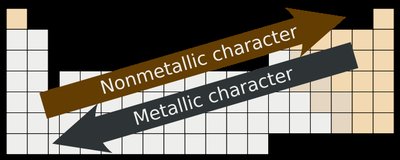
Covalent bonds: Formed by sharing electrons, typically between nonmetals.
Ionic bonds: Formed by transfer of electrons from a metal to a nonmetal, resulting in oppositely charged ions.
Covalent Bonds and Molecular Representation
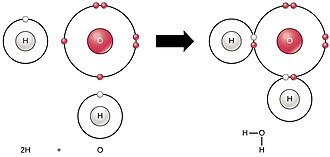
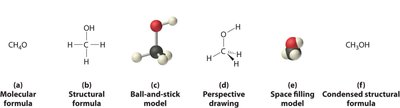
A covalent bond is the sharing of electron pairs between atoms, resulting in the formation of molecules. Molecules can be represented in several ways:
Molecular formula: Shows the number and type of atoms (e.g., CH2O).
Structural formula: Shows how atoms are connected.
Ball-and-stick model, perspective drawing, space-filling model, condensed formula: Visualize the 3D structure and connectivity.
Ions and Ionic Bonds
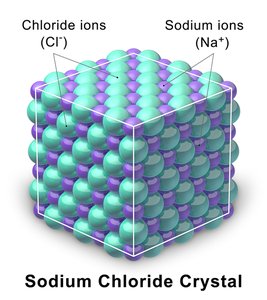
Ionic bonds result from the electrostatic attraction between oppositely charged ions. Metals lose electrons to become cations (positively charged), while nonmetals gain electrons to become anions (negatively charged).
Example: Na (metal) loses 1 electron to become Na+; Cl (nonmetal) gains 1 electron to become Cl−.
The resulting ionic compound is electrically neutral.
Common Monoatomic Ions
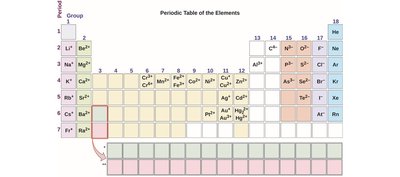
Main group elements tend to form ions with specific charges. Transition metals can form multiple ions (multivalent).
Polyatomic Ions
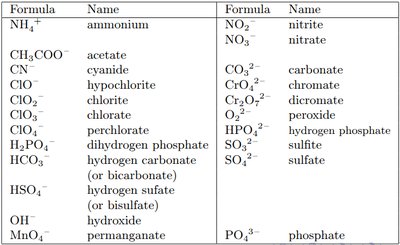
Polyatomic ions are groups of covalently bonded atoms that carry a net charge. It is important to memorize their formulas, charges, and names.
Naming Ionic and Molecular Compounds
Naming Binary Ionic Compounds
Binary ionic compounds (two elements) are named by stating the cation (element name) first, followed by the anion (element root + -ide). For metals with multiple possible charges, a Roman numeral indicates the charge.
Example: Ca3P2 is calcium phosphide.
Fe3P2 is iron(II) phosphide; FeP is iron(III) phosphide.
Ionic Compounds with Polyatomic Ions
For compounds containing polyatomic ions, name the cation first and the polyatomic ion second. Most polyatomic ions end in -ate or -ite, except for hydroxide, cyanide, and peroxide, which end in -ide. Some ions are related by the presence of hydrogen (e.g., HCO3− is hydrogen carbonate or bicarbonate).
Oxoanions
Oxoanions are polyatomic ions containing oxygen. Naming depends on the number of oxygens:
Two ions: fewer oxygens = -ite, more oxygens = -ate (e.g., SO32− is sulfite, SO42− is sulfate).
More than two: hypo- (least), per- (most) are added as prefixes (e.g., ClO− is hypochlorite, ClO4− is perchlorate).
Naming Binary Molecular (Covalent) Compounds
Binary molecular compounds are named similarly to ionic compounds, but prefixes are used to indicate the number of each atom. The more cation-like element is named first, followed by the more anion-like element with the -ide ending.
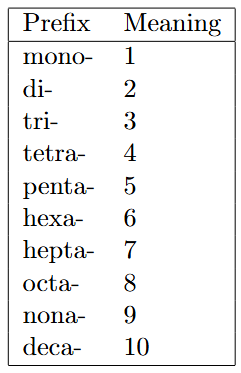
Prefixes for Covalent Compounds
Prefixes are used to specify the number of each type of atom in a covalent compound. If the prefix ends with a or o and the element name begins with a vowel, the final vowel of the prefix is dropped.
Prefix | Meaning |
|---|---|
mono- | 1 |
di- | 2 |
tri- | 3 |
tetra- | 4 |
penta- | 5 |
hexa- | 6 |
hepta- | 7 |
octa- | 8 |
nona- | 9 |
deca- | 10 |
Summary Table: Key Polyatomic Ions
Formula | Name | Formula | Name |
|---|---|---|---|
NH4+ | ammonium | NO2− | nitrite |
CH3COO− | acetate | NO3− | nitrate |
CN− | cyanide | CO32− | carbonate |
ClO− | hypochlorite | CrO42− | chromate |
ClO2− | chlorite | Cr2O72− | dichromate |
ClO3− | chlorate | O22− | peroxide |
ClO4− | perchlorate | HPO42− | hydrogen phosphate |
H2PO4− | dihydrogen phosphate | SO32− | sulfite |
HCO3− | hydrogen carbonate (bicarbonate) | SO42− | sulfate |
HSO4− | hydrogen sulfate (bisulfate) | PO43− | phosphate |
OH− | hydroxide | MnO4− | permanganate |
