 Indietro
Atomic Orbitals and Quantum Numbers: Structure, Properties, and Electron Configuration
Guida di studio - Note intelligenti
 Appunti personalizzati basati sui tuoi materiali, ampliati con definizioni chiave, esempi e contesto.
Atomic Orbitals and Quantum Numbers
Introduction to Atomic Orbitals
Atomic orbitals are mathematical functions that describe the probability distribution of an electron’s position and energy relative to the nucleus in an atom. These orbitals are derived from solutions to the Schrödinger equation and are fundamental to understanding atomic structure and chemical bonding.
Wavefunction (\(\Psi\)): A mathematical function that describes the wavelike nature of electrons in an atom.
Probability Density Function (\(\Psi^2\)): The square of the wavefunction, representing the probability of finding an electron in a particular region of space.
Nodes: Regions where the probability of finding an electron is zero.

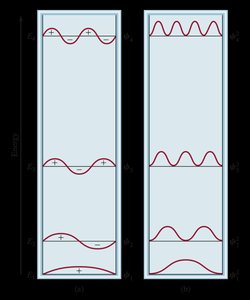
Wavefunctions and Probability Density
The wavefunction (\(\Psi\)) describes the quantum state of an electron, while the probability density (\(\Psi^2\)) gives the likelihood of finding the electron at a specific location. The shapes and energies of these orbitals are determined by quantum numbers.
Radial Probability Function: Shows how the probability of finding an electron varies with distance from the nucleus.
Radial Nodes: Spherical regions where the probability density is zero.
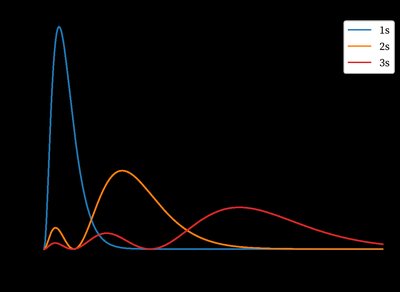
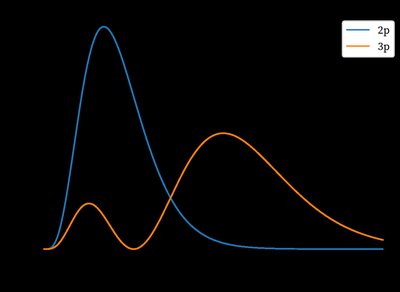
Quantum Numbers
Quantum numbers are used to describe the properties of atomic orbitals and the electrons within them. Each electron in an atom is described by a unique set of four quantum numbers:
Principal Quantum Number (n): Indicates the size and energy level of the orbital. Possible values: 1, 2, 3, ...
Angular Momentum Quantum Number (l): Indicates the shape of the orbital. Possible values: 0 to (n-1).
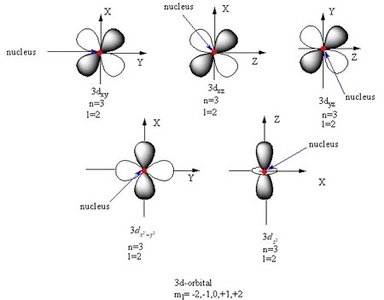
Magnetic Quantum Number (m_l): Indicates the orientation of the orbital in space. Possible values: -l to +l.
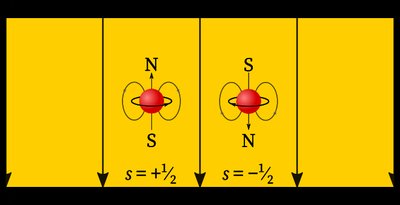
Electron Spin Quantum Number (m_s): Indicates the spin orientation of the electron. Possible values: +1/2 or -1/2.
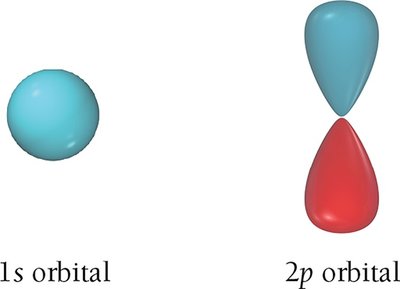
Shapes and Orientations of Atomic Orbitals
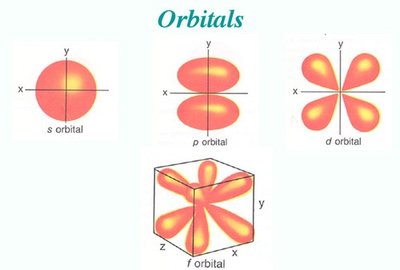
The shape and orientation of atomic orbitals are determined by the quantum numbers n and l. The most common types of orbitals are s, p, d, and f:
s orbitals (l = 0): Spherical shape, one orientation.
p orbitals (l = 1): Dumbbell shape, three orientations (m_l = -1, 0, +1).
d orbitals (l = 2): Cloverleaf shape, five orientations (m_l = -2, -1, 0, +1, +2).
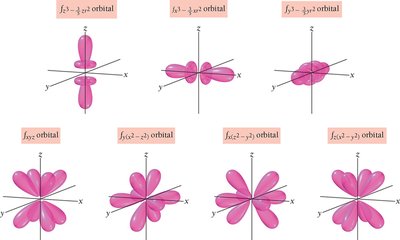
f orbitals (l = 3): Complex shapes, seven orientations.
Radial Probability and Nodes
As the principal quantum number n increases, the electron’s average distance from the nucleus increases, and the size of the orbital grows. The number of nodes also increases with n.
Radial Nodes: Number of radial nodes = n - l - 1.
Angular Nodes: Number of angular nodes = l.
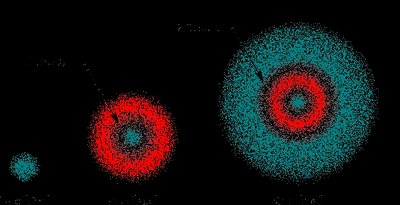
Trajectory Versus Probability
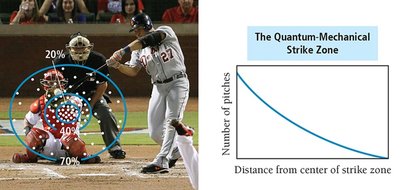
In classical mechanics, particles follow defined trajectories. In quantum mechanics, the position of an electron is described by a probability distribution map, not a precise path.
Classical Trajectory: Predictable path based on initial conditions.
Quantum Probability Map: Only the probability of finding an electron in a region can be determined.

Atomic Orbitals: Energy, Shielding, and Penetration
Orbital Energy Diagrams
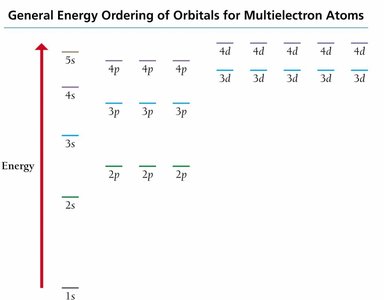
In hydrogen and other one-electron species, all orbitals with the same principal quantum number n are degenerate (same energy). In multi-electron atoms, energy splitting occurs due to electron-electron interactions, shielding, and penetration effects.
Order of Orbital Energies (for multi-electron atoms):
Degeneracy: Orbitals with the same n and l are degenerate in hydrogen-like atoms.
Shielding and Penetration
Shielding and penetration describe how electrons in different orbitals experience the effective nuclear charge.
Shielding: Inner electrons partially block the nuclear charge from outer electrons, reducing the effective nuclear charge felt by the latter.
Penetration: The ability of an electron in a given orbital to get close to the nucleus. Orbitals with greater penetration (e.g., s orbitals) experience a higher effective nuclear charge and are lower in energy.
Penetration order:
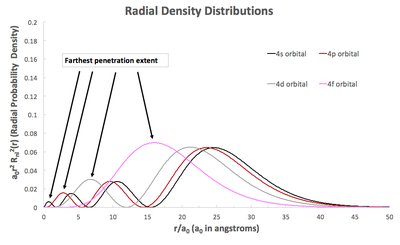
Electron Configuration Principles
Pauli Exclusion Principle
No two electrons in an atom can have the same set of four quantum numbers (n, l, m_l, m_s). Each orbital can hold a maximum of two electrons with opposite spins.
Implication: Electron pairs in the same orbital must have opposite spins (m_s = +1/2 and -1/2).
Aufbau Principle
Electrons fill atomic orbitals in order of increasing energy, starting with the lowest energy orbital available.
Order of filling: Follows the energy ordering of orbitals (see above).
Hund’s Rule
When electrons occupy degenerate orbitals (orbitals of the same energy), one electron enters each orbital until all are half-filled before pairing begins. This results in the maximum number of unpaired electrons with parallel spins.
Example: In the 2p subshell, electrons fill each of the three p orbitals singly before any pairing occurs.
Valence Electrons and Exceptions
Valence electrons are those in the outermost principal quantum level (main group elements: s and p electrons; transition metals: s and highest energy d electrons). Some elements have electron configurations that deviate from the predicted order due to increased stability of half-filled or fully filled subshells (e.g., Cr and Cu).
Example (Chromium): Predicted: ; Actual:
Example (Copper): Predicted: ; Actual:
Summary Table: Quantum Numbers and Orbitals
Quantum Number | Symbol | Possible Values | Physical Meaning |
|---|---|---|---|
Principal | n | 1, 2, 3, ... | Energy level, size of orbital |
Angular Momentum | l | 0 to n-1 | Shape of orbital (s, p, d, f) |
Magnetic | m_l | -l to +l | Orientation of orbital |
Spin | m_s | +1/2, -1/2 | Spin direction of electron |
Key Equations
Number of orbitals in a shell:
Maximum electrons in a shell:
Number of radial nodes:
Example: Electron Configuration of Iron (Fe, Z=26)
1s2 2s2 2p6 3s2 3p6 4s2 3d6
Additional info: The above content covers the quantum-mechanical model of the atom, atomic orbitals, quantum numbers, electron configuration, and the principles governing electron arrangement in atoms, as required for a General Chemistry college course.
