 Indietro
How Atoms Differ: Atomic Structure and Subatomic Particles – Study Guidance
Guida di studio - Note intelligenti
 Appunti personalizzati basati sui tuoi materiali, ampliati con definizioni chiave, esempi e contesto.
Q1. What are the three main subatomic particles found in atoms?
Background
Topic: Atomic Structure
This question tests your understanding of the basic components that make up an atom and their roles.
Key Terms:
Proton: Positively charged particle found in the nucleus.
Neutron: Neutral particle found in the nucleus.
Electron: Negatively charged particle found outside the nucleus.
Step-by-Step Guidance
Recall the structure of an atom: it consists of a nucleus and an electron cloud.
Identify which particles are found in the nucleus and which are found outside.
Think about the charges associated with each particle.
Try solving on your own before revealing the answer!
Final Answer:
The three main subatomic particles are protons, neutrons, and electrons.
Protons and neutrons are located in the nucleus, while electrons are found in the electron cloud surrounding the nucleus.
Q2. Where are protons, neutrons, and electrons located in an atom?
Background
Topic: Atomic Structure
This question is about the spatial arrangement of subatomic particles within an atom.
Key Terms:
Nucleus: The central part of the atom containing protons and neutrons.
Electron cloud: The region surrounding the nucleus where electrons are found.
Step-by-Step Guidance
Recall the definition of the nucleus and electron cloud.
Determine which particles are found in each region.
Think about why electrons are not found in the nucleus.
Try solving on your own before revealing the answer!
Final Answer:
Protons and neutrons are located in the nucleus, while electrons are located in the electron cloud outside the nucleus.
Q3. What is the charge of each subatomic particle?
Background
Topic: Atomic Structure
This question tests your knowledge of the electrical charges of protons, neutrons, and electrons.
Key Terms:
Proton: +1 charge
Neutron: 0 charge (neutral)
Electron: -1 charge
Step-by-Step Guidance
Recall the charge associated with each particle.
Think about how these charges affect the overall charge of an atom.
Consider why atoms are usually neutral.
Try solving on your own before revealing the answer!
Final Answer:
Protons have a positive charge (+1), neutrons are neutral (0), and electrons have a negative charge (-1).
Q4. How do the numbers of protons, neutrons, and electrons compare in a neutral atom?
Background
Topic: Atomic Structure and Charge Balance
This question is about the relationship between the numbers of protons and electrons in a neutral atom, and how neutrons fit in.
Key Terms:
Neutral atom: An atom with equal numbers of protons and electrons.
Atomic number: Number of protons in the nucleus.
Mass number: Sum of protons and neutrons.
Step-by-Step Guidance
Recall that atoms are electrically neutral unless they are ions.
Think about how the charges of protons and electrons balance each other.
Consider how the number of neutrons can vary without affecting the charge.
Try solving on your own before revealing the answer!
Final Answer:
In a neutral atom, the number of protons equals the number of electrons. The number of neutrons can vary and is not necessarily equal to the number of protons or electrons.
Q5. What does the atomic number represent?
Background
Topic: Atomic Number and Element Identity
This question tests your understanding of what the atomic number tells you about an atom.
Key Terms:
Atomic number (): The number of protons in the nucleus of an atom.
Step-by-Step Guidance
Recall the definition of atomic number.
Think about how the atomic number determines the identity of an element.
Consider how the atomic number is used in the periodic table.
Try solving on your own before revealing the answer!
Final Answer:
The atomic number represents the number of protons in the nucleus of an atom and determines the element's identity.
Q6. What does the mass number represent?
Background
Topic: Mass Number and Isotopes
This question is about the sum of protons and neutrons in an atom and how it relates to isotopes.
Key Terms:
Mass number (): The sum of protons and neutrons in the nucleus.
Isotope: Atoms of the same element with different numbers of neutrons.
Step-by-Step Guidance
Recall the formula for mass number: where is protons and is neutrons.
Think about how mass number differs from atomic number.
Consider how isotopes have the same atomic number but different mass numbers.
Try solving on your own before revealing the answer!
Final Answer:
The mass number represents the total number of protons and neutrons in the nucleus of an atom.
Q7. How do you determine the number of neutrons in an atom?
Background
Topic: Calculating Neutrons
This question is about using atomic and mass numbers to find the number of neutrons in an atom.
Key Formula:
Step-by-Step Guidance
Identify the mass number () and atomic number () for the atom.
Subtract the atomic number from the mass number to find the number of neutrons.
Check your calculation to ensure you used the correct values.
Try solving on your own before revealing the answer!
Final Answer:
The number of neutrons in an atom is found by subtracting the atomic number from the mass number: .
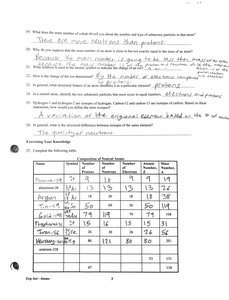
Q8. Complete the table for various elements by filling in the number of protons, neutrons, and electrons.
Background
Topic: Atomic Structure and Element Identification
This question tests your ability to use atomic and mass numbers to determine the numbers of protons, neutrons, and electrons for different elements.
Key Formula:
(for neutral atoms)
Step-by-Step Guidance
For each element, identify the atomic number and mass number from the table.
Calculate the number of protons (atomic number).
Calculate the number of neutrons (mass number minus atomic number).
Calculate the number of electrons (same as protons for neutral atoms).
Fill in the table with your calculated values for each element.
Try solving on your own before revealing the answer!
Final Answer:
The completed table should show, for each element, the correct numbers of protons, neutrons, and electrons based on the atomic and mass numbers provided. For example, for Argon (atomic number 18, mass number 40):
Protons: 18
Neutrons: 22
Electrons: 18
Repeat this process for each element in the table.
