 Indietro
Atomic Theory and the Development of Quantum Theory
Guida di studio - Note intelligenti
 Appunti personalizzati basati sui tuoi materiali, ampliati con definizioni chiave, esempi e contesto.
Atomic Theory
Introduction to Atomic Theory
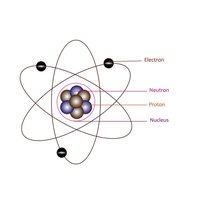
Atomic theory provides a scientific explanation for the properties of matter and energy, which are not directly observable. It forms the foundation for understanding chemical behavior and the structure of atoms.
Atomic theory explains the composition and behavior of matter at the smallest scale.
It is continually revised as new experimental evidence emerges.
Historical Models of the Atom
Development of Atomic Models
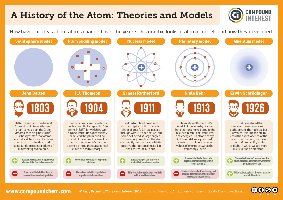
The atomic model has evolved through a series of scientific discoveries and experiments. Each model addressed limitations of its predecessor and incorporated new evidence.
Dalton's Billiard Ball Model (1803): Atoms are indivisible, solid spheres. Matter is composed of these fundamental units.
Thomson's Plum Pudding Model (1897): Atoms contain negatively charged electrons embedded in a positively charged 'pudding.'
Rutherford's Nuclear Model (1911): Most of the atom's mass and positive charge are concentrated in a small nucleus; electrons orbit the nucleus.
Bohr's Model (1913): Electrons occupy specific energy levels (orbits) around the nucleus and can move between levels by absorbing or emitting energy.


Bohr's Observations and the Stability of Atoms
Atomic Spectra and Energy Levels
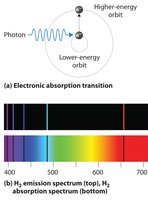
Bohr observed that when atoms are excited by energy, they emit light at specific wavelengths, producing a unique spectrum for each element. This observation led to the concept of quantized energy levels.
Electrons can only exist in certain allowed energy levels.
When an electron absorbs energy, it moves to a higher energy level; when it returns to a lower level, it emits a photon of light with energy equal to the difference between the levels.
Classical Physics vs. Atomic Stability
According to classical physics, accelerating charged particles (like electrons in orbit) should lose energy and spiral into the nucleus. However, atoms are stable, indicating that classical physics cannot fully explain atomic structure.
This discrepancy led to the development of quantum theory.
The Electromagnetic Spectrum and Quantum Theory
Nature of Light
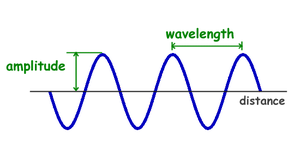
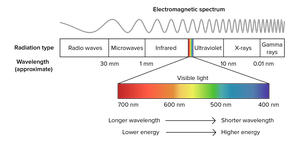
Classical theory describes light as an electromagnetic wave characterized by its wavelength and amplitude. Different wavelengths correspond to different types of electromagnetic radiation.
Wavelength (\lambda): The distance between successive peaks of a wave.
Amplitude: The height of the wave, related to its intensity.
The Ultraviolet Catastrophe and Quantization of Energy
Classical models failed to explain the observed drop in energy emission at ultraviolet wavelengths (the 'ultraviolet catastrophe'). Max Planck resolved this by proposing that energy is quantized—only certain discrete values are allowed.
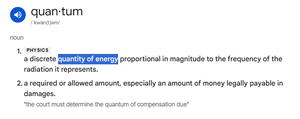
Quantization: Energy is emitted or absorbed in discrete packets called quanta.
This concept matched experimental data and revolutionized the understanding of atomic and electromagnetic phenomena.
Planck's Quantum Theory and Einstein's Expansion
Planck's Quantum Theory
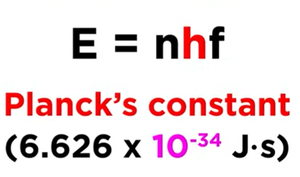
Planck introduced the idea that the energy of electromagnetic radiation is quantized and can be calculated using Planck's constant (h).
The energy of a quantum is given by the equation:
Where n is an integer, h is Planck's constant ( J·s), and f is the frequency of the radiation.
Einstein and the Quantum Theory of Light
Albert Einstein expanded on Planck's work by proposing that light itself is quantized into particles called photons. Each photon carries a specific amount of energy proportional to its frequency.
This theory explained the photoelectric effect and earned Einstein the Nobel Prize.
Bohr's Model and Quantum Numbers
Principal Quantum Number and Electron Configuration
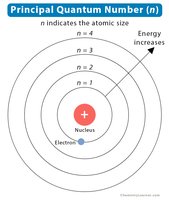
Bohr used quantum theory to build a model of the atom where electrons occupy specific energy levels, each identified by a principal quantum number (n).
Principal quantum number (n): Indicates the main energy level or shell of an electron.
The maximum number of electrons in each shell is given by .
Electrons in higher energy levels have more energy and are farther from the nucleus.
Revising Atomic Theory
Atomic theory continues to be revised as new evidence emerges. The quantum model of the atom incorporates the work of many scientists and explains the stability and behavior of atoms in terms of quantized energy levels and electron transitions.
Electrons absorb or emit energy in discrete quanta when transitioning between energy levels.
Quantum theory forms the basis for modern chemistry and physics.
