 Indietro
Lecture 1
Guida di studio - Note intelligenti
 Appunti personalizzati basati sui tuoi materiali, ampliati con definizioni chiave, esempi e contesto.
Atomic Theory
Introduction to Chemistry and Matter
Chemistry is the scientific study of matter, which is composed of atoms. Matter can be classified into substances and mixtures.
Substances are either elements (e.g., carbon, oxygen) or compounds (e.g., carbon dioxide).
Mixtures consist of two or more substances physically combined (e.g., air is a mixture of oxygen and nitrogen).
Dalton’s Atomic Model and Mass Laws
Dalton’s atomic theory explained several important mass laws:
Law of Conservation of Mass: Matter is neither created nor destroyed in chemical reactions.
Law of Constant Composition: A given compound always contains the same proportion of elements by mass.
Law of Multiple Proportions: When two elements form more than one compound, the ratios of the masses of the second element that combine with a fixed mass of the first element are simple whole numbers.
Divisibility of the Atom: Early Experiments
Early atomic models considered the atom indivisible, but later experiments showed otherwise.
J.J. Thomson’s cathode ray experiments (1897) demonstrated the existence of electrons, indicating atoms are divisible.
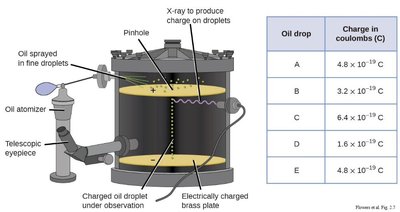
Millikan’s oil drop experiment (1909) measured the charge of the electron.
Thomson’s "plum pudding model" (1904) proposed that electrons were embedded in a positively charged sphere.
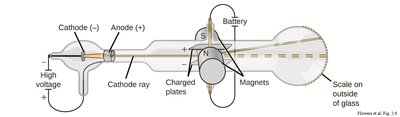
The Nuclear Atom: Rutherford’s Gold Foil Experiment
The discovery of the nucleus revolutionized atomic theory.
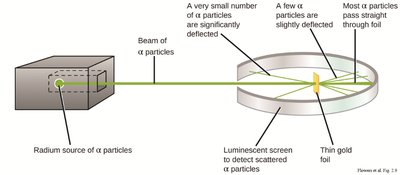
Alpha (α) particles are small, positively charged particles emitted by radioactive materials.
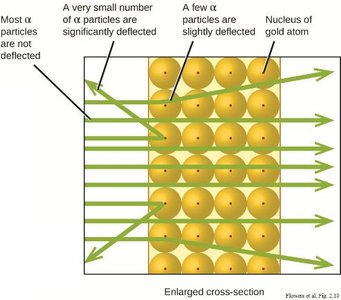
Rutherford’s gold foil experiment (1909) showed that most α particles passed through gold foil, but some were deflected at large angles, suggesting a dense, positively charged nucleus at the center of the atom.
This led to the rejection of the plum pudding model and the acceptance of the nuclear model of the atom.
Subatomic Particles
Atoms are composed of three main subatomic particles:
Protons (p+): Positively charged, mass ≈ 1 amu
Neutrons (n0): Neutral, mass ≈ 1 amu
Electrons (e–): Negatively charged, mass ≈ 1/1836 amu
Key constants:
e = C
1 amu = g
Isotopes
Isotopes are atoms of the same element with different numbers of neutrons and thus different masses.
Example:
12C: mass = 12 amu, abundance = 98.892%
13C: mass = 13.00335 amu, abundance = 1.108%
The average atomic mass is calculated using the weighted average of all isotopes.
Isotope notation: where A = mass number, Z = atomic number, X = element symbol.
Ions
Atoms can gain or lose electrons to form ions (charged species).
Cations are positively charged (loss of electrons), anions are negatively charged (gain of electrons).
Example:
11 p+, 12 n0, 10 e–: Na+ ion
17 p+, 18 n0, 18 e–: Cl– ion
Elements and the Periodic Table
Classification of Elements
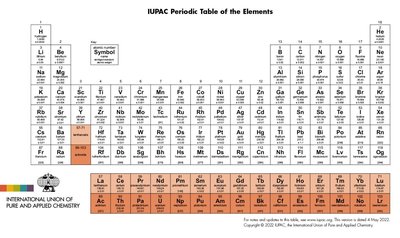
The periodic table organizes elements by increasing atomic number and recurring chemical properties.
Groups (columns): Elements with similar chemical properties.
Periods (rows): Horizontal rows of elements.
Main-group elements: Groups 1, 2, and 13–18.
Transition elements: Groups 3–12.
Metals, nonmetals, metalloids: Classified by physical and chemical properties.
Alkali metals: Group 1
Alkaline-earth metals: Group 2
Halogens: Group 17
Noble gases: Group 18
Naming Compounds and Writing Formulas
Ionic Compounds: Monatomic Ions
Ionic compounds are formed from the combination of metal cations and nonmetal anions.
Name the cation first, then the anion. The anion name ends with “-ide.”
Examples:
CaBr2: Calcium bromide
Magnesium nitride: Mg3N2
Common Monatomic Ions:
Charge | Formula | Name |
|---|---|---|
1+ | H+ | Hydrogen |
1+ | Li+ | Lithium |
1+ | Na+ | Sodium |
1+ | K+ | Potassium |
1+ | Ag+ | Silver |
2+ | Mg2+ | Magnesium |
2+ | Ca2+ | Calcium |
2+ | Sr2+ | Strontium |
2+ | Ba2+ | Barium |
2+ | Zn2+ | Zinc |
3+ | Al3+ | Aluminum |
1– | H– | Hydride |
1– | F– | Fluoride |
1– | Cl– | Chloride |
1– | Br– | Bromide |
1– | I– | Iodide |
2– | O2– | Oxide |
2– | S2– | Sulfide |
3– | N3– | Nitride |
Metals with Multiple Ions
Some metals can form more than one type of ion.
Specify the charge using Roman numerals in parentheses.
Examples:
FeCl3: Iron(III) chloride
Copper(II) selenide: CuSe
Some Metals That Form More Than One Monatomic Ion:
Element | Ion Formula | Systematic Name | Common Name |
|---|---|---|---|
Cobalt | Co2+ | Cobalt(II) | |
Cobalt | Co3+ | Cobalt(III) | |
Copper | Cu+ | Copper(I) | Cuprous |
Copper | Cu2+ | Copper(II) | Cupric |
Iron | Fe2+ | Iron(II) | Ferrous |
Iron | Fe3+ | Iron(III) | Ferric |
Lead | Pb2+ | Lead(II) | |
Lead | Pb4+ | Lead(IV) | |
Tin | Sn2+ | Tin(II) | Stannous |
Tin | Sn4+ | Tin(IV) | Stannic |
Ionic Compounds: Polyatomic Ions
Polyatomic ions are ions composed of two or more atoms covalently bonded, acting as a single charged unit.
Examples:
NaClO: Sodium hypochlorite
LiClO2: Lithium chlorite
CsClO3: Cesium chlorate
KClO4: Potassium perchlorate
NH4H2PO4: Ammonium dihydrogen phosphate
Strontium iodate: Sr(IO3)2
Lithium peroxide: Li2O2
Mercury(I) acetate: Hg2(CH3COO)2
Common Polyatomic Ions:
Formula | Name |
|---|---|
NH4+ | Ammonium |
H3O+ | Hydronium |
O22– | Peroxide |
OH– | Hydroxide |
CH3COO– | Acetate |
CN– | Cyanide |
N3– | Azide |
CO32– | Carbonate |
HCO3– | Bicarbonate |
NO3– | Nitrate |
NO2– | Nitrite |
SO42– | Sulfate |
HSO4– | Hydrogen sulfate |
SO32– | Sulfite |
HSO3– | Hydrogen sulfite |
PO43– | Phosphate |
HPO42– | Hydrogen phosphate |
H2PO4– | Dihydrogen phosphate |
ClO4– | Perchlorate |
ClO3– | Chlorate |
ClO2– | Chlorite |
ClO– | Hypochlorite |
CrO42– | Chromate |
Cr2O72– | Dichromate |
MnO4– | Permanganate |
Millikan’s Oil Drop Experiment
Millikan’s experiment determined the charge of the electron by observing the behavior of oil droplets in an electric field.
Measured charges were always multiples of a fundamental value, confirming the quantization of electric charge.
Summary Table: Key Experiments in Atomic Theory
Experiment | Scientist(s) | Discovery |
|---|---|---|
Cathode Ray Tube | J.J. Thomson | Electron |
Oil Drop | R. Millikan | Electron charge |
Gold Foil | E. Rutherford (Geiger & Marsden) | Nucleus |
Additional info:
For a deeper understanding, students should practice naming and writing formulas for both monatomic and polyatomic ionic compounds, and be familiar with the periodic table layout and group properties.
