 Indietro
Atomic Theory, Periodic Table Organization, and Chemical Nomenclature: Study Guide
Guida di studio - Note intelligenti
 Appunti personalizzati basati sui tuoi materiali, ampliati con definizioni chiave, esempi e contesto.
Atomic Theory and Experimental Evidence
Historical Foundations and Key Experiments
The development of atomic theory was shaped by experimental discoveries and scientific reasoning. Early scientists, including those who studied radioactivity, contributed to our understanding of atomic structure.
Dalton's Atomic Theory: Proposed in 1807, Dalton's theory consists of five postulates that describe the nature of atoms and matter.
Key Experiments: The work of Thomson, Millikan, Rutherford, and Chadwick provided evidence for the existence and properties of subatomic particles.
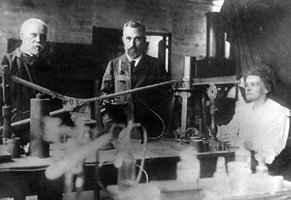
Example: The discovery of radioactivity by early researchers led to the identification of new subatomic particles.
Dalton's Atomic Theory: The Five Postulates
Dalton's atomic theory forms the basis for modern chemistry. The five postulates are:
Atoms: Matter is composed of exceedingly small particles called atoms. An atom is the smallest unit of an element that can participate in a chemical change.
Elemental Identity: An element consists of only one type of atom, which has a characteristic mass.
Distinct Properties: Atoms of one element differ in properties from atoms of all other elements.
Compound Formation: Compounds consist of atoms of two or more elements combined in a small, whole-number ratio.
Conservation: Atoms are neither created nor destroyed during a chemical change, but rearrange to yield different types of matter.
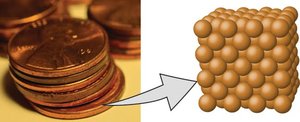
Example: Pennies made prior to 1982 are composed of approximately copper atoms.
Introductory Laws of Matter
Dalton's postulates support several fundamental laws:
Law of Constant Composition: All samples of a pure compound contain the same elements in the same proportion by mass.
Law of Conservation of Matter: The total quantity of matter remains unchanged during chemical or physical changes.
Law of Multiple Proportions: When two elements form more than one compound, the masses of one element that combine with a fixed mass of the other are in a ratio of small, whole numbers.
Modern Atomic Theory: Subatomic Particles
Modern atomic theory identifies three main subatomic particles:
Electron: Discovered by J.J. Thomson using the cathode ray experiment, which determined the charge-to-mass ratio of the electron.
Proton: Positively charged particle found in the nucleus.
Neutron: Neutral particle discovered by Chadwick, also located in the nucleus.
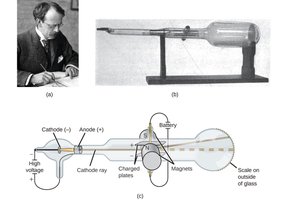
Example: The cathode ray experiment used magnets to examine the charge-to-mass ratio of electrons.
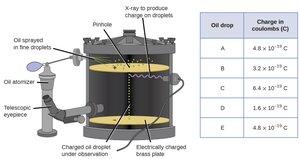
Example: Millikan's oil drop experiment determined the charge of the electron by observing charged oil droplets.
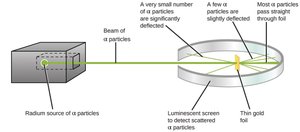
Example: Rutherford's gold foil experiment revealed the existence of the atomic nucleus.
Subatomic Particle Properties
Subatomic particles are measured in atomic mass units (amu):
1 amu = g
Atomic Properties and the Periodic Table
Atomic Number and Mass Number
The atomic number and mass number are fundamental identifiers for elements:
Atomic Number (Z): The number of protons in the nucleus of an atom. Determines the element's identity.
Mass Number (A): The total number of protons and neutrons in an atom.
Number of Neutrons:
Symbolic Notation: Uses element abbreviation, mass number, and atomic number to describe atoms.
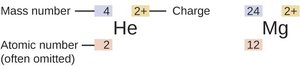
Example: represents a helium ion with 2 protons, 2 neutrons, and a 2+ charge.
Periodic Table Organization
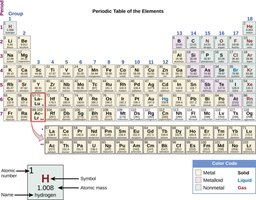
The periodic table arranges elements by increasing atomic number and groups elements with similar properties:
Periods: Horizontal rows
Groups: Vertical columns
Metals: Left side
Nonmetals: Right side
Metalloids: Stairstep area
Periodicity: Repeating properties of elements
Atomic Weight and Isotopic Abundance
Atomic weight is calculated as the weighted average of isotopic masses:
Atomic Weight Formula:
Example: Calculating the average atomic mass of silicon using isotopic abundances.
Chemical Nomenclature in Molecular and Ionic Compounds
Types of Chemical Formulas
Chemical compounds can be represented in several ways:
Molecular Formula: Shows the exact number of atoms of each element in a molecule.
Empirical Formula: Shows the simplest whole-number ratio of atoms in a compound.
Structural Formula: Shows the arrangement of atoms within the molecule.
Common Ions and Naming Ionic Compounds
Ionic compounds are formed from metals and nonmetals. The most common ions are predictable based on group number:
Group 1: Alkali metals, always form +1 ions
Group 2: Alkaline earth metals, always form +2 ions
Halogens: Group 17, form -1 ions
Naming Molecular Compounds and Acids
Molecular compounds are named using prefixes to indicate the number of atoms. Acids are named based on their composition:
Binary Acids: Named as "hydro-" + base name + "-ic acid"
Oxyacids: Named based on the polyatomic ion present
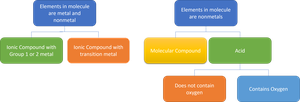
Example: The decision tree helps determine whether a compound is ionic, molecular, or an acid, and guides the naming process.
Summary Table: Subatomic Particles
Particle | Charge | Location | Relative Mass (amu) |
|---|---|---|---|
Proton | +1 | Nucleus | 1 |
Neutron | 0 | Nucleus | 1 |
Electron | -1 | Outside nucleus | ~0.0005 |
Additional info:
Concept maps (images_2, image_7, image_12) visually organize the progression from atomic theory to periodic table properties and chemical nomenclature.
Worksheet problems reinforce understanding of atomic structure, periodic table organization, and chemical nomenclature.
