 Indietro
Atoms and Elements: Foundations of Atomic Theory and the Periodic Table
Guida di studio - Note intelligenti
 Appunti personalizzati basati sui tuoi materiali, ampliati con definizioni chiave, esempi e contesto.
Atoms and Elements
Introduction to Atoms
Atoms are the fundamental building blocks of matter. The concept of the atom has evolved over centuries, leading to our modern understanding of chemical elements and their properties.
Atom: The smallest identifiable unit of an element, retaining the chemical properties of that element.
Element: A substance composed of only one type of atom; there are about 90 naturally occurring elements and over 20 synthetic ones.
The word atom comes from the Greek atomos, meaning indivisible.
Example: If you cut a piece of graphite (carbon) into smaller pieces, you eventually reach individual carbon atoms, which cannot be further divided without losing the properties of carbon.
Historical Development of Atomic Theory
The idea of atoms dates back to ancient Greece, but scientific evidence for atoms emerged much later.
Leucippus and Democritus (5th c. B.C.): Proposed that matter is composed of indivisible particles called atoms.
Plato and Aristotle (4th c. B.C.): Argued that matter is continuous and not made of atoms; their view dominated for centuries.
John Dalton (early 1800s): Formulated the first modern atomic theory based on experimental evidence.
Robert Brown (1827): Observed random motion of pollen grains in water (Brownian motion), later explained by Einstein as evidence for atoms.
Scientific Method: The atomic hypothesis became accepted only when experiments could test and potentially falsify it.
The Laws That Led to Atomic Theory
Three Fundamental Laws
Three key laws provided the foundation for Dalton's atomic theory:
Law of Conservation of Mass (Lavoisier): Mass is neither created nor destroyed in a chemical reaction.
Law of Definite Proportions (Proust): A given compound always contains the same proportion of elements by mass.
Law of Multiple Proportions (Dalton): When two elements form more than one compound, the masses of one element that combine with a fixed mass of the other are in ratios of small whole numbers.
Example: Sulfur dioxide (SO2) and sulfur trioxide (SO3) obey the law of multiple proportions when comparing the mass of oxygen per gram of sulfur in each compound.
Dalton's Atomic Theory
Dalton's atomic theory explains the above laws with four main postulates:
Each element is composed of tiny, indestructible particles called atoms.
All atoms of a given element have the same mass and properties.
Atoms combine in simple, whole-number ratios to form compounds.
Atoms of one element cannot change into atoms of another element in a chemical reaction; they only rearrange.
Connection: Each law is explained by specific statements in Dalton's theory (e.g., conservation of mass by the indestructibility of atoms).
Discovery of Subatomic Particles
The Electron
Experiments at the end of the 19th century revealed that atoms are composed of smaller particles.
J. J. Thomson's Cathode Ray Experiment: Discovered the electron, a negatively charged particle present in all atoms. Measured the charge-to-mass ratio ( C/g), showing electrons are much lighter than atoms.
Properties of Electrical Charge: Like charges repel, unlike charges attract, and equal amounts of positive and negative charge cancel each other.
Millikan's Oil Drop Experiment
Robert Millikan measured the charge of a single electron ( C) by balancing charged oil droplets in an electric field. Combining this with Thomson's ratio gave the electron's mass ( g).
Structure of the Atom: The Nucleus
Thomson's Plum-Pudding Model: Electrons embedded in a sphere of positive charge.
Rutherford's Gold Foil Experiment: Most alpha particles passed through gold foil, but some were deflected sharply, indicating a small, dense, positively charged nucleus.
Chadwick's Discovery of the Neutron: The nucleus contains neutral particles (neutrons) with a mass similar to protons.
Conclusion: Atoms are mostly empty space, with a dense nucleus containing protons and neutrons, and electrons in the surrounding space.
Subatomic Particles: Protons, Neutrons, and Electrons
Properties and Definitions
Proton: Positively charged particle in the nucleus; defines the element (atomic number Z).
Neutron: Neutral particle in the nucleus; contributes to atomic mass but not charge.
Electron: Negatively charged particle outside the nucleus; much lighter than protons or neutrons.
Particle | Mass (kg) | Mass (amu) | Charge (relative) |
|---|---|---|---|
Proton | 1.67262 × 10⁻²⁷ | 1.0073 | +1 |
Neutron | 1.67493 × 10⁻²⁷ | 1.0087 | 0 |
Electron | 9.10938 × 10⁻³¹ | 0.00055 | −1 |
Atomic Number (Z): Number of protons in the nucleus; determines the element.
Mass Number (A): Total number of protons and neutrons:
Isotopes and Ions
Isotopes: Atoms of the same element with different numbers of neutrons (e.g., 20Ne, 21Ne, 22Ne).
Ions: Atoms that have gained or lost electrons, resulting in a net charge. Cations are positive (lost electrons), anions are negative (gained electrons).
Example: Sodium atom (Na) loses one electron to become Na+; chlorine atom (Cl) gains one electron to become Cl−.
The Periodic Law and the Periodic Table
Organization and Patterns
The periodic table arranges elements by increasing atomic number, revealing recurring patterns in their properties (periodicity).
Groups (columns): Elements with similar chemical properties.
Periods (rows): Elements with increasing atomic number.
Main-group elements: Groups 1, 2, and 13–18; properties are predictable from position.
Transition elements: Groups 3–12; properties are less predictable.
Four Important Families:
Family | Group | Characteristic Behavior and Examples |
|---|---|---|
Noble gases | 18 | Inert, nonreactive gases (e.g., He, Ne, Ar) |
Alkali metals | 1 | Highly reactive metals (e.g., Li, Na, K) |
Alkaline earth metals | 2 | Reactive metals (e.g., Mg, Ca) |
Halogens | 17 | Reactive nonmetals (e.g., F, Cl, Br) |
Metals, Nonmetals, Metalloids:
Type | Where Found | Properties | Chemical Behavior | Examples |
|---|---|---|---|---|
Metals | Left and center | Shiny, conductive, malleable | Lose electrons in reactions | Na, Fe, Cu |
Nonmetals | Upper right | Dull, poor conductors | Gain electrons in reactions | O, Cl, S |
Metalloids | Stair-step line | Intermediate properties | Varied | Si, Sb |
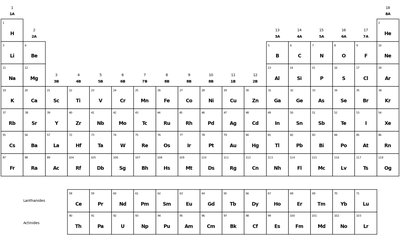
Example: Elements in the same group (e.g., Cl and F) have similar chemical properties due to similar electron configurations.
Additional info: The periodic law is explained by quantum mechanics, which is covered in later chapters. The periodic table is a predictive tool for chemical behavior and reactivity.
