 Indietro
Atoms and Elements: Foundations of Atomic Structure and the Periodic Table
Guida di studio - Note intelligenti
 Appunti personalizzati basati sui tuoi materiali, ampliati con definizioni chiave, esempi e contesto.
Atoms and Elements
Introduction to Atoms and Elements
Atoms are the fundamental building blocks of matter, and elements are pure substances consisting of only one type of atom. Understanding atomic structure and the classification of elements is essential for studying chemistry.

The Atomic Theory of Matter
Dalton’s Atomic Theory
Dalton’s Atomic Theory laid the groundwork for modern chemistry by proposing that:
All matter is composed of tiny, indestructible particles called atoms.
Atoms of a given element are identical in mass and properties, but differ from those of other elements.
Atoms combine in simple, whole-number ratios to form compounds.
Atoms are neither created nor destroyed in chemical reactions; they are rearranged.
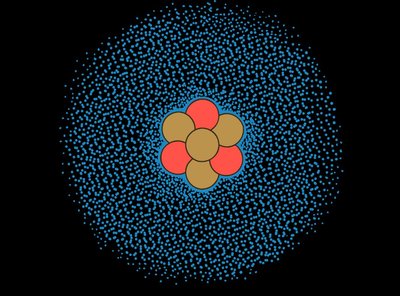
The Modern View of Atomic Structure
Subatomic Particles
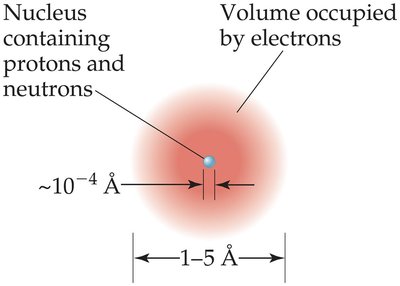
Atoms consist of a dense nucleus containing protons and neutrons, surrounded by a cloud of electrons. The nucleus accounts for nearly all the atom’s mass, while electrons occupy most of its volume.
Protons (p+): Positively charged particles found in the nucleus.
Neutrons (n0): Neutral particles also located in the nucleus.
Electrons (e−): Negatively charged particles found in the electron cloud around the nucleus.
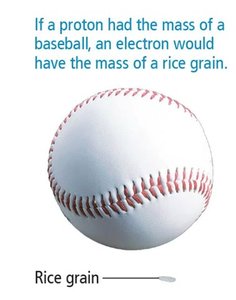
Relative Masses: Protons and neutrons have nearly the same mass (~1 amu), while electrons are much lighter (about 1/1836 the mass of a proton).
Atomic Number, Mass Number, and Isotopes
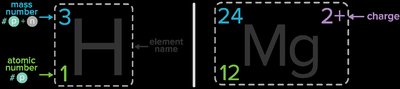
Atomic Number (Z) and Mass Number (A)
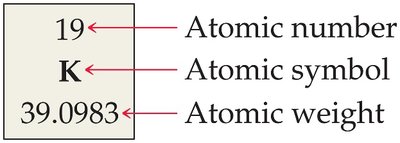
The atomic number (Z) is the number of protons in an atom and defines the element. The mass number (A) is the sum of protons and neutrons in the nucleus.
Atomic Number (Z): Number of protons
Mass Number (A): Number of protons + neutrons
Isotopes
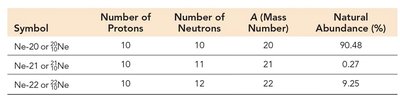
Isotopes are atoms of the same element (same Z) with different numbers of neutrons (different A). Isotopes have nearly identical chemical properties but different masses.
Symbol | Number of Protons | Number of Neutrons | A (Mass Number) | Natural Abundance (%) |
|---|---|---|---|---|
Ne-20 or 20Ne | 10 | 10 | 20 | 90.48 |
Ne-21 or 21Ne | 10 | 11 | 21 | 0.27 |
Ne-22 or 22Ne | 10 | 12 | 22 | 9.25 |
The Periodic Table of Elements
Organization and Classification
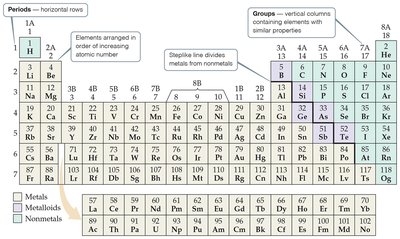
The periodic table arranges elements in order of increasing atomic number and groups them by similar chemical properties. Elements are classified as metals, nonmetals, or metalloids.
Periods: Horizontal rows (numbered 1–7)
Groups (Families): Vertical columns (numbered 1–18 or 1A–8A/1B–8B)
Metals: Left and center of the table; good conductors, malleable, ductile
Nonmetals: Upper right; poor conductors, brittle
Metalloids: Border metals and nonmetals; intermediate properties
Ions and Ionic Compounds
Formation of Ions
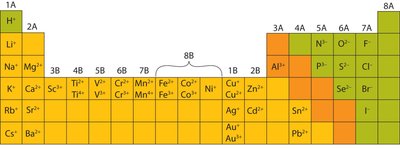
An ion is an atom or group of atoms with a net electrical charge due to the loss or gain of electrons.
Cation: Positively charged ion (loss of electrons)
Anion: Negatively charged ion (gain of electrons)
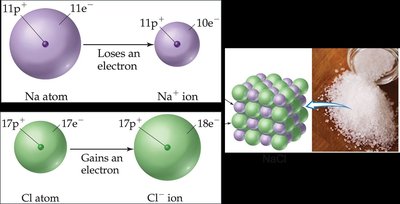
Ionic compounds are formed from the electrostatic attraction between cations (usually metals) and anions (usually nonmetals). The formula is written with the cation first (e.g., NaCl).
Atomic Mass, Avogadro’s Number, and the Mole
Atomic Mass Unit (amu) and Atomic Weight
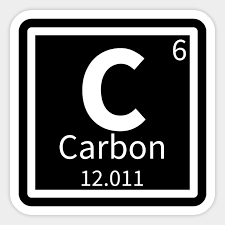
The atomic mass unit (amu) is defined as one-twelfth the mass of a carbon-12 atom. The atomic weight of an element is the weighted average of the masses of its naturally occurring isotopes.
1 amu = 1.66054 × 10⁻²⁴ g
Atomic weight (weighted average):
Avogadro’s Number and the Mole
The mole (mol) is the SI unit for amount of substance. One mole contains Avogadro’s number () of particles (atoms, molecules, ions, etc.).
1 mol = particles
Used as a conversion factor between number of particles and amount in moles
Conversions: Mass, Moles, and Number of Atoms
Conversions between mass, moles, and number of atoms are fundamental in chemistry:
Moles to atoms:
Atoms to moles:
Mass to moles:
Moles to mass:
To convert between mass and number of atoms, use two steps: mass to moles, then moles to atoms (or vice versa).
Summary Table: Key Atomic Properties
Particle | Symbol | Charge | Relative Mass (amu) |
|---|---|---|---|
Electron | e− | −1 | 0.00055 |
Proton | p+ | +1 | 1.0073 |
Neutron | n0 | 0 | 1.0087 |
Example: Calculate the number of atoms in 2.00 g of hydrogen (H, molar mass = 1.008 g/mol):
Step 1:
Step 2: atoms
Additional info: This guide covers the foundational concepts of atomic structure, isotopes, ions, and the periodic table, as well as essential calculations involving atomic mass, the mole, and Avogadro’s number.
