 Indietro
Atoms and Elements: Foundations of General Chemistry
Guida di studio - Note intelligenti
 Appunti personalizzati basati sui tuoi materiali, ampliati con definizioni chiave, esempi e contesto.
Atoms: The Essential Building Blocks
Definition and Properties of Atoms
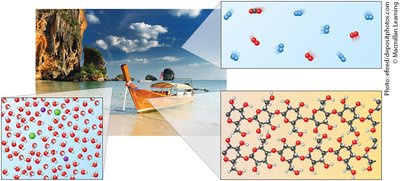
An atom is the smallest unit of an element that retains the unique properties of that element. There are 118 known elements, with 98 occurring naturally on Earth. Atoms combine to form compounds and mixtures, giving rise to the diversity of matter.
Element: A pure substance consisting of only one type of atom.
Compound: A substance formed when atoms of different elements combine in fixed ratios.
Mixture: A physical combination of two or more substances where each retains its own properties.
Historical Development of Atomic Theory
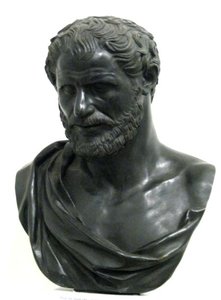
The concept of the atom dates back to ancient Greece. Democritus (~400 BCE) proposed that matter is composed of indivisible particles called atomos.
Fundamental Laws of Chemistry
The Law of Conservation of Mass
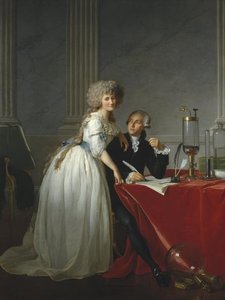
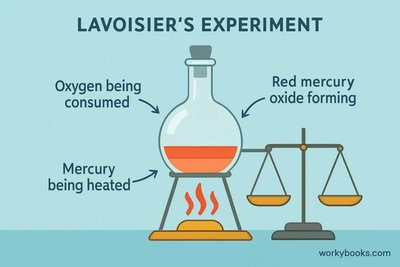
Formulated by Antoine Lavoisier, this law states that mass is neither created nor destroyed in a chemical reaction. The total mass of reactants equals the total mass of products.
Key Point: Chemical reactions rearrange atoms but do not change their total mass.
Example: Heating mercury in the presence of oxygen forms red mercury oxide, but the total mass remains constant.
The Law of Constant Composition
This law states that a pure compound always contains the same elements in the same proportion by mass, regardless of its source.
Example: Water (H2O) always contains two hydrogen atoms and one oxygen atom.
The Law of Multiple Proportions
When two elements form more than one compound, the masses of one element that combine with a fixed mass of the other are in ratios of small whole numbers.
Example: Mercury(I) oxide (Hg2O) and Mercury(II) oxide (HgO) have different ratios of mercury to oxygen.
Dalton’s Atomic Theory
Postulates of Dalton’s Atomic Theory
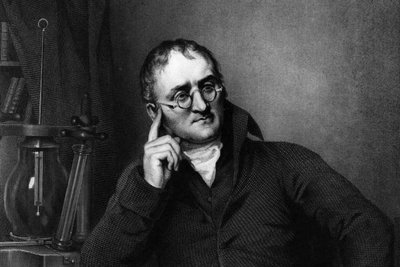
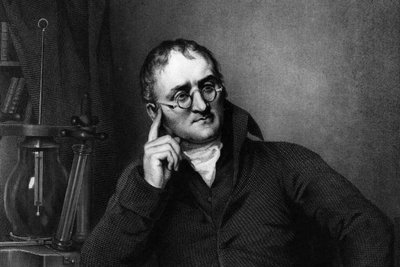
John Dalton (1808) proposed a modern atomic theory based on experimental evidence:
Elements are made of tiny, indivisible particles called atoms.
Atoms of each element are unique.
Atoms combine in whole-number ratios to form compounds.
Atoms are unchanged in chemical reactions; only their arrangements change.
The Periodic Table of Elements
Organization and Classification
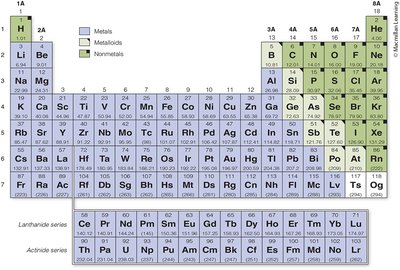
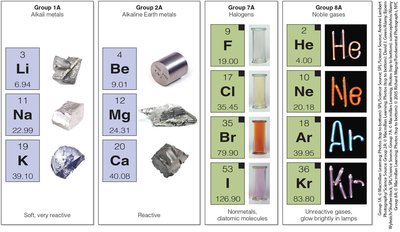
Dmitri Mendeleev organized elements by increasing atomic mass and grouped elements with similar properties. The modern periodic table arranges elements by increasing atomic number and groups them into metals, nonmetals, and metalloids.
Groups (families): Vertical columns with similar chemical properties.
Periods: Horizontal rows.
Metals: Left of the staircase, good conductors.
Nonmetals: Right of the staircase, poor conductors.
Metalloids: Border the staircase, intermediate properties.
Uncovering Atomic Structure
Subatomic Particles
Atoms are composed of three main subatomic particles:
Protons: Positively charged, located in the nucleus.
Neutrons: Neutral, located in the nucleus.
Electrons: Negatively charged, found in the electron cloud surrounding the nucleus.
Mass and Charge of Subatomic Particles
Atomic mass unit (amu):
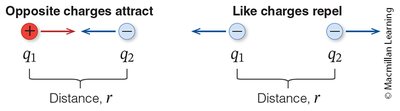
Charge: Measured in coulombs (C). Like charges repel, opposite charges attract.
Coulomb’s Law:
Discovery of the Electron: Cathode-Ray Tube Experiments
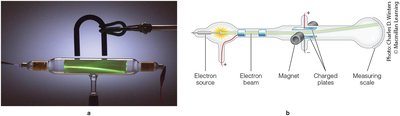
J.J. Thomson discovered the electron using cathode-ray tubes, determining the charge-to-mass ratio of the electron.
Electrons are negatively charged and much lighter than atoms.
Deflection in electric and magnetic fields revealed their properties.
Millikan’s Oil Drop Experiment
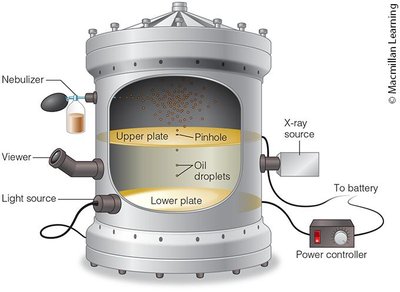
Robert Millikan measured the charge of the electron using the oil drop experiment, finding the fundamental unit of electric charge.
Charge of electron:
Mass of electron:
Atomic Models: Plum Pudding and Nuclear Model
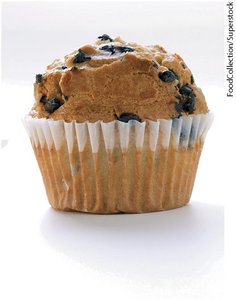
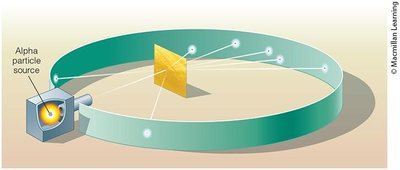
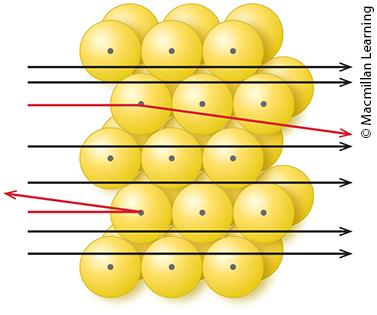
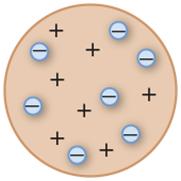
Early models of the atom included the "plum pudding" model, where electrons were embedded in a positively charged matrix. Rutherford’s gold foil experiment disproved this, showing that atoms have a small, dense, positively charged nucleus.
Plum pudding model: Electrons scattered in a sphere of positive charge.
Rutherford model: Dense nucleus with electrons orbiting around it.
Summary Table: Subatomic Particles
Subatomic Particle | Location | Mass (amu) | Charge |
|---|---|---|---|
Proton | Nucleus | 1.0073 | +1 |
Neutron | Nucleus | 1.0087 | 0 |
Electron | Electron cloud | 0.0005 | -1 |
Models of the Atom
Development of Atomic Models
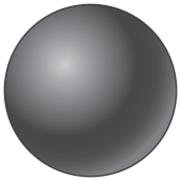
Dalton’s model (1808): Atoms are indivisible spheres.
Plum pudding model (1904): Electrons in a positive matrix.
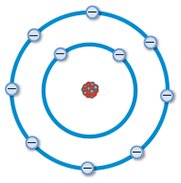
Bohr model (1913): Electrons orbit the nucleus in fixed paths.
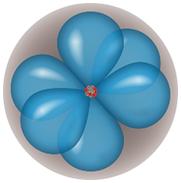
Quantum model (1920s): Electrons exist in probabilistic clouds (orbitals).
Formation of Ions
Neutral Atoms and Ions
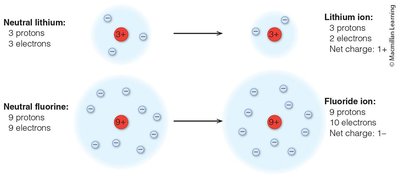
Atoms are neutral when the number of protons equals the number of electrons. Ions are formed when atoms gain or lose electrons:
Cation: Positively charged ion (loss of electrons).
Anion: Negatively charged ion (gain of electrons).
Describing Atoms: Identity and Mass
Atomic Number and Isotopes
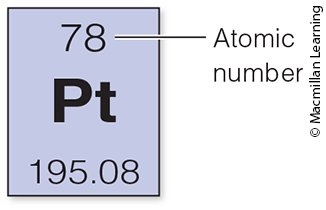
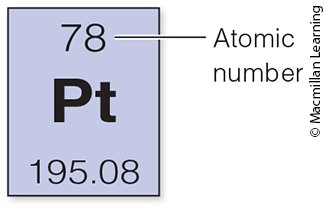
The atomic number (Z) is the number of protons in the nucleus and defines the element. Isotopes are atoms of the same element with different numbers of neutrons, resulting in different mass numbers (A).
Atomic number (Z): Number of protons.
Mass number (A): Number of protons + neutrons.
Isotopes: Same Z, different A.
Isotopic Mass and Abundance
Isotopes have different masses and natural abundances. The average atomic mass is a weighted average based on isotopic abundance.
Example: Hydrogen has three isotopes: protium, deuterium, and tritium.
Calculating Average Atomic Mass
The average atomic mass is calculated as:
= mass of isotope i
= decimal abundance of isotope i
Atoms in Compounds: Formula Mass and Percent Composition
Formula Mass
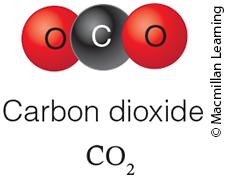
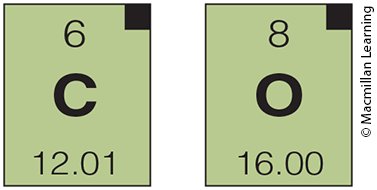
The formula mass is the sum of the atomic masses of all atoms in a chemical formula, expressed in amu.
Example: For CO2:
Percent Composition
Percent composition is the percentage by mass of each element in a compound.
Example: Oxygen in K2CO3:
The Mole Concept
Avogadro’s Number and the Mole
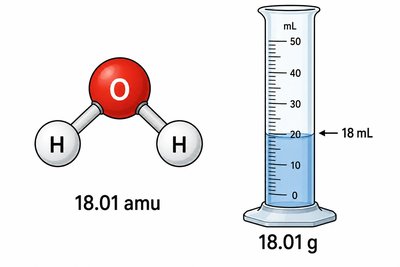
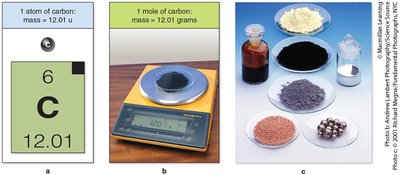
The mole is a counting unit in chemistry, defined as items (Avogadro’s number). It allows chemists to relate atomic-scale quantities to macroscopic amounts.
Molar Mass
The molar mass is the mass of one mole of a substance, numerically equal to the atomic or molecular mass in grams.
Example: 1 mole of carbon = 12.01 g; 1 mole of NaCl = 58.44 g
Conversions Between Grams, Moles, and Particles
Conversions use the relationships:
1 mole = particles
1 mole = molar mass in grams
Example Calculations:
Atoms in 2.54 mol He: atoms
Moles in 1.0 x 10²² C atoms: mol
Mass of 1.73 mol Ne: g
Moles in 15.3 g NaCl: mol
