 Indietro
Atoms and Elements: Foundations of Modern Chemistry
Guida di studio - Note intelligenti
 Appunti personalizzati basati sui tuoi materiali, ampliati con definizioni chiave, esempi e contesto.
Atoms and Elements
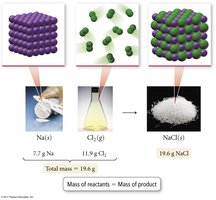
Law of Conservation of Mass
The Law of Conservation of Mass states that the total mass remains constant during a chemical reaction. This means that the mass of the substances before the reaction equals the mass of the substances after the reaction. This principle is fundamental to all chemical equations and reactions.
Key Point: Mass is neither created nor destroyed in a chemical reaction.
Example: When sodium (Na) reacts with chlorine gas (Cl2), the total mass of reactants equals the mass of the product (NaCl).
Law of Definite Proportions (Law of Constant Composition)
The Law of Definite Proportions states that all samples of a given compound, regardless of their source or how they were prepared, have the same proportions of their constituent elements. This law is essential for understanding the fixed composition of compounds.
Key Point: The ratio of elements in a compound is always the same.
Example: Water (H2O) always contains hydrogen and oxygen in a mass ratio of 2:16 (or 1:8).
Law of Multiple Proportions
The Law of Multiple Proportions states that when two elements (A and B) form more than one compound, the masses of element B that combine with 1g of element A can be expressed as a ratio of small whole numbers. This law supports the concept of atoms combining in simple ratios.
Key Point: Different compounds formed from the same elements have mass ratios that are simple whole numbers.
Example: Carbon monoxide (CO) and carbon dioxide (CO2) have oxygen-to-carbon mass ratios of 1.33:1 and 2.67:1, respectively. The ratio between these two is 2:1.
Dalton’s Atomic Theory
Dalton’s Atomic Theory laid the foundation for modern chemistry by proposing that:
Each element is composed of tiny particles called atoms.
All atoms of a given element have the same mass and properties that distinguish them from atoms of other elements.
Atoms combine in simple, whole-number ratios to form compounds.
In chemical reactions, atoms only change the way they are bound together; they are not created or destroyed.
Discovery of Electrons
J.J. Thomson discovered the electron through cathode ray experiments, determining the charge-to-mass ratio of the electron as .
Key Point: Electrons are negatively charged subatomic particles present in all atoms.
Millikan’s Oil Drop Experiment
Millikan’s experiment determined the charge and mass of a single electron:
Mass of electron:
Charge of electron:
Rutherford’s Gold Foil Experiment and the Nuclear Atom
Rutherford’s experiment disproved the Plum Pudding model and led to the nuclear model of the atom, where:
The atom consists of a dense nucleus containing protons and neutrons.
Electrons occupy the surrounding electron cloud.
Subatomic Particles and Atomic Mass Units (amu)
Atoms are composed of three main subatomic particles:
Protons (p+): Positively charged, found in the nucleus.
Neutrons (n0): Neutral, found in the nucleus.
Electrons (e-): Negatively charged, found in the electron cloud.
The atomic mass unit (amu) is defined as 1/12 the mass of a carbon-12 atom.
Atomic Number (Z) and Chemical Symbols
The atomic number (Z) is the number of protons in the nucleus and identifies the element. In a neutral atom, the number of electrons equals the number of protons. Elements are represented by their chemical symbols (e.g., H for hydrogen, Na for sodium).
Isotopes and Mass Number (A)
Isotopes are atoms of the same element with different numbers of neutrons. The mass number (A) is the sum of protons and neutrons in the nucleus and must be a whole number. Many elements have two or more naturally occurring isotopes, each with a characteristic natural abundance.
Example: Neon has three isotopes: Neon-20 (90.48%), Neon-21 (0.27%), and Neon-22 (9.25%).
Ions
Ions are atoms or molecules that have gained or lost electrons, resulting in a net charge. When atoms lose electrons, they become cations (positively charged). When they gain electrons, they become anions (negatively charged).
Example: Na (Z = 11) loses one electron to become Na+; Cl (Z = 17) gains one electron to become Cl-.
The Periodic Law and the Periodic Table
The Periodic Law states that when elements are arranged in order of increasing atomic number, elements with similar properties occur at regular intervals. The Periodic Table organizes elements into rows (periods) and columns (groups or families) based on their properties.
Group 1A: Alkali metals
Group 2A: Alkaline earth metals
Group 7A: Halogens
Group 8A: Noble gases
Atomic Mass and Isotopic Abundance
The atomic mass of an element is a weighted average of the masses of all its naturally occurring isotopes. For example, chlorine has two main isotopes: chlorine-35 (34.97 amu, 75.77%) and chlorine-37 (36.97 amu, 24.26%).
The Mole and Avogadro’s Number
The mole (mol) is the amount of substance containing particles (Avogadro’s number). The value of the mole is defined such that 12 grams of carbon-12 contains exactly one mole of carbon atoms.
Conversion factors: particles
Example: atoms C atoms
Molar Mass
The molar mass of an element (in grams per mole) is numerically equal to its atomic mass in atomic mass units (amu). This allows conversion between mass and number of moles.
Example: The molar mass of hydrogen is 1 g/mol.

Stoichiometric Calculations: Moles, Grams, and Atoms
Stoichiometric calculations involve converting between moles, grams, and number of atoms using molar mass and Avogadro’s number.
Grams to moles:
Moles to grams:
Moles to atoms:
Atoms to moles:
Example: Calculate the number of lead (Pb) atoms in 6.03 mol of lead:
atoms Pb
Example: A platinum ring contains platinum atoms. The number of moles is:
mol Pt
Summary Table: Key Atomic Properties
Property | Definition | Symbol |
|---|---|---|
Atomic Number | Number of protons in nucleus | Z |
Mass Number | Number of protons + neutrons | A |
Isotope | Atoms with same Z, different neutrons | - |
Cation | Atom with positive charge (lost electrons) | - |
Anion | Atom with negative charge (gained electrons) | - |
Mole | 6.022 x 10²³ particles | mol |
Molar Mass | g/mol, numerically equal to atomic mass (amu) | - |
