 Indietro
Atoms and Elements: Foundations of Modern Atomic Theory
Guida di studio - Note intelligenti
 Appunti personalizzati basati sui tuoi materiali, ampliati con definizioni chiave, esempi e contesto.
Atoms and Elements
Introduction to Atoms
The concept of the atom is fundamental to understanding chemistry. Atoms are the smallest identifiable units of elements and are the building blocks of all matter. The word atom comes from the Greek atomos, meaning "indivisible." While atoms themselves are composed of smaller subatomic particles, they cannot be divided further and still retain the properties of the element.
Brownian Motion: Experimental Evidence for Atoms
Brownian motion provided early experimental evidence for the existence of atoms. In 1827, Robert Brown observed the random movement of pollen particles in water, which was later explained by Albert Einstein in 1905 as the result of collisions with water molecules. Jean Perrin's experiments in 1908 confirmed Einstein's theory, solidifying the atomic model of matter.
Today, advanced instruments like the Scanning Tunneling Microscope (STM) allow scientists to image and manipulate individual atoms, bridging the gap between the macroscopic and microscopic worlds.
Early Ideas About the Building Blocks of Matter
Ancient Greek philosophers Leucippus and Democritus first proposed that matter was composed of small, indestructible particles called atoms. However, Aristotle's view that matter was made of fire, air, earth, and water dominated for nearly 2000 years. The scientific revolution in the 16th and 17th centuries, led by figures like Copernicus, Galileo, and Newton, paved the way for John Dalton's atomic theory in the early 1800s.
Modern Atomic Theory and the Laws That Led to It
The Law of Conservation of Mass
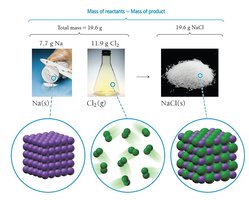
Formulated by Antoine Lavoisier in 1789, the Law of Conservation of Mass states that in a chemical reaction, matter is neither created nor destroyed. This law supports the idea that matter is composed of small, indestructible particles (atoms). The total mass of reactants equals the total mass of products in a chemical reaction.
The Law of Definite Proportions
Joseph Proust's Law of Definite Proportions (1797) states that all samples of a given compound have the same proportions of their constituent elements, regardless of their source or preparation method. For example, water always decomposes into hydrogen and oxygen in a mass ratio of 2:16 (or 1:8).
The Law of Multiple Proportions
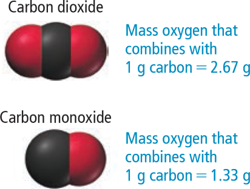
John Dalton's Law of Multiple Proportions (1804) states that when two elements form more than one compound, the masses of one element that combine with a fixed mass of the other are in ratios of small whole numbers. For example, carbon and oxygen form both carbon monoxide (CO) and carbon dioxide (CO2), with the mass of oxygen per gram of carbon in a simple ratio.
Dalton’s Atomic Theory
Dalton's atomic theory (1808) explained these laws with four main postulates:
Each element is composed of tiny, indestructible particles called atoms.
All atoms of a given element have the same mass and properties.
Atoms combine in simple, whole-number ratios to form compounds.
Atoms of one element cannot change into atoms of another element; chemical reactions only rearrange how atoms are bound together.
The Discovery of Subatomic Particles
The Electron
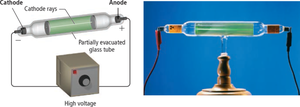
J. J. Thomson discovered the electron through cathode ray experiments. He found that cathode rays are streams of negatively charged particles (electrons) that travel from the cathode to the anode in a vacuum tube. Thomson measured the charge-to-mass ratio of the electron as .
Millikan’s Oil Drop Experiment
Robert Millikan determined the charge of a single electron using the oil drop experiment, allowing the calculation of the electron's mass.
The Structure of the Atom: Plum-Pudding Model
Thomson proposed the "plum-pudding" model, where electrons were embedded in a positively charged sphere. However, this model was soon challenged by new experiments.
Rutherford’s Gold Foil Experiment and the Nuclear Model
Ernest Rutherford's gold foil experiment showed that most alpha particles passed through gold foil, but some were deflected at large angles. This led to the nuclear model of the atom, where:
Most of the atom's mass and all positive charge are concentrated in a small nucleus.
Electrons move through the empty space around the nucleus.
The number of protons equals the number of electrons, making the atom electrically neutral.
The Discovery of the Neutron
James Chadwick discovered the neutron in 1932. Neutrons are neutral particles in the nucleus with a mass similar to protons. The presence of neutrons explains the difference in mass between isotopes of the same element.
Subatomic Particles
Types and Properties of Subatomic Particles
Atoms are composed of three main subatomic particles:
Protons (p+): Positively charged, located in the nucleus.
Neutrons (n): Neutral, located in the nucleus.
Electrons (e-): Negatively charged, move rapidly around the nucleus.
The nucleus is extremely small and dense, containing nearly all the atom's mass. The atomic mass unit (amu) is defined as 1/12 the mass of a carbon-12 atom.
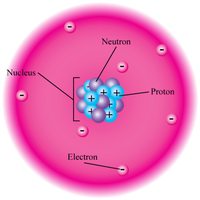
Table: Properties of Subatomic Particles
Particle | Symbol | Charge | Mass (amu) |
|---|---|---|---|
Proton | p+ | +1 | 1.0073 |
Neutron | n | 0 | 1.0087 |
Electron | e- | -1 | 0.00055 |
Elements and Atomic Number
Defining Elements by Atomic Number
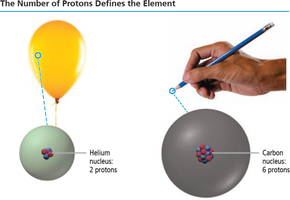
The number of protons in an atom's nucleus, called the atomic number (Z), defines the element. Every atom of a given element has the same number of protons and thus the same atomic number.
Chemical Symbols
Elements are represented by chemical symbols, usually one or two letters. The first letter is always capitalized, and the second (if present) is lowercase. Some symbols are derived from Latin names (e.g., Na for sodium from natrium).
Isotopes
Definition and Notation
Isotopes are atoms of the same element (same number of protons) but with different numbers of neutrons. The mass number (A) is the sum of protons and neutrons: .
Isotopes are represented as:
AZX (where X is the chemical symbol, A is the mass number, Z is the atomic number)
Or as X-A (e.g., C-13 for carbon-13)
Natural Abundance
The relative amount of each isotope in a naturally occurring sample is called its natural abundance. Mass spectrometry allows precise measurement of isotope abundances.
Example: Calculating Neutrons in an Isotope
For an argon isotope with mass number 40 (A = 40) and atomic number 18 (Z = 18):
Number of neutrons = A - Z = 40 - 18 = 22
Summary Table: Key Laws and Concepts
Law/Concept | Description | Key Scientist(s) |
|---|---|---|
Law of Conservation of Mass | Matter is neither created nor destroyed in chemical reactions. | Lavoisier |
Law of Definite Proportions | All samples of a compound have the same element proportions. | Proust |
Law of Multiple Proportions | Element masses in compounds are in small whole number ratios. | Dalton |
Atomic Theory | All matter is composed of atoms; atoms of each element are unique. | Dalton |
