 Indietro
Atoms and Elements: Foundations of Modern Chemistry
Guida di studio - Note intelligenti
 Appunti personalizzati basati sui tuoi materiali, ampliati con definizioni chiave, esempi e contesto.
Atoms and Elements
Introduction to Atoms
Atoms are the fundamental building blocks of matter. The concept of the atom originated from the Greek word atomos, meaning "indivisible." Cutting a material, such as graphite, into smaller pieces eventually yields individual atoms, which cannot be divided further without losing their chemical identity. - Key Point: Atoms compose all ordinary matter. - Key Point: There are about 91 naturally occurring elements, each defined by its atoms.
Historical Development of Atomic Theory
Early philosophers like Leucippus and Democritus proposed that matter was composed of small, indestructible particles called atoms. However, Plato and Aristotle believed matter had no smallest parts and was made of fire, air, earth, and water. The scientific approach, championed by John Dalton, provided evidence for the atomic theory.
Modern Atomic Theory and Fundamental Laws
The Law of Conservation of Mass
Antoine Lavoisier formulated the law of conservation of mass, stating that in a chemical reaction, matter is neither created nor destroyed. The total mass of reactants equals the total mass of products. Example: When sodium reacts with chlorine to form sodium chloride, the mass of reactants equals the mass of the product. 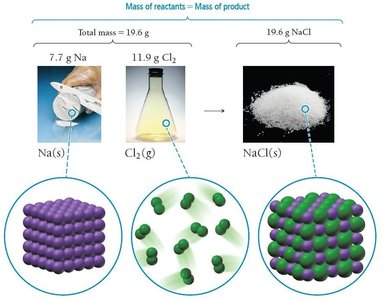
The Law of Definite Proportions
Joseph Proust observed that all samples of a given compound have the same proportions of their constituent elements, regardless of source or preparation. - Example: Water always decomposes into 16.0 g oxygen and 2.0 g hydrogen, an 8:1 mass ratio.
The Law of Multiple Proportions
John Dalton's law states that when two elements form different compounds, the masses of one element that combine with a fixed mass of the other can be expressed as ratios of small whole numbers. - Example: Carbon monoxide and carbon dioxide both contain carbon and oxygen, but the mass ratios of oxygen to carbon are 1.33:1 and 2.67:1, respectively. 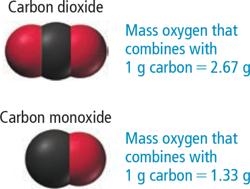
Discovery of Subatomic Particles
The Electron
J. J. Thomson discovered the electron through cathode ray experiments, showing that these rays were composed of negatively charged particles. 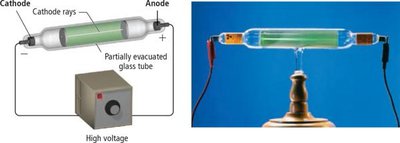 - Key Point: Electrons travel in straight lines, are independent of the cathode material, and carry a negative charge. Thomson measured the charge-to-mass ratio of the electron:
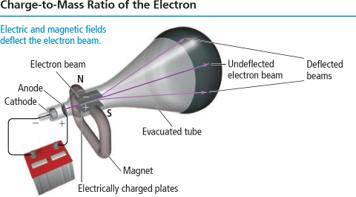
Millikan’s Oil Drop Experiment
Robert Millikan determined the charge of a single electron using oil droplets suspended in an electric field. The charge was always a whole-number multiple of C. 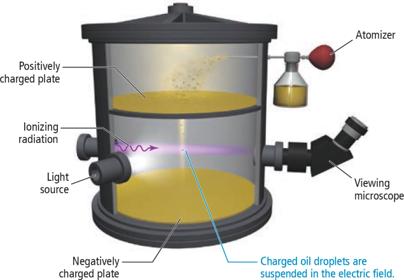
Properties of Electrical Charge
- Positive and negative charges attract. - Like charges repel. - Charges of equal magnitude but opposite sign sum to zero. 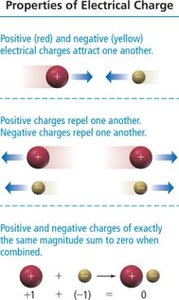
Atomic Models
Plum-Pudding Model: Thomson proposed that electrons were embedded in a sphere of positive charge. 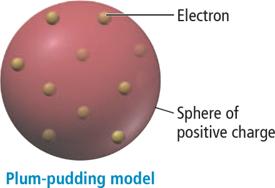 Rutherford’s Gold Foil Experiment: Rutherford directed alpha particles at gold foil, expecting them to pass through with minimal deflection. Instead, some were deflected at large angles, leading to the nuclear model of the atom.
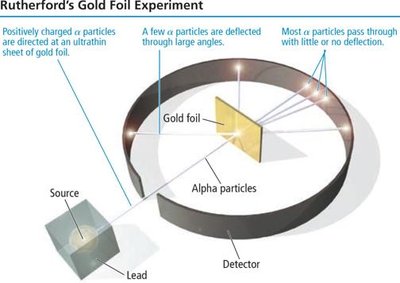
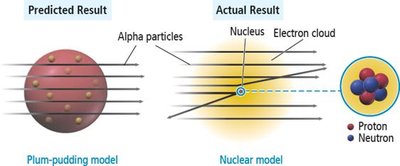
Structure of the Atom
Subatomic Particles
Atoms are composed of protons, neutrons, and electrons. - Proton: Positive charge, mass kg - Neutron: No charge, mass kg - Electron: Negative charge, mass kg
Table: Subatomic Particles
Particle | Mass (kg) | Charge |
|---|---|---|
Proton | 1.67262 × 10⁻²⁷ | +1 |
Neutron | 1.67493 × 10⁻²⁷ | 0 |
Electron | 0.00091 × 10⁻²⁷ | -1 |
Defining Elements by Protons
The number of protons in the nucleus (atomic number, Z) defines the element. 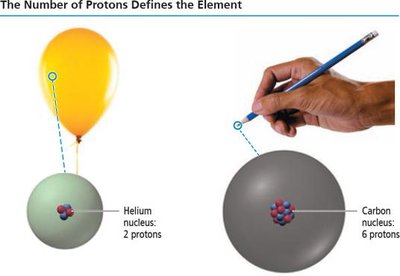
The Periodic Table and Classification of Elements
Structure of the Periodic Table
The periodic table organizes elements by increasing atomic number. Each element is identified by its atomic number and chemical symbol. 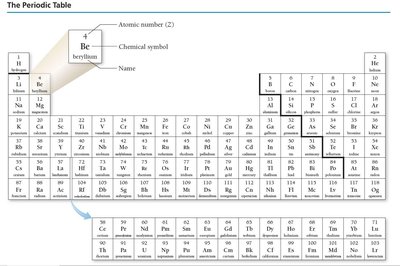
Classification of Elements
Elements are classified as metals, nonmetals, or metalloids. 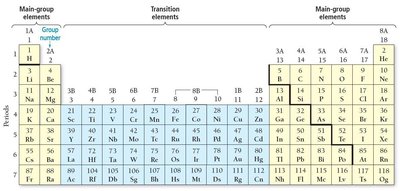 - Metals: Good conductors, malleable, ductile, shiny, tend to lose electrons. - Nonmetals: Poor conductors, not malleable or ductile, tend to gain electrons. - Metalloids: Exhibit mixed properties, often semiconductors.
Groups and Periods
- Groups: Vertical columns (1–18) - Periods: Horizontal rows (1–7)
Special Groups
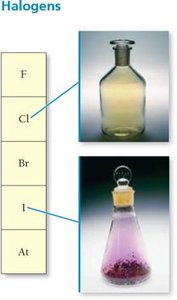
- Noble Gases (Group 8A): Unreactive, stable elements. - Alkali Metals (Group 1A): Highly reactive metals. 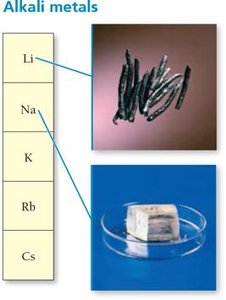 - Alkaline Earth Metals (Group 2A): Fairly reactive metals. - Halogens (Group 7A): Very reactive nonmetals.
Isotopes and Atomic Mass
Isotopes
Atoms of the same element with different numbers of neutrons are called isotopes. The sum of protons and neutrons is the mass number (A). 
Table: Neon Isotopes
Symbol | Protons | Neutrons | Mass Number (A) | Natural Abundance (%) |
|---|---|---|---|---|
Ne-20 | 10 | 10 | 20 | 90.48 |
Ne-21 | 10 | 11 | 21 | 0.27 |
Ne-22 | 10 | 12 | 22 | 9.25 |
Atomic Mass
Atomic mass is the weighted average of the masses of an element's isotopes, based on their natural abundance. 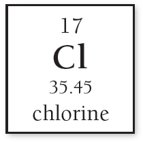
Ions and the Periodic Table
Formation of Ions
Atoms can lose or gain electrons to form ions. - Cations: Positively charged (e.g., Na+) - Anions: Negatively charged (e.g., F-)
Predictable Ion Charges
Main-group metals tend to lose electrons, forming cations with charges equal to their group number. Main-group nonmetals tend to gain electrons, forming anions with charges equal to their group number minus eight. 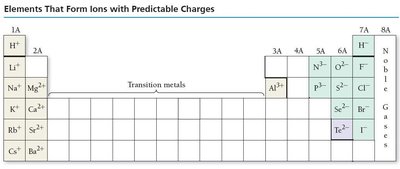
Counting Atoms: The Mole Concept
The Mole and Avogadro’s Number
The mole (mol) is a unit representing particles (Avogadro’s number). 1 mole of an element contains $6.022 \times 10^{23}$ atoms.
Converting Between Mass, Moles, and Atoms
The molar mass (grams per mole) is numerically equal to the atomic mass (amu). Conversion steps: 1. Mass of element (g) → Moles of element (mol) 2. Moles of element → Number of atoms 
Mass Spectrometry
Mass spectrometry is used to determine the masses and abundances of isotopes, providing accurate atomic mass values. 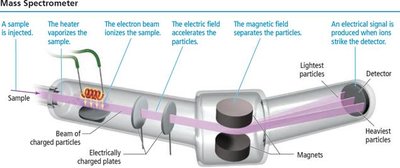
Summary Table: Key Atomic Concepts
Concept | Definition | Example |
|---|---|---|
Atom | Smallest unit of an element | Carbon atom |
Element | Defined by number of protons | Helium (2 protons) |
Isotope | Same element, different neutrons | Ne-20, Ne-21, Ne-22 |
Mole | 6.022 × 10²³ particles | 1 mol C atoms |
Cation | Positive ion | Na+ |
Anion | Negative ion | F- |
