 Indietro
Atoms and Elements: Foundations of Modern Atomic Theory
Guida di studio - Note intelligenti
 Appunti personalizzati basati sui tuoi materiali, ampliati con definizioni chiave, esempi e contesto.
Atoms and Elements
Brownian Motion: Atoms Confirmed
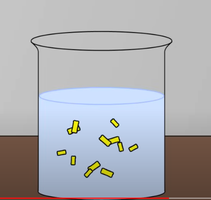
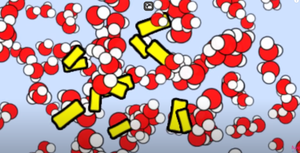
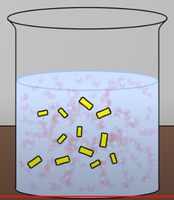
Brownian motion refers to the random movement of particles suspended in a fluid, first observed by Robert Brown in 1827. This phenomenon was later explained by Albert Einstein and Jean Perrin, who demonstrated that the motion results from collisions with invisible molecules, providing strong evidence for the existence of atoms and molecules.
Key Point 1: Brownian motion is caused by the constant, random collisions of suspended particles with molecules of the surrounding fluid.
Key Point 2: The observation of Brownian motion confirmed the molecular nature of matter.
Example: Pollen grains suspended in water exhibit random movement, which is not due to life but to molecular collisions.
Early Ideas About the Building Blocks of Matter
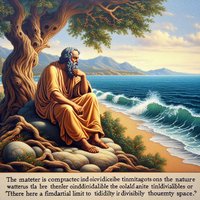
The concept of fundamental particles in matter dates back to ancient civilizations. Greek philosophers Leucippus and Democritus proposed that matter is composed of small, indivisible particles called atoms. In contrast, Plato and Aristotle believed in four basic elements and infinite divisibility of matter.
Key Point 1: Atomism posits that matter consists of tiny, indestructible particles called atoms.
Key Point 2: Anti-atomistic views held that matter is made of four elements (water, fire, earth, air) and is infinitely divisible.
Example: "Nothing exists except atoms and empty space"—a quote attributed to Democritus.
Additional info: The atomistic perspective laid the groundwork for modern chemistry, while the four-element theory dominated Western thought until the scientific revolution.
Modern Atomic Theory and the Laws That Led to It
Modern atomic theory was developed through the study of several fundamental laws that describe the behavior of matter in chemical reactions. These laws provided the basis for John Dalton's atomic theory.
The Law of Conservation of Mass
Formulated by Antoine Lavoisier, this law states that matter is neither created nor destroyed in a chemical reaction. The mass of reactants equals the mass of products.
Equation:
Example: Burning hydrogen in oxygen produces water, but the total mass remains unchanged.
The Law of Definite Proportions
Joseph Proust observed that all samples of a given compound have the same proportions of their constituent elements, regardless of source or preparation. This is also known as the law of constant composition.
Key Point 1: The ratio of elements in a compound is always fixed.
Example: Water (H2O) always has a mass ratio of hydrogen to oxygen of 1:8.
Sample | Mass of Compound (g) | Mass of Hydrogen (g) | Mass of Oxygen (g) | Ratio (H:O) |
|---|---|---|---|---|
1 | 18 | 2 | 16 | 1:8 |
2 | 36 | 4 | 32 | 1:8 |
3 | 54 | 6 | 48 | 1:8 |
Sample | Mass of Compound (g) | Mass of Nitrogen (g) | Mass of Hydrogen (g) | Ratio (N:H) |
|---|---|---|---|---|
1 | 17 | 14 | 3 | 14:3 |
2 | 34 | 28 | 6 | 14:3 |
3 | 51 | 42 | 9 | 14:3 |
Additional info: The law of definite proportions is fundamental to understanding chemical formulas and stoichiometry.
The Law of Multiple Proportions
This law states that when two elements form more than one compound, the masses of one element that combine with a fixed mass of the other are in ratios of small whole numbers.
Key Point 1: Different compounds formed from the same elements have mass ratios that are simple whole numbers.
Example: Carbon monoxide (CO) and carbon dioxide (CO2) have different mass ratios of carbon to oxygen.
Compound | Mass of Carbon (g) | Mass of Oxygen (g) | Ratio (C:O) |
|---|---|---|---|
CO | 12.01 | 16.00 | 12.01:16.00 |
CO2 | 12.01 | 32.00 | 12.01:32.00 |
Additional info: The ratio of oxygen in CO2 to CO is 2:1, illustrating the law of multiple proportions.
John Dalton and the Atomic Theory
John Dalton formulated the atomic theory based on experimental evidence and the laws described above. His postulates established the foundation for modern chemistry.
Postulate 1: Each element is composed of tiny, indestructible particles called atoms.
Postulate 2: All atoms of a given element have the same mass and properties.
Postulate 3: Atoms combine in simple, whole-number ratios to form compounds.
Postulate 4: Atoms of one element cannot change into atoms of another element; they only rearrange in chemical reactions.
Additional info: Dalton's atomic theory explained the laws of conservation of mass, definite proportions, and multiple proportions, and remains a cornerstone of chemical science.
