 Indietro
Atoms & Elements: Structure, Properties, and the Periodic Table
Guida di studio - Note intelligenti
 Appunti personalizzati basati sui tuoi materiali, ampliati con definizioni chiave, esempi e contesto.
Atoms & Elements
Periodic Table: Classifications
The periodic table organizes elements based on their properties and atomic structure. Elements are classified into three main categories: metals, non-metals, and metalloids.
Metals: Largest classification; typically solid, shiny, malleable, ductile, and good conductors of heat and electricity.
Non-metals: Generally gases or brittle solids; dull, poor conductors, and not malleable or ductile.
Metalloids: Exhibit properties intermediate between metals and non-metals; found along the staircase line on the periodic table.
Example: Silicon (Si) is a metalloid, while calcium (Ca) is a metal with properties similar to barium (Ba).
Periodic Table: Group Names
Elements are further organized into periods (horizontal rows) and groups (vertical columns, also called families). There are 18 groups, each with similar chemical properties due to their electron configurations.
Representative Elements: Groups 1, 2, and 13–18 (also called main group elements).
Transition Metals: Groups 3–12, known for variable oxidation states.
Example: Strontium (Sr) is a metal in the 4th period.
Periodic Table: Element Symbols
Each element is represented by a unique symbol, usually derived from its English or Latin name. The periodic table is arranged by increasing atomic number (number of protons).
Atomic Number (Z): Number of protons in the nucleus.
Element Symbol: One or two letters, e.g., H for hydrogen, Na for sodium (from Latin Natrium).
Periodic Table: Elemental Forms
Elements exist in different forms in nature:
Monoatomic: Stable as single atoms (e.g., noble gases).
Diatomic: Stable as pairs (e.g., H2, N2, O2, F2, Cl2, Br2, I2).
Polyatomic: Stable in groups larger than two (e.g., S8).
Homonuclear: Molecules with the same element (e.g., O2); Heteronuclear: Molecules with different elements (e.g., CO).
Periodic Table: Phases of Matter
At room temperature (25°C, 1 atm), elements can exist as solids, liquids, or gases:
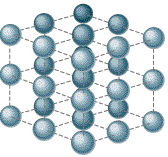
Solids: Fixed shape and volume; particles are closely packed in a regular pattern.
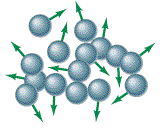
Liquids: Fixed volume but take the shape of their container; particles are close but can move past each other.
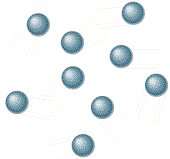
Gases: Take both the shape and volume of their container; particles are far apart and move freely.
Periodic Table: Charges and Ions
Elements form ions by losing or gaining electrons to achieve noble gas configurations:
Metals: Lose electrons to form positively charged cations.
Non-metals: Gain electrons to form negatively charged anions.
Transition Metals: Often have variable charges (Type II metals).
Example: Gallium forms a +3 ion (Ga3+); selenium forms a -2 ion (Se2–).
Calculating Molar Mass
Molar mass is the mass of one mole of a substance, expressed in grams per mole (g/mol). It is calculated by summing the atomic masses of all atoms in a chemical formula.
Formula:
Also called molecular weight or formula mass.
Example: For (NH4)2SO4:
2 N × 14.01 g/mol = 28.02 g/mol
8 H × 1.008 g/mol = 8.064 g/mol
1 S × 32.07 g/mol = 32.07 g/mol
4 O × 16.00 g/mol = 64.00 g/mol
Total = 132.154 g/mol
The Mole Concept
The mole is a counting unit in chemistry, linking the atomic scale to the macroscopic scale. One mole contains Avogadro's number () of particles (atoms, molecules, ions, or formula units).
Conversions:
Moles ↔ Particles:
Moles ↔ Mass:
The Atom: Structure and Subatomic Particles
An atom consists of a dense nucleus (protons and neutrons) surrounded by electrons.
Protons (p+): Positive charge, mass ≈ 1 amu
Neutrons (n0): No charge, mass ≈ 1 amu
Electrons (e–): Negative charge, mass ≈ 0.0005 amu
Atomic Models and Experiments
Rutherford Gold Foil Experiment
Rutherford's experiment demonstrated that atoms have a small, dense, positively charged nucleus. Alpha particles were directed at gold foil; most passed through, but some were deflected, indicating a concentrated nucleus.
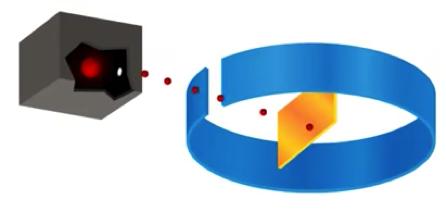
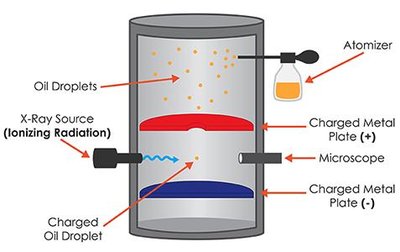
Millikan Oil Drop Experiment
Millikan measured the charge of the electron by balancing the gravitational and electrical forces on tiny charged oil droplets.
Isotopes
Isotopes are atoms of the same element (same number of protons) with different numbers of neutrons. They are represented as:
Atomic Number (Z): Number of protons
Mass Number (A): Number of protons + neutrons
Isotope Notation: (e.g., for calcium-43)
Ions
Ions are atoms or molecules that have gained or lost electrons:
Cations: Positively charged (loss of electrons)
Anions: Negatively charged (gain of electrons)
Isoelectronic: Species with the same number of electrons
Atomic Mass
The atomic mass of an element is the weighted average of the masses of its isotopes, measured in atomic mass units (amu), daltons (Da), or kilograms (kg).
Formula:
Law of Conservation of Mass
States that matter is neither created nor destroyed in a chemical reaction; the mass of reactants equals the mass of products.
Law of Definite Proportions
A chemical compound always contains the same proportion of elements by mass, regardless of sample size or source.
Atomic Theory
John Dalton's atomic theory (1803) states:
All matter is made of indivisible atoms.
Atoms of the same element are identical in mass and properties.
Atoms combine in simple, whole-number ratios to form compounds.
Chemical reactions rearrange atoms but do not create or destroy them.
Law of Multiple Proportions
When two elements form more than one compound, the masses of one element that combine with a fixed mass of the other are in ratios of small whole numbers.
*Additional info: Some explanations and formulas have been expanded for clarity and completeness based on standard general chemistry curriculum.*
