 Indietro
Atoms and Ionic Bonds: Structure, Formation, and Properties
Guida di studio - Note intelligenti
 Appunti personalizzati basati sui tuoi materiali, ampliati con definizioni chiave, esempi e contesto.
Ionic Bonds and Ionic Compounds
Introduction to Ionic and Covalent Compounds
Ionic and covalent bonds are the two primary types of chemical bonds that hold atoms together in compounds. Understanding the differences between these bonds is fundamental to predicting compound properties and behaviors.
Ionic bonds form between metals and nonmetals through the transfer of electrons, resulting in the formation of ions.
Covalent bonds form between nonmetals through the sharing of electrons.
Some compounds may contain both ionic and covalent character, especially those with polyatomic ions.
Empirical formulas are used for ionic compounds because they do not exist as discrete molecules.
Example: MgF2 (magnesium fluoride) is an ionic compound, while SF6 (sulfur hexafluoride) is covalent.
Naming Ionic Compounds
Rules for Naming
Naming ionic compounds requires identifying the cation and anion, including their charges and, if necessary, the use of Roman numerals for transition metals.
Monoatomic ions: Single-atom ions, e.g., Na+, Cl–.
Transition metal ions: May have multiple possible charges, e.g., Fe2+ (iron(II)), Fe3+ (iron(III)).
Polyatomic ions: Ions composed of multiple atoms, e.g., SO42– (sulfate), NH4+ (ammonium).
For compounds with polyatomic ions, the name is cation + anion (e.g., magnesium sulfate for MgSO4).
Examples:
Al(ClO3)3: aluminum perchlorate
NaHCO3: sodium hydrogen carbonate (sodium bicarbonate)
FeCl3: iron(III) chloride or ferric chloride
Common Ions and Polyatomic Ions
Monoatomic Ions
Group 1 (alkali metals): +1 charge (e.g., Li+, Na+, K+)
Group 2 (alkaline earth metals): +2 charge (e.g., Mg2+, Ca2+)
Group 16 (chalcogens): –2 charge (e.g., O2–, S2–)
Group 17 (halogens): –1 charge (e.g., F–, Cl–)
Transition Metal Ions
Transition metals can form multiple cations with different charges, requiring Roman numerals in their names.
Examples: Cu+ (copper(I)), Fe2+ (iron(II)), Fe3+ (iron(III))
Polyatomic Ions
Ammonium: NH4+
Sulfate: SO42–
Nitrate: NO3–
Phosphate: PO43–
Oxoanions: Polyatomic ions containing oxygen, such as chlorate (ClO3–), perchlorate (ClO4–), etc.
Naming oxoanions with hydrogen: HPO42– (hydrogen phosphate), H2PO4– (dihydrogen phosphate).
Atomic and Ionic Radii
Trends and Definitions
The size of atoms and ions is important for understanding chemical bonding and properties.
Covalent radius: Half the distance between nuclei of two bonded atoms.
Metallic radius: Half the distance between nuclei in a metallic lattice.
Ionic radius: Size of an ion in a crystal lattice; cations are smaller and anions are larger than their parent atoms.
Example: Na+ is smaller than Na, Cl– is larger than Cl.
Ionization Energy
Definition and Trends
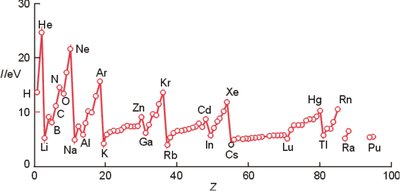
Ionization energy (IE) is the energy required to remove an electron from an atom or ion in the gas phase. It is a key factor in determining how easily an atom forms cations.
First ionization energy (IE1):
Second ionization energy (IE2):
Ionization energy generally increases across a period and decreases down a group.
Electron Configurations and Stability
Favored Configurations and the Octet Rule
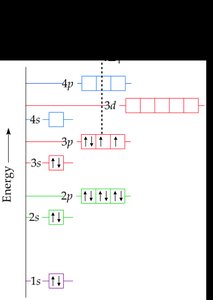
Atoms tend to achieve stable electron configurations, often resembling the nearest noble gas. This is the basis for the octet rule, which states that atoms are most stable with eight electrons in their valence shell.
Closed shell: Completely filled s and p subshells (noble gas configuration).
Half-filled shell: Subshells with half their maximum number of electrons also have some stability.
Nonmetals (p-block) tend to gain electrons; metals (s-block) tend to lose electrons.
Transition metals (d-block) may not achieve noble gas configurations and can form multiple cations.
Formation and Properties of Ionic Compounds
Predicting Ionic Compounds
Ionic compounds are formed by the combination of cations and anions in ratios that result in electrical neutrality. The empirical formula represents the simplest whole-number ratio of ions.
Example: Aluminum nitride (AlN) forms from Al3+ and N3–.
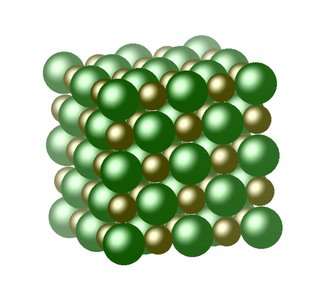
Ionic compounds do not exist as discrete molecules but as extended lattices.
Ionic Bonding and Lattice Energy
Ionic compounds are held together by electrostatic attractions between oppositely charged ions. The strength of this attraction is quantified as lattice energy.
Coulomb's Law: , where and are the charges, is the distance between ions, and is a
proportionality constant. ( z_1 is the charge of the cation)( z_2 is the charge of the anion )( bottom is the inter-nucellar distance)
Lattice energy increases with higher charges and smaller ionic radii.
Calculating Lattice Energy
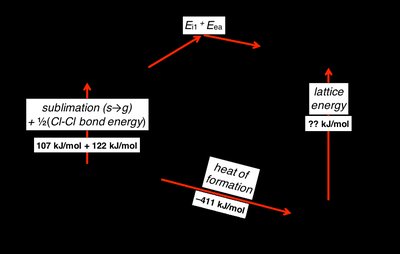
Lattice energy can be calculated using thermochemical cycles (Born-Haber cycle), which combine several energetic steps involved in forming an ionic solid from its elements.
Steps include sublimation, ionization, bond dissociation, electron affinity, and lattice formation.
The sum of these energies gives the overall enthalpy change for the formation of the ionic compound.
Trends in Lattice Energy and Melting Point
Lattice energy and melting point are related to the strength of ionic bonding. Compounds with higher lattice energies generally have higher melting points.
Lattice energy increases with increasing ion charge and decreasing ion size.
Melting points follow similar trends as lattice energy.
we do this to find the melting point and to demistrate the space between the ions the bigger the space the lower the melting point .
Compound | Interionic Distance (Å) | Melting Point (°C) | Lattice Energy (kJ/mol) |
|---|---|---|---|
NaF | 2.31 | 988 | 923 |
NaCl | 2.79 | 801 | 787 |
NaBr | 2.94 | 790 | 747 |
NaI | 3.18 | 660 |
cat ion charge- anion charge- |
|---|
