 Indietro
Atoms and the Structure of Matter: General Chemistry Chapter 1 Study Notes
Guida di studio - Note intelligenti
 Appunti personalizzati basati sui tuoi materiali, ampliati con definizioni chiave, esempi e contesto.
Atoms and Matter
Introduction to Matter
Matter is defined as anything that has mass and occupies space. Chemistry is the scientific discipline that seeks to understand the properties and behavior of matter by studying its composition and structure at the atomic and molecular level.
Atoms: The basic submicroscopic particles that constitute the fundamental building blocks of ordinary matter.
Molecules: Substances formed when two or more atoms bond together in specific geometric arrangements.
Example: A water molecule consists of two hydrogen atoms and one oxygen atom bonded together.
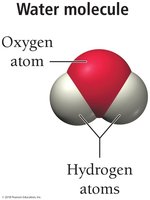
Classification of Matter
States of Matter
Matter can exist in three primary physical states: solid, liquid, and gas. The arrangement and movement of particles in each state determine their properties.
Solid: Atoms or molecules are tightly packed in fixed locations, resulting in a fixed volume and rigid shape.
Liquid: Atoms or molecules are closely packed but can move relative to each other, giving liquids a fixed volume but not a fixed shape.
Gas: Atoms or molecules are widely spaced and free to move, making gases compressible and able to fill the shape of their container.
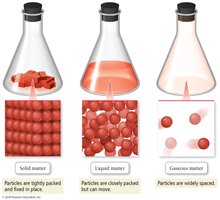
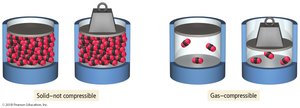
Compressibility of Solids and Gases
Solids are not compressible due to their tightly packed structure, while gases are compressible because their particles are widely spaced.
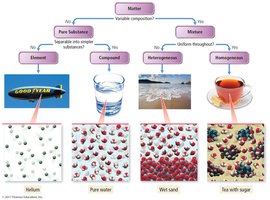
Classification by Composition
Matter can also be classified based on its composition:
Pure Substance: Made up of only one component with invariant composition. Can be an element or a compound.
Mixture: Composed of two or more components in variable proportions. Can be heterogeneous (non-uniform) or homogeneous (uniform).
Early Atomic Theory
Historical Perspectives
Early philosophers such as Leucippus and Democritus proposed that matter was composed of small, indestructible particles called atoms. Later, John Dalton provided experimental evidence supporting the atomic theory.
Laws Leading to Atomic Theory
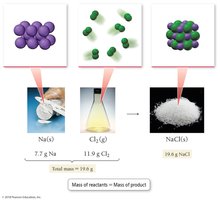
Law of Conservation of Mass: In a chemical reaction, matter is neither created nor destroyed.
Law of Definite Proportions: All samples of a given compound have the same proportions of their constituent elements.
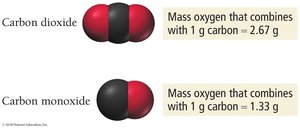
Law of Multiple Proportions: When two elements form different compounds, the masses of one element that combine with a fixed mass of the other can be expressed as ratios of small whole numbers.
Structure of the Atom
Discovery of Subatomic Particles
Atoms are composed of three main subatomic particles: protons, neutrons, and electrons.
Proton: Positively charged particle found in the nucleus.
Neutron: Neutral particle found in the nucleus.
Electron: Negatively charged particle found outside the nucleus.
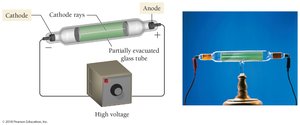
J.J. Thomson's Cathode Ray Experiment
Thomson's experiment led to the discovery of the electron, showing that atoms contain negatively charged particles.
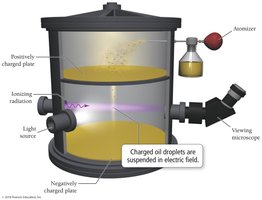
Millikan's Oil Drop Experiment
Millikan determined the charge of a single electron using his oil drop experiment.
Atomic Models
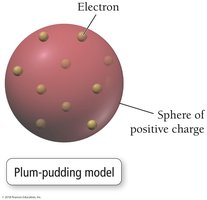
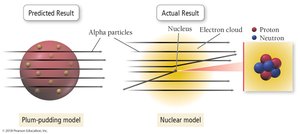
Plum-Pudding Model: Proposed by J.J. Thomson, this model suggested electrons were embedded in a sphere of positive charge.
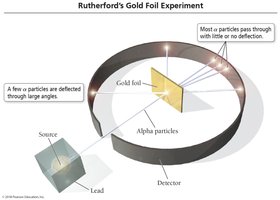
Rutherford's Gold Foil Experiment: Demonstrated that atoms have a small, dense nucleus containing protons, with electrons dispersed in empty space.
Neutrons
Neutrons were discovered by James Chadwick, explaining the previously unaccounted mass in the nucleus.
Subatomic Particles Table
Properties of Subatomic Particles
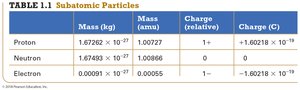
The following table summarizes the mass and charge of protons, neutrons, and electrons:
Particle | Mass (kg) | Mass (amu) | Charge (relative) | Charge (C) |
|---|---|---|---|---|
Proton | 1.67262 × 10⁻²⁷ | 1.00727 | 1+ | +1.60218 × 10⁻¹⁹ |
Neutron | 1.67493 × 10⁻²⁷ | 1.00866 | 0 | 0 |
Electron | 0.00091 × 10⁻²⁷ | 0.00055 | 1– | –1.60218 × 10⁻¹⁹ |
Elements and the Periodic Table
Atomic Number and Element Identity
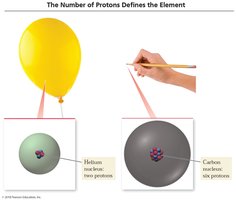
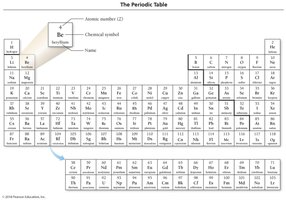
The number of protons in an atom's nucleus defines the element and is called the atomic number (Z).
Isotopes
Definition and Representation
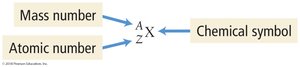
Isotopes are atoms of the same element with different numbers of neutrons, resulting in different mass numbers (A).
Notation: where X is the chemical symbol, A is the mass number, and Z is the atomic number.
Alternative Notation: Chemical symbol or name followed by a dash and the mass number (e.g., C-12).

Natural Abundance
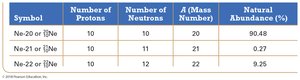
The relative amount of each isotope in a naturally occurring sample is called its natural abundance.
Symbol | Number of Protons | Number of Neutrons | Mass Number (A) | Natural Abundance (%) |
|---|---|---|---|---|
Ne-20 | 10 | 10 | 20 | 90.48 |
Ne-21 | 10 | 11 | 21 | 0.27 |
Ne-22 | 10 | 12 | 22 | 9.25 |
Ions
Charged Atoms
Atoms can lose or gain electrons during chemical changes, forming ions:
Cations: Positively charged ions formed by loss of electrons (typically metals).
Anions: Negatively charged ions formed by gain of electrons (typically nonmetals).
Atomic Mass
Average Atomic Mass
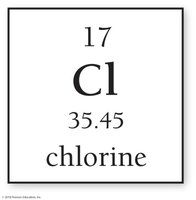
The atomic mass of an element is the weighted average of the masses of its isotopes, based on their natural abundance.
Formula:
Mass Spectrometry
Measuring Atomic Mass and Isotope Abundance
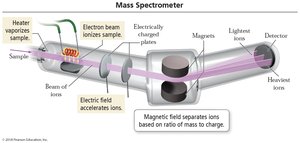
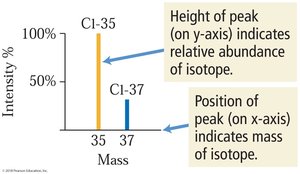
Mass spectrometry is a technique used to measure the masses of atoms and the percent abundances of isotopes by separating particles according to their mass-to-charge ratio.
The Mole and Avogadro's Number
Definition of the Mole
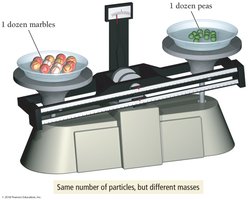
A mole is a counting unit in chemistry, defined as containing exactly entities (Avogadro's number). The mole allows chemists to relate the mass of a substance to the number of particles it contains.
Example: 1 mol of water molecules contains molecules.
Mole Conversions
To convert between number of moles and number of atoms:
Use the conversion factor:
Mass and Moles
The mass of 1 mole of atoms of an element is called the molar mass, and is numerically equal to the element's atomic mass in atomic mass units (amu), but expressed in grams per mole (g/mol).
Example:
 ----------------------------------------
