 Indietro
Atoms, Molecules, and Ions: Foundations of Modern Chemistry
Guida di studio - Note intelligenti
 Appunti personalizzati basati sui tuoi materiali, ampliati con definizioni chiave, esempi e contesto.
Atoms, Molecules, and Ions
Atomic Theory of Matter
The concept of the atom as the fundamental building block of matter has evolved from philosophical speculation to a scientific theory supported by experimental evidence. John Dalton's atomic theory, developed in the early 1800s, laid the groundwork for modern chemistry by explaining the nature of elements and compounds.
Law of Constant Composition: Compounds always contain the same proportion of elements by mass. For example, water (H2O) always contains two hydrogen atoms for every oxygen atom.
Law of Conservation of Mass: Mass is neither created nor destroyed in chemical reactions. The total mass of reactants equals the total mass of products.
Law of Multiple Proportions: When two elements form more than one compound, the masses of one element that combine with a fixed mass of the other are in ratios of small whole numbers.
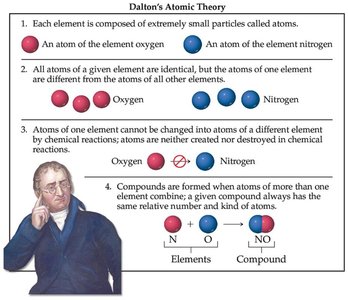
Dalton's Atomic Theory (Summary):
Elements are composed of extremely small particles called atoms.
All atoms of a given element are identical in mass and properties, but differ from atoms of other elements. Additional info: Isotopes are exceptions to this postulate.
Atoms are not created or destroyed in chemical reactions; they are simply rearranged. Additional info: Nuclear reactions are exceptions.
Atoms of different elements combine in simple whole-number ratios to form compounds.
Discovery of Subatomic Particles
Dalton's model of the atom was later refined as scientists discovered that atoms are composed of even smaller particles: electrons, protons, and neutrons.
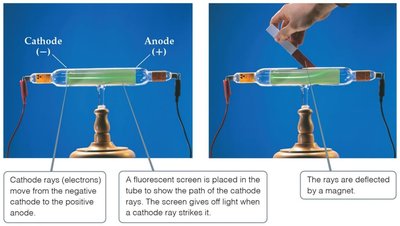
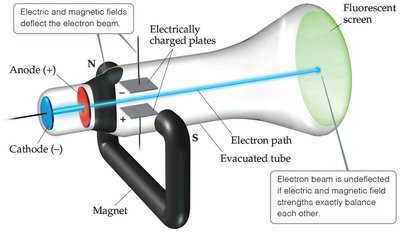
Electrons: Discovered by J.J. Thomson using cathode ray tubes. Electrons are negatively charged and have a very small mass compared to protons and neutrons.
Protons: Positively charged particles found in the nucleus.
Neutrons: Neutral particles also found in the nucleus.
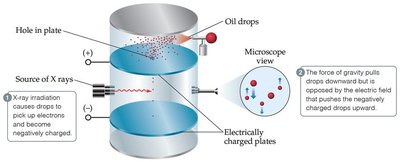
Millikan Oil-Drop Experiment: Determined the charge and mass of the electron.
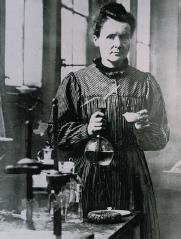
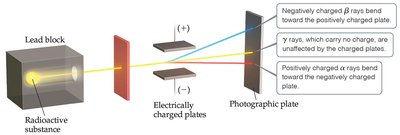
Radioactivity: The spontaneous emission of radiation by certain elements, first observed by Henri Becquerel and studied by Marie and Pierre Curie, revealed the existence of subatomic particles and atomic energy.
Models of the Atom
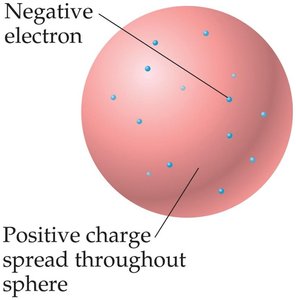
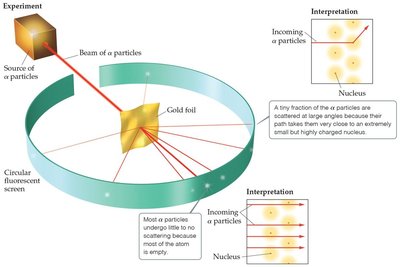
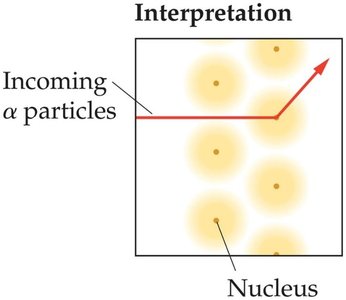
Early models of the atom, such as Thomson's "plum pudding" model, were replaced by the nuclear model after Ernest Rutherford's gold foil experiment demonstrated that atoms have a small, dense, positively charged nucleus.
Modern View of Atomic Structure
Atoms consist of a nucleus containing protons and neutrons, surrounded by electrons occupying most of the atom's volume. The nucleus contains nearly all the atom's mass.
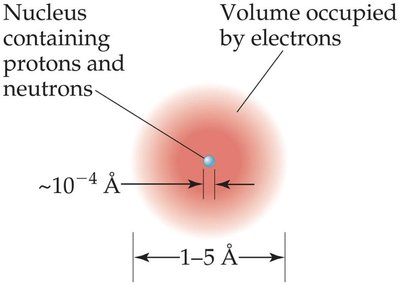
Protons: Charge +1, mass ≈ 1 amu
Neutrons: Charge 0, mass ≈ 1 amu
Electrons: Charge -1, mass ≈ 0.0005 amu
Particle | Charge | Mass (amu) |
|---|---|---|
Proton | +1 | 1.0073 |
Neutron | 0 | 1.0087 |
Electron | -1 | 5.486 × 10⁻⁴ |
Atomic Number, Mass Number, and Isotopes
The atomic number (Z) is the number of protons in an atom and defines the element. The mass number (A) is the sum of protons and neutrons. Isotopes are atoms of the same element with different numbers of neutrons.
Isotope | Protons | Neutrons |
|---|---|---|
Carbon-12 | 6 | 6 |
Carbon-13 | 6 | 7 |
Carbon-14 | 6 | 8 |
Atomic Mass Unit and Atomic Weight
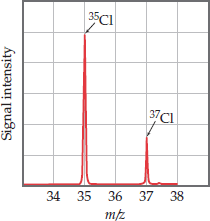
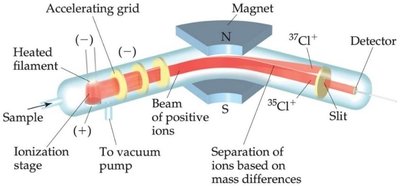
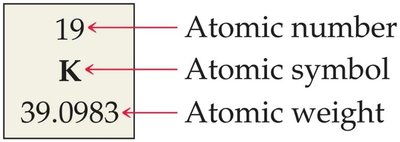
Atomic and molecular masses are measured in atomic mass units (amu). The atomic weight of an element is the weighted average of the masses of its naturally occurring isotopes.
1 amu = 1.66053907 × 10⁻²⁴ g
Atomic weight formula:
The Periodic Table
Organization and Structure
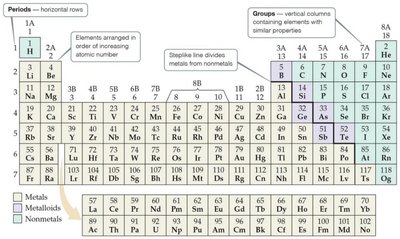
The periodic table arranges elements in order of increasing atomic number. Rows are called periods, and columns are called groups. Elements in the same group have similar chemical properties.
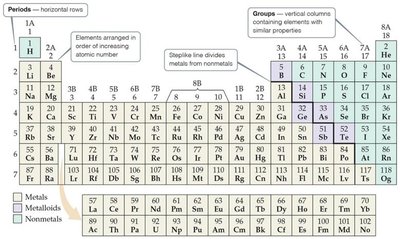
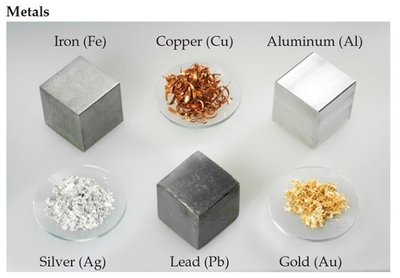
Metals: Left side; shiny, conductive, mostly solids.
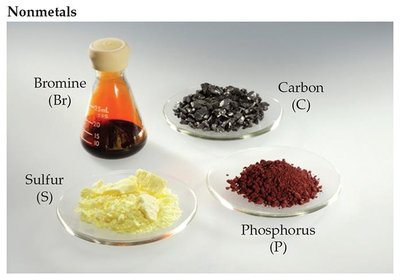
Nonmetals: Right side; can be solids, liquids, or gases.
Metalloids: Along the staircase line; properties intermediate between metals and nonmetals.
Groups and Periodicity
Certain groups have specific names and characteristic properties:
Group | Name | Elements |
|---|---|---|
1A | Alkali metals | Li, Na, K, Rb, Cs, Fr |
2A | Alkaline earth metals | Be, Mg, Ca, Sr, Ba, Ra |
6A | Chalcogens | O, S, Se, Te, Po |
7A | Halogens | F, Cl, Br, I, At |
8A | Noble gases | He, Ne, Ar, Kr, Xe, Rn |
Molecules, Ions, and Compounds
Molecules and Molecular Compounds
A molecule is a group of atoms bonded together. Molecular compounds are composed of two or more nonmetals. Chemical formulas indicate the number and type of atoms in a molecule.
Diatomic molecules: H2, N2, O2, F2, Cl2, Br2, I2
Empirical formula: Lowest whole-number ratio of atoms.
Molecular formula: Actual number of atoms in a molecule.
Ions and Ionic Compounds
Ions are charged particles formed when atoms gain or lose electrons. Cations are positive (loss of electrons, usually metals), and anions are negative (gain of electrons, usually nonmetals). Ionic compounds are formed from the electrostatic attraction between cations and anions.
Empirical formulas are used for ionic compounds.
Naming Inorganic Compounds
Chemical nomenclature provides systematic names for compounds:
Ionic compounds: Name the cation first, then the anion. Use Roman numerals for cations with multiple charges.
Acids: If the anion ends in -ide, use "hydro-...ic acid"; if -ite, use "...ous acid"; if -ate, use "...ic acid".
Binary molecular compounds: Use prefixes (mono-, di-, tri-, etc.) to indicate the number of atoms.
Prefix | Number |
|---|---|
mono- | 1 |
di- | 2 |
tri- | 3 |
tetra- | 4 |
penta- | 5 |
hexa- | 6 |
hepta- | 7 |
octa- | 8 |
nona- | 9 |
deca- | 10 |
Organic Compounds: Hydrocarbons and Alcohols
Organic chemistry focuses on compounds containing carbon. The simplest hydrocarbons are alkanes (single bonds only). Alcohols are derived from alkanes by replacing a hydrogen with an -OH group. Isomers are compounds with the same molecular formula but different structures.
Alkanes: Methane (CH4), Ethane (C2H6), Propane (C3H8), etc.
Alcohols: Methanol (CH3OH), Ethanol (C2H5OH), etc.
Carboxylic acids: Contain the -COOH group, e.g., acetic acid (CH3COOH).
Additional info: The systematic naming of organic compounds follows IUPAC rules, which are covered in more detail in organic chemistry courses.
