 Indietro
Atoms, Molecules, and Ions: Structure, Formulas, and Nomenclature
Guida di studio - Note intelligenti
 Appunti personalizzati basati sui tuoi materiali, ampliati con definizioni chiave, esempi e contesto.
Atoms, Molecules, and Ions
Symbols of Elements
Elements are represented by one or two-letter symbols, with the first letter always capitalized. The atomic number (Z) is the number of protons in the nucleus of an atom, which defines the element. The mass number is the total number of protons and neutrons in an atom and is expressed in atomic mass units (amu).
Atomic Number (Z): Number of protons in the nucleus.
Mass Number (A): Number of protons + number of neutrons.
Element Symbol: One or two letters (e.g., H for hydrogen, He for helium).
Isotopes
Isotopes are atoms of the same element that have different numbers of neutrons, and thus different mass numbers. They have identical chemical properties but different physical properties due to their mass difference.
Example: Carbon has three common isotopes: , , and .
Notation: , where A = mass number, Z = atomic number, X = element symbol.
Atomic Weights
The atomic weight (or average atomic mass) of an element is the weighted average of the masses of its naturally occurring isotopes, based on their relative abundances.
Formula:
Example (Carbon):
The Periodic Table
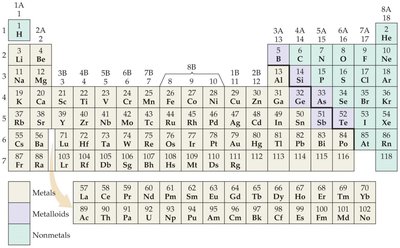
The periodic table is a systematic arrangement of elements in order of increasing atomic number. Rows are called periods, and columns are called groups. Elements in the same group have similar chemical properties. Common group names include alkali metals, alkaline earth metals, chalcogens, halogens, and noble gases.
Diatomic Molecules
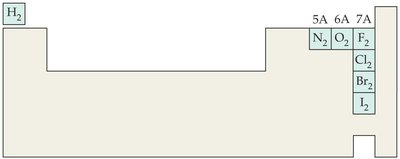
Some elements exist naturally as diatomic molecules, meaning they are found as molecules composed of two atoms. The seven diatomic elements are: H2, N2, O2, F2, Cl2, Br2, and I2.
Molecules and Compounds
Molecular Compounds and Formulas
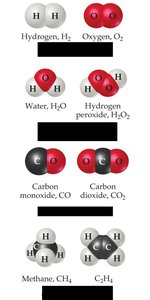
Molecular compounds are composed of molecules, typically containing only nonmetals. The subscript in a chemical formula indicates the number of atoms of each element in a molecule.
Empirical Formula: Shows the simplest whole-number ratio of atoms (e.g., CH2 for ethylene).
Molecular Formula: Shows the actual number of atoms of each element (e.g., C2H4 for ethylene).
Structural Formula: Shows the arrangement of atoms and bonds.
Structural and Perspective Formulas
Structural formulas display the connectivity of atoms, while perspective drawings show the three-dimensional arrangement. For example, ethane (C2H6) can be represented as:
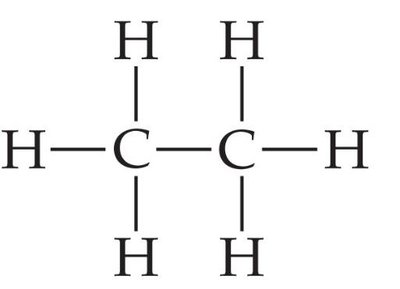
Molecular formula of ethane: C2H6
Empirical formula of ethane: CH3
Ions and Ionic Compounds
Formation of Ions
Atoms become ions by gaining or losing electrons. Cations are positively charged (formed by losing electrons, usually metals), and anions are negatively charged (formed by gaining electrons, usually nonmetals). The nucleus remains unchanged during this process.
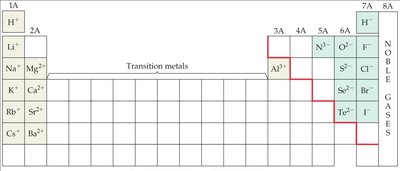
Ionic Bonds and Compounds
Ionic compounds are formed by the electrostatic attraction between cations and anions, typically between metals and nonmetals. Electrons are transferred from the metal to the nonmetal, resulting in a neutral compound.
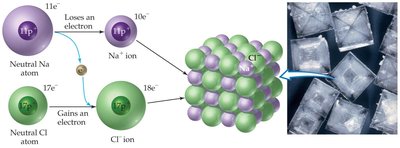
Writing Formulas for Ionic Compounds
Formulas for ionic compounds are written so that the total positive and negative charges balance to zero. The criss-cross method is often used to determine the correct ratio of ions.
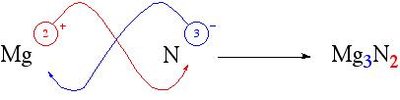
Example: Mg2+ and N3− combine to form Mg3N2.
Monatomic and Polyatomic Ions
Monatomic ions consist of a single atom with a charge. Cations (usually metals) retain the element name; anions (usually nonmetals) end in -ide. Polyatomic ions are composed of two or more atoms covalently bonded, carrying a net charge. Their names and formulas must be memorized (e.g., NO3− is nitrate).
Examples of monatomic cations: Na+ (sodium), Fe2+ (iron(II)), Fe3+ (iron(III))
Examples of monatomic anions: Cl− (chloride), O2− (oxide)
Examples of polyatomic ions: SO42− (sulfate), NH4+ (ammonium)
