 Indietro
Atoms, Molecules, and the Foundations of Modern Chemistry
Guida di studio - Note intelligenti
 Appunti personalizzati basati sui tuoi materiali, ampliati con definizioni chiave, esempi e contesto.
The Nature of Scientific Theories
Scientific Theories and Models
Scientific theories are comprehensive explanations of natural phenomena, built upon well-established hypotheses and validated by experimental evidence. They not only describe what happens in nature but also explain how and why these events occur. Theories are never absolutely proven; they remain open to revision as new observations are made.
Definition: A scientific theory is a model that explains and predicts natural phenomena.
Validation: Theories are supported by repeated experimental results.
Limitation: Theories can be modified or replaced if new evidence contradicts them.
Early Ideas About the Building Blocks of Matter
Ancient Philosophical Concepts
Ancient Greek philosophers such as Democritus proposed that matter is composed of small, indestructible particles called atoms. However, other philosophers like Plato and Aristotle believed matter was continuous and made up of four elements: earth, air, fire, and water.
Democritus: "Nothing exists except atoms and empty space; everything else is opinion."
Plato and Aristotle: Rejected atomism, favoring the four-element theory.
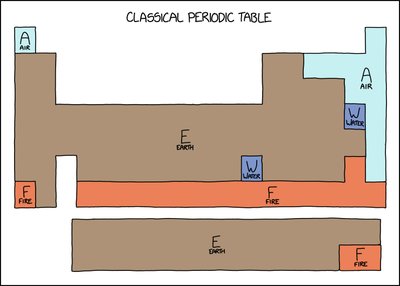
Additional info: The image humorously depicts the classical four-element theory mapped onto the modern periodic table, highlighting the historical context of early matter theories.
Transition to Scientific Approach
The scientific method eventually replaced philosophical speculation. John Dalton provided experimental evidence supporting the atomic theory, laying the foundation for modern chemistry.
Modern Atomic Theory and Fundamental Laws
The Laws Leading to Atomic Theory
Three key laws established the atomic theory:
Law of Conservation of Mass: Matter is neither created nor destroyed in chemical reactions (Antoine Lavoisier).
Law of Definite Proportions: All samples of a compound have the same proportions of their constituent elements (Joseph Proust).
Law of Multiple Proportions: When two elements form more than one compound, the masses of one element that combine with a fixed mass of the other are in ratios of small whole numbers (John Dalton).
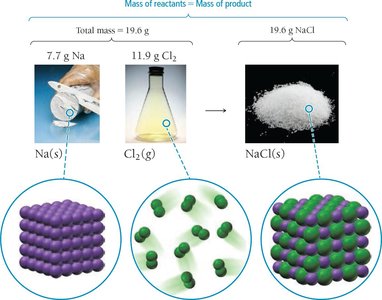
Example: The reaction of sodium and chlorine to form sodium chloride demonstrates the law of conservation of mass: the total mass of reactants equals the mass of the product.
Dalton's Atomic Theory
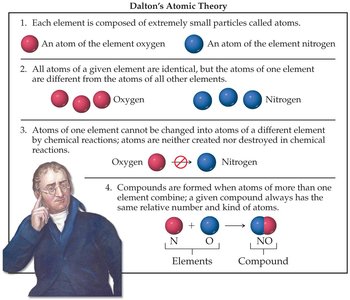
Dalton's atomic theory formalized the concept of atoms as the fundamental building blocks of matter:
Each element is composed of extremely small particles called atoms.
All atoms of a given element are identical in mass and properties, but differ from those of other elements.
Atoms cannot be created, destroyed, or transformed into atoms of another element in chemical reactions.
Compounds are formed when atoms of different elements combine in fixed, simple ratios.
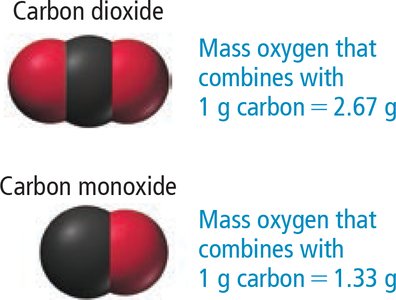
Law of Multiple Proportions Example
Dalton's law of multiple proportions can be illustrated with carbon monoxide (CO) and carbon dioxide (CO2):
CO: 1 g C combines with 1.33 g O
CO2: 1 g C combines with 2.67 g O
The ratio of oxygen masses is 2:1, a small whole number ratio.
Atomic Structure and Subatomic Particles
Discovery of the Electron
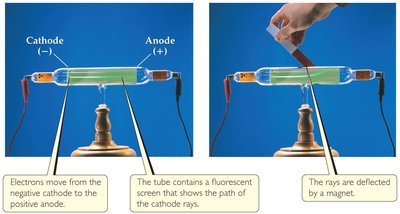
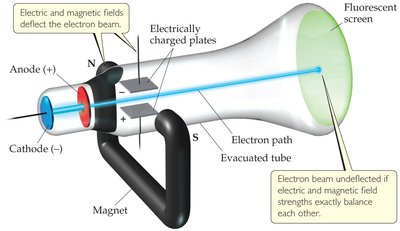
J. J. Thomson's cathode ray experiments revealed the existence of electrons—negatively charged particles present in all atoms. He measured the charge-to-mass ratio of the electron using electric and magnetic fields.
Key findings: Electrons travel in straight lines, are independent of the cathode material, and carry a negative charge.
Charge-to-mass ratio:
Millikan's Oil Drop Experiment
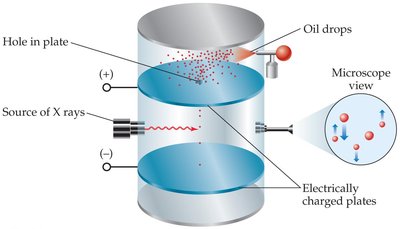
Robert Millikan determined the charge of a single electron using the oil drop experiment. By balancing gravitational and electrical forces on tiny charged oil droplets, he found the fundamental charge:
Electron charge: C
Plum-Pudding Model of the Atom
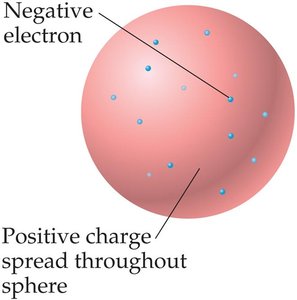
Thomson proposed that electrons were embedded in a sphere of positive charge, like "plums in a pudding." This model was later disproven by further experiments.
Radioactivity and the Discovery of Subatomic Particles
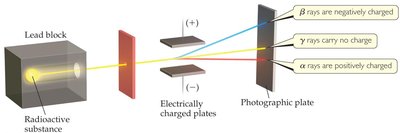
Radioactivity is the spontaneous emission of radiation from unstable atomic nuclei. Ernest Rutherford identified three types of radiation: alpha (α, positively charged), beta (β, negatively charged), and gamma (γ, neutral).
Rutherford's Gold Foil Experiment and the Nuclear Model
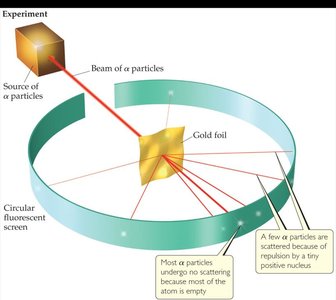
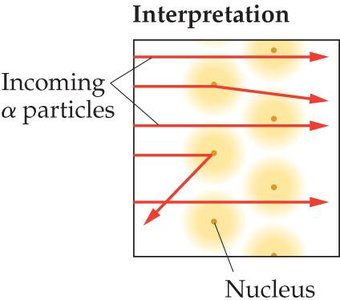
Rutherford's gold foil experiment showed that atoms have a small, dense, positively charged nucleus. Most alpha particles passed through the foil, but some were deflected, indicating a concentrated center of mass and charge.
The Nuclear Atom
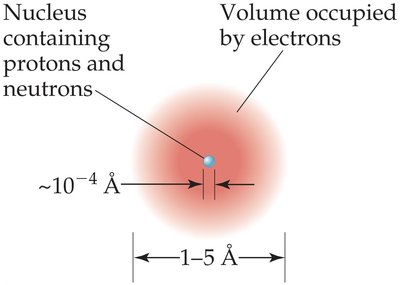
The atom consists of a tiny nucleus (containing protons and neutrons) surrounded by electrons occupying most of the atom's volume. The nucleus is about Å in diameter, while the atom is 1–5 Å.
Subatomic Particles: Properties and Comparison
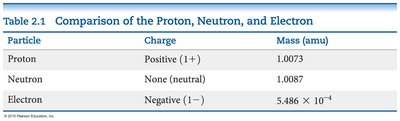
Atoms are composed of three main subatomic particles:
Particle | Charge | Mass (amu) |
|---|---|---|
Proton | +1 | 1.0073 |
Neutron | 0 | 1.0087 |
Electron | −1 | 5.486 × 10⁻⁴ |
Atomic Mass and Mass Spectrometry
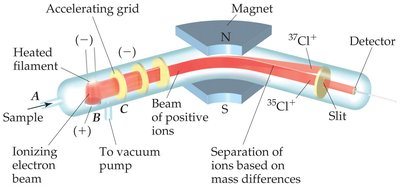
Atomic mass is measured in atomic mass units (amu), defined as one-twelfth the mass of a carbon-12 atom. Mass spectrometry allows precise measurement of atomic and molecular masses by separating ions based on their mass-to-charge ratio.
1 amu = 1.66054 × 10⁻²⁴ g
The Periodic Table and Periodic Law
Development of the Periodic Table
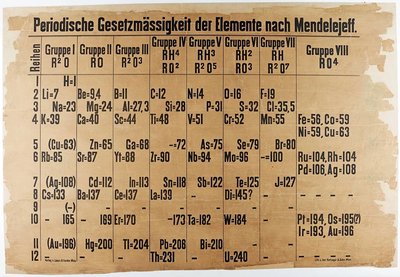
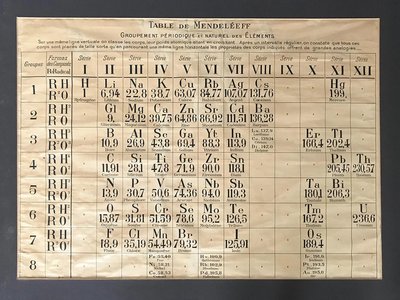
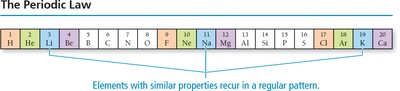
Dmitri Mendeleev organized elements by increasing atomic mass, observing that elements with similar properties recur periodically. His table predicted the existence of undiscovered elements.
The Periodic Law
The periodic law states that when elements are arranged by increasing atomic number, their physical and chemical properties recur in a regular pattern.
Modern Periodic Table
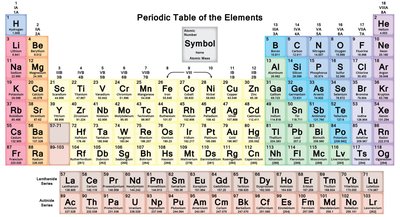
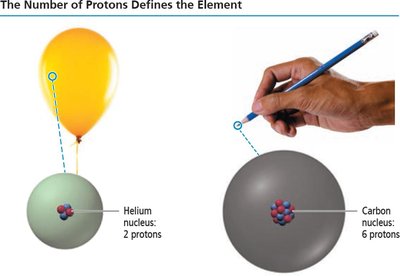
The modern periodic table arranges elements by increasing atomic number. Each element is defined by its number of protons (atomic number, Z). The table is organized into groups (columns) and periods (rows).
Element Symbols and Atomic Notation
Elements are represented by one- or two-letter symbols. The atomic number (Z) is the number of protons, and the mass number (A) is the total number of protons and neutrons.
Isotopes and Atomic Weight
Isotopes are atoms of the same element with different numbers of neutrons. The atomic weight of an element is the weighted average of the masses of its naturally occurring isotopes.
Symbol | Number of Protons | Number of Neutrons | Mass Number (A) | Natural Abundance (%) |
|---|---|---|---|---|
Ne-20 | 10 | 10 | 20 | 90.48 |
Ne-21 | 10 | 11 | 21 | 0.27 |
Ne-22 | 10 | 12 | 22 | 9.25 |

Atomic Weight Formula:
Classification of Elements
Groups and Periods
The periodic table is divided into 18 groups (vertical columns) and 7 periods (horizontal rows). Elements in the same group share similar chemical properties.
Metals, Nonmetals, and Metalloids
Metals: Good conductors, malleable, ductile, shiny, tend to lose electrons.
Nonmetals: Poor conductors, not malleable or ductile, tend to gain electrons.
Metalloids: Exhibit properties intermediate between metals and nonmetals; some are semiconductors.
Main-Group and Transition Elements
Main-group elements: Groups 1, 2, and 13–18 (1A–8A); properties are predictable.
Transition elements: Groups 3–12 (B groups); properties are less predictable.
Special Groups
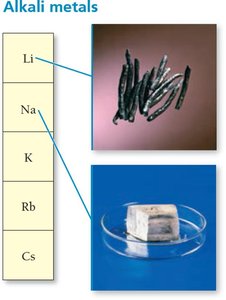
Alkali metals (Group 1A): Highly reactive metals (e.g., Na, K).
Alkaline earth metals (Group 2A): Fairly reactive metals (e.g., Mg, Ca).
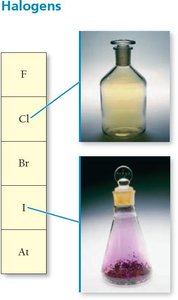
Halogens (Group 7A): Very reactive nonmetals (e.g., F, Cl, Br, I).
Noble gases (Group 8A): Unreactive gases (e.g., He, Ne, Ar).
Molecules, Compounds, and Chemical Formulas
Diatomic Molecules
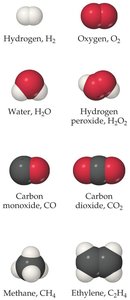
Seven elements exist as diatomic molecules at room temperature: H2, N2, O2, F2, Cl2, Br2, I2.
Chemical Formulas
Empirical formula: Lowest whole-number ratio of atoms in a compound.
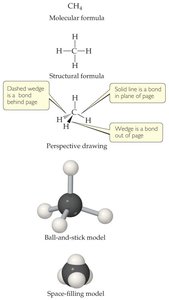
Molecular formula: Actual number of atoms of each element in a molecule.
Structural formula: Shows the connectivity of atoms.
Perspective/3D models: Show spatial arrangement of atoms.
Ions and Ionic Compounds
Formation of Ions
Main-group metals lose electrons to form cations; main-group nonmetals gain electrons to form anions. The resulting ions combine to form ionic compounds, often crystalline solids known as salts.
Alkali metals: Form 1+ ions.
Alkaline earth metals: Form 2+ ions.
Halogens: Form 1− ions.
Oxygen family nonmetals: Form 2− ions.
Additional info: The charge of main-group element ions can often be predicted from their group number: cation charge = group number; anion charge = group number minus eight.
