 Indietro
Class 2, Ch. 5.1: Atoms and Elements
Guida di studio - Note intelligenti
 Appunti personalizzati basati sui tuoi materiali, ampliati con definizioni chiave, esempi e contesto.
Class 2, Ch. 5.1: Atoms & Elements
What are atoms? Why are atoms important in chemistry?
Atoms are the fundamental building blocks of matter. They are the smallest units that retain the properties of an element. Understanding atoms is crucial because all chemical reactions and properties of substances are determined by the behavior and arrangement of atoms.
Atoms are composed of subatomic particles: protons, neutrons, and electrons.
Atoms combine to form molecules and compounds, which make up all substances.
Studying atoms helps explain the nature of matter and the changes it undergoes.
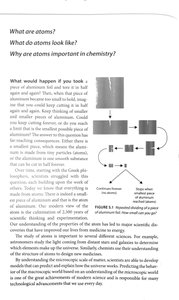
Example: Dividing a piece of silver repeatedly eventually leads to individual atoms, which cannot be divided further without losing the properties of silver.
Quantum Mechanics
Peeking Inside the Atom with Light
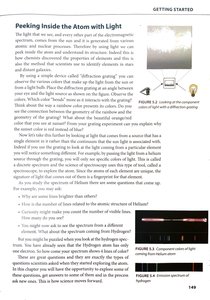
Light is a powerful tool for probing the structure of atoms. When atoms absorb or emit light, they produce characteristic spectra that reveal information about their internal structure.
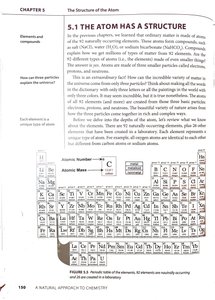
Atoms emit light at specific wavelengths, creating unique spectral lines.
These spectral lines can be used to identify elements and study their properties.
Experiments with light helped scientists understand the arrangement of electrons in atoms.
Example: The emission spectrum of hydrogen shows distinct lines, each corresponding to a specific energy transition of electrons.
Atoms & Elements
The Atom Has a Structure
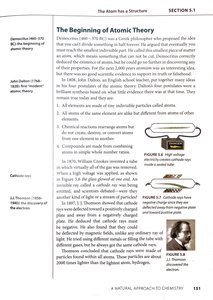
Atoms are not indivisible; they have an internal structure consisting of a nucleus and electrons. The periodic table organizes elements based on their atomic structure and properties.
Atomic Number (Z): The number of protons in the nucleus, which determines the element.
Atomic Mass: The sum of protons and neutrons in the nucleus.
The periodic table arranges elements in order of increasing atomic number.
Example: Carbon has an atomic number of 6, meaning it has 6 protons.
Atoms & Elements
The Beginning of Atomic Theory
The concept of the atom originated in ancient Greece but was developed scientifically in the 19th century. John Dalton proposed that elements are made of tiny, indivisible particles called atoms, and that atoms of different elements have different properties.
Dalton's Atomic Theory:
All matter is composed of atoms.
Atoms of a given element are identical in mass and properties.
Atoms cannot be created or destroyed in chemical reactions.
Atoms combine in simple ratios to form compounds.
Later experiments showed that atoms are divisible and contain subatomic particles.
Example: Dalton's theory explained the law of definite proportions in compounds.
Atoms & Elements
The Discovery of the Nucleus
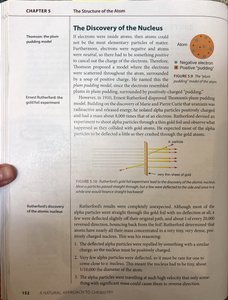
Ernest Rutherford's experiments revealed that atoms have a small, dense nucleus containing protons and neutrons, surrounded by electrons. This overturned earlier models that depicted atoms as uniform spheres.
Rutherford's gold foil experiment showed that most of the atom is empty space, with a central nucleus.
The nucleus contains positively charged protons and neutral neutrons.
Electrons orbit the nucleus at relatively large distances.
Example: The scattering of alpha particles by gold foil demonstrated the existence of the nucleus.
Atoms & Elements
The Interior of an Atom
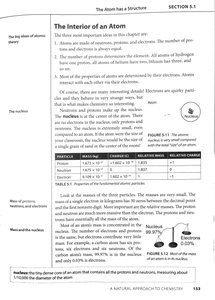
Atoms consist of three main types of subatomic particles: protons, neutrons, and electrons. The properties of these particles determine the behavior and characteristics of atoms.
Protons: Positively charged particles found in the nucleus.
Neutrons: Neutral particles found in the nucleus.
Electrons: Negatively charged particles orbiting the nucleus.
The number of protons determines the element; the number of neutrons determines the isotope; the number of electrons determines chemical behavior.
Example: Hydrogen has one proton and one electron; carbon has six protons, six neutrons, and six electrons.
Particle | Symbol | Relative Mass | Relative Charge |
|---|---|---|---|
Proton | p+ | 1 | +1 |
Neutron | n | 1 | 0 |
Electron | e- | 1/1836 | -1 |
Additional info: The mass of electrons is much smaller than that of protons and neutrons, so most of the atom's mass is concentrated in the nucleus.
